
Suspected shooter legally purchased rifle, pistol and shotgun; local politicians call for action

The entire 13-member Minneapolis City Council called for law changes, saying, “Thoughts and prayers cannot be our only response.”

The Minnesota Star Tribune
August 28, 2025 at 2:43AM
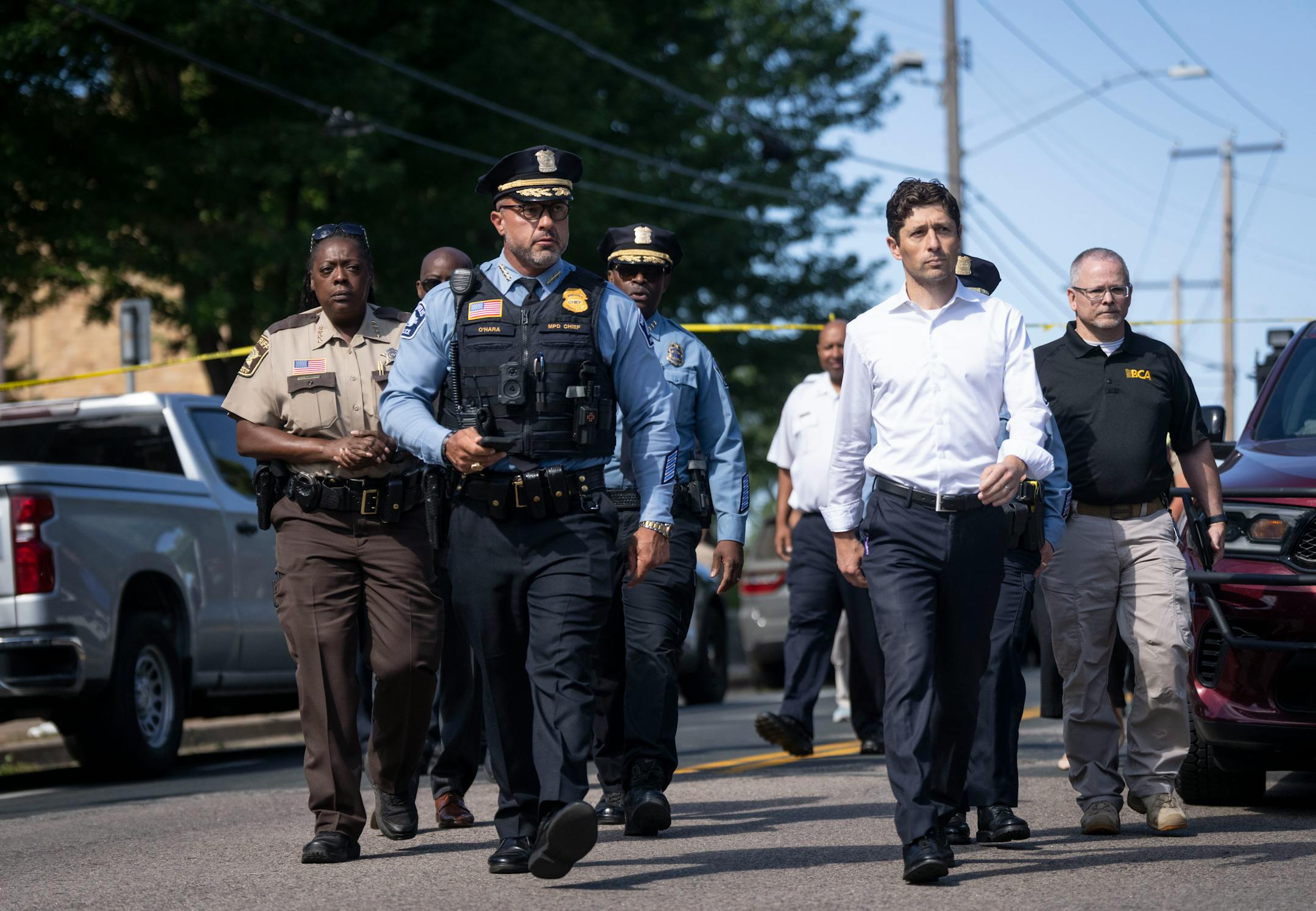
Minneapolis Police Chief Brian O’Hara and Mayor Jacob Frey walk to a news conference at the scene of a shooting that killed two children and wounded 17 other people at Annunciation Church on Wednesday in Minneapolis. (Renée Jones Schneider/The Minnesota Star Tribune)

Robin Westman used a legally purchased rifle, pistol and shotgun for the siege on a Minneapolis Catholic church Wednesday morning, killing two children sitting in pews on the third day of school and injuring 17 other people before dying by suicide in the back of the church.

Westman had legally purchased all three weapons recently, Minneapolis Police Chief Brian O’Hara said during a Wednesday news conference.

The federal Bureau of Alcohol Tobacco Firearms and Explosives was on the scene Wednesday at Annunciation Church. ATF spokeswoman Ashlee Sherrill told the Minnesota Star Tribune the agency did an expedited trace of the weapons’ purchase history, which was completed by Wednesday afternoon and turned over to investigators.

A notebook entry in English but using Cyrillic letters on a YouTube account believed to be the shooter’s referenced how “shockingly easy” it was to buy a gun from a pawn shop.

Minnesota gun laws

Under Minnesota law, any purchaser of a firearm is subject to a federal background check, but not necessarily a permit.

You need a permit to purchase a handgun, but not most shotguns or rifles. Certain shotguns, rifles or pistol-type firearms are classified as “semi-automatic military style assault weapons” under state statute and require a permit to purchase. Most traditional hunting firearms don’t require a permit to purchase.

You need to be 21 to buy a handgun in Minnesota and 18 to purchase all other guns. Westman was 23.

There is no limit to how many firearms one person may own in Minnesota.

Westman would’ve needed a permit to purchase the handgun and semiautomatic military rifle. Applying for such a permit takes more time than an actual in-store purchase and includes a background check. The shotgun purchase also would have required a background check, but that can be completed while the customer waits.

“So all of the background checks that we want done were done,” said Rob Doar, senior vice president of the Minnesota Gun Owners Caucus and a gun-rights advocate.

Westman had no criminal record, according to O’Hara and a search of criminal court records.

The shooter’s guns

Doar reviewed a YouTube video believed to be posted by Westman showing various guns and ammunition and identified the weapons as an AR-15 rifle, a Mossberg 590 Cruiser shotgun, a Smith & Wesson M&P compact 9 mm handgun with three magazines, and a revolver that appears to be a Colt 38 Special police issue.

Doar also saw in the video two 30-round AR-15 magazines among numerous others holding anywhere from 20 to 60 rounds.

The AR-15 magazine had M855 NATO Green Tip ammunition, while the 9 mm handgun had Full Metal Jacket rounds.

“Both of these are relatively cheap, range ammunition, not typically used for hunting or self-defense, as they have poor soft target performance,” Doar said. “The NATO round is designed to shoot through barricades, utilizing a steel core. They are sold cheaply as surplus range ammunition.”

Calls for stricter gun laws

As is often the case after a mass shooting in America, Democrats Wednesday began calling for stricter gun laws, although there were few specifics.

Minneapolis Mayor Jacob Frey said Wednesday that more than “thoughts and prayers” were needed.

“Don’t just say this is about thoughts and prayers right now. These kids were literally praying. It was the first week of school,” Frey said during a news conference.

The 13-member Minneapolis City Council released a statement calling for changes to laws, saying such tragedies have become “far too common” in the U.S.

“Every level of government must act to ensure that these preventable tragedies never happen again,” the council said. “We are committed to working with local, state, federal government, and all other partners to pass meaningful changes to our laws that will make our community safer.”

Gov. Tim Walz said after the TV cameras are gone, Minnesotans will work to prevent any future “unthinkable” tragedies that are all too common.

“Keep us in your thoughts and prayers, but also keep us in the thoughts for action,” Walz said during a news conference.

Doar said that instead of “chasing our tails when we’re trying to figure out what type of law could have prevented this,” investigators should look at the signs that preceded the shootings.

Minnesota consistently earns high ratings by gun-control groups, he noted, and last year a red-flag law went into effect allowing family members, roommates, partners and law enforcement to petition judges to temporarily remove guns from people they fear are a danger to themselves or others.

That law, along with expanded background checks for transfers and increased penalties for machine gun ownership, went into effect in 2023 after Democrats passed them while in control of the Legislature and governor’s office.

Gun regulations face challenges

Restricting firearms has proved difficult in recent years.

In a series of landmark cases last decade, the U.S. Supreme Court ruled that the Second Amendment enshrines the right of Americans to own many types of guns for self-defense, vastly narrowing the degree to which states and local governments can enact their own restrictions.

This summer, for example, the state Supreme Court ruled that it is legal for Minnesotans to possess ghost guns without a serial number because current state law does not clearly restrict it. Weeks later, a district judge struck down state law that bans what are known as binary triggers on guns because lawmakers tucked it into a massive budget bill in a way that violated the state Constitution.

Susan Du of the Minnesota Star Tribune contributed to this story.

Correction: This story has been corrected to reflect that a district judge, not the Minnesota Supreme Court, struck down the state's binary trigger ban.
about the writers

about the writers

Deena Winter

Reporter

Deena Winter is Minneapolis City Hall reporter for the Star Tribune.

See Moreicon

Paul Walsh

Reporter

Paul Walsh is a general assignment reporter at the Minnesota Star Tribune. He wants your news tips, especially in and near Minnesota.

See Moreicon