

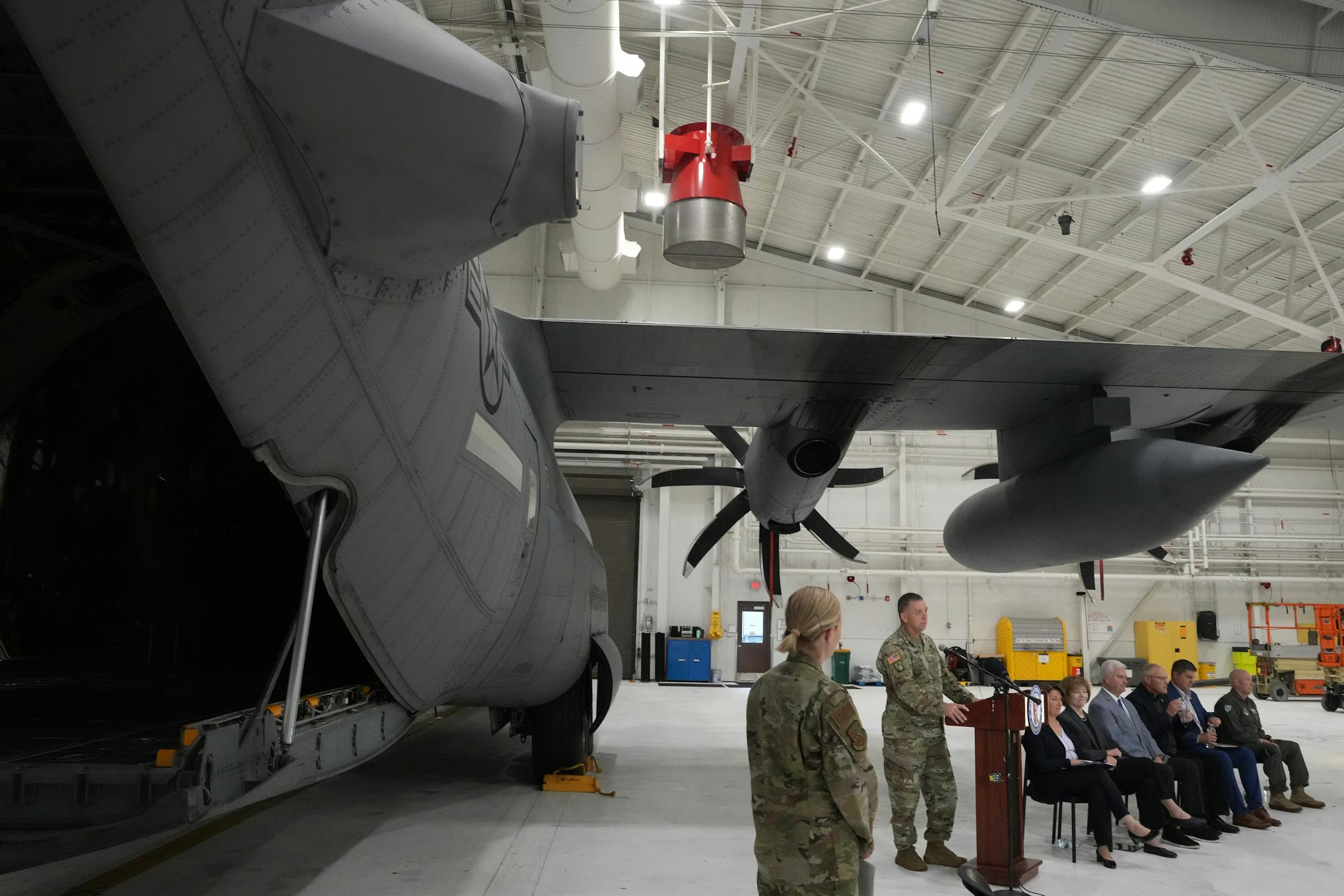
The Minnesota Air National Guard unit based next to Minneapolis-St. Paul International Airport will be receiving eight new C-130J Super Hercules aircraft in the coming years, allowing the unit to continue the air transport and disaster relief missions it has performed for half a century.
The Department of the Air Force selected four units around the country to receive eight of the $112 million, larger, faster, more efficient aircraft to replace their aging C-130H fleets, which are about 25 years old.
If Minnesota's 133rd Airlift Wing hadn't been selected, its future mission may have changed drastically, Guard officials and politicians said.
"This is a monumental step forward for Minnesota and the Minnesota National Guard," said Maj. Gen. Shawn Manke, adjutant general of the Minnesota National Guard. "These new aircraft will provide our Air Guard with greater capability in supporting our state and our nation around the world."
The aircraft will arrive between 2026 and 2028, and pilots will need about six months of training to fly them. The other units to receive upgrades to their fleets will be the 103rd Airlift Wing in Hartford, Conn., the 120th Airlift Wing in Great Falls, Mont., and the 182nd Airlift Wing in Peoria, Ill.
C-130s are a hulking, versatile military transport aircraft, used for everything from transporting personnel and cargo to dropping relief aid after natural disasters to serving as a hospital in the sky for injured service members.
Brig. Gen. Dan Gabrielli, a former C-130 pilot who leads the 133rd Airlift Wing as well as the 148th Fighter Wing out of Duluth, was giddy in describing the advantages the new planes have over the old ones.
The new C-130J is 15 feet longer. It can carry 128 people as opposed to 90 people, or 92 paratroopers as opposed to 65. For medical evacuation missions, the new model can carry 97 stanchions that support cots on them as opposed to 72. The new model also has better fuel efficiency and a longer expected life span.


