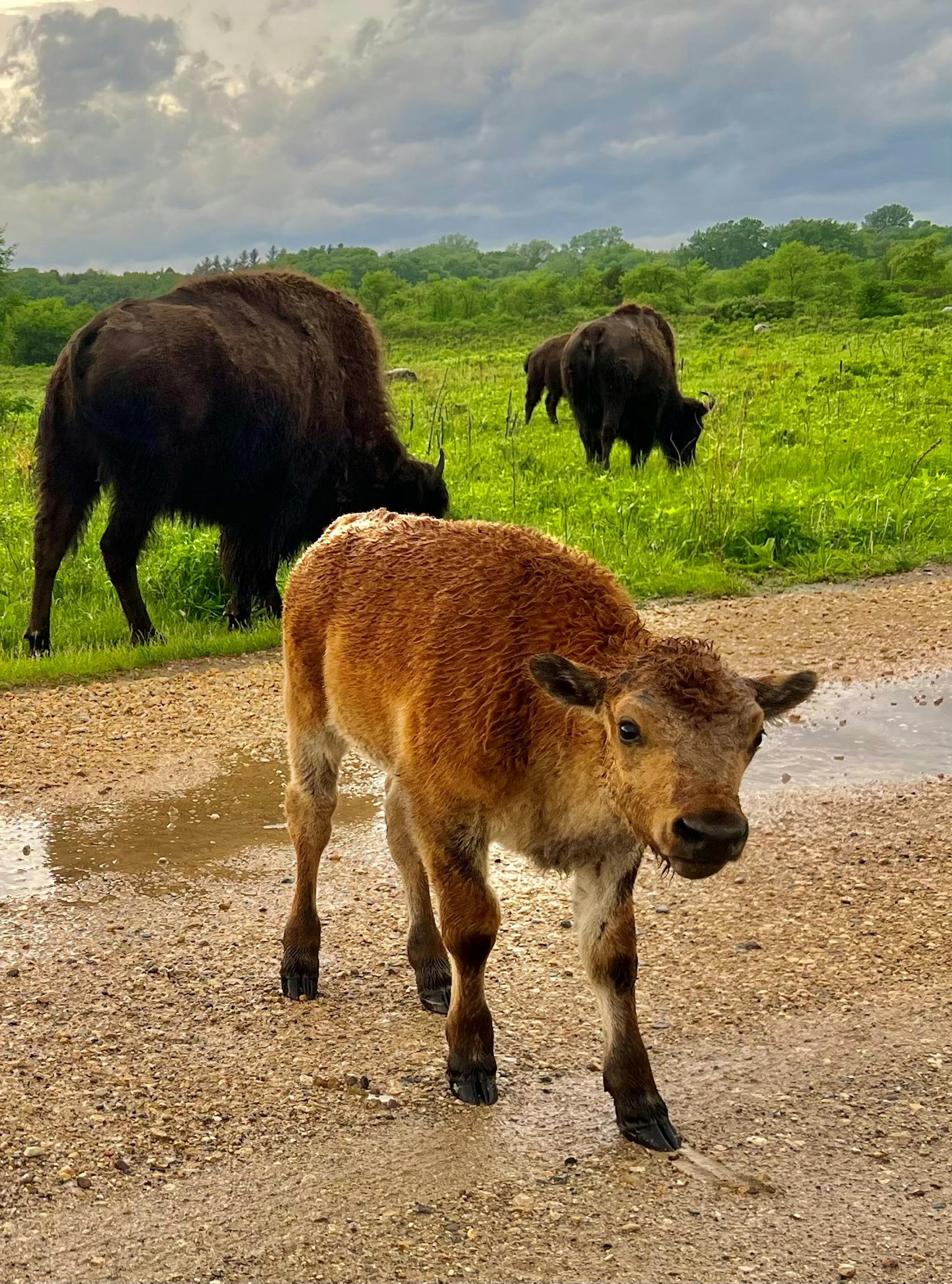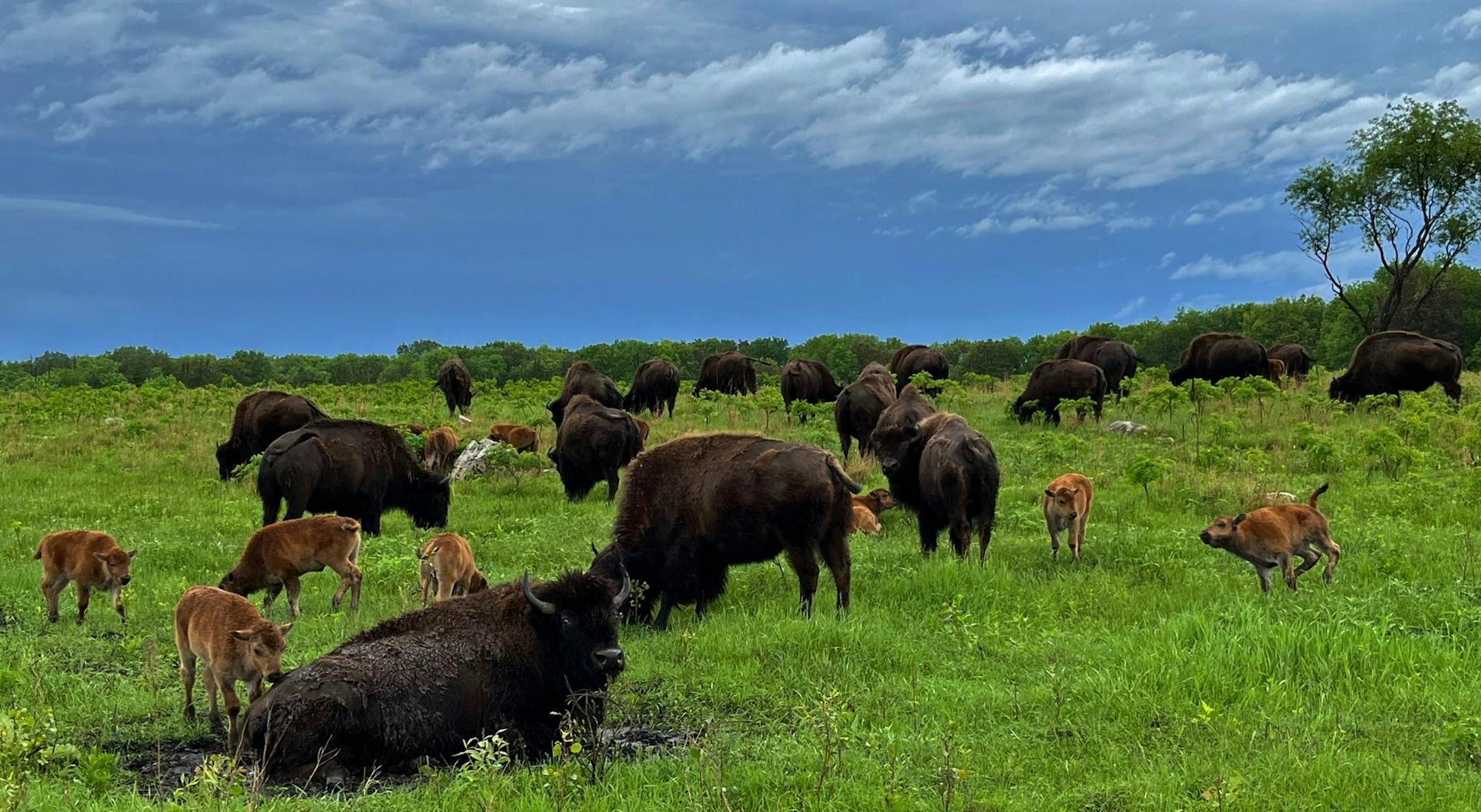
Interspersed with their behemoth mothers, dark and heavy like the skies overhead one morning this week, bison calves looked the image of spring in the prairie of Minneopa State Park near Mankato.
They also are the picture of health.
Sixteen calves were born at the state park in the last month, the most in any spring since wild bison were settled in the park. Last year, 13 calves were born there.
The iconic animals are part of the Minnesota Conservation Bison Herd, which also exists at Blue Mounds State Park near Luverne, Minn., and is well-established in the state's historic bison range, as well as at the Minnesota Zoo and in Oxbow Park & Zollman Zoo in Byron, in Olmsted County. The calves at Minneopa bring the park's size to 47. Blue Mounds added 25 calves this spring. As of fall of 2021, the entire herd was 114.
All are part of a still-expanding partnership managed by the Department of Natural Resources and the Minnesota Zoo whose chief aim is preserving the genetics and building the population of a mammal nearly hunted to extinction in the 19th century. The conservation herd has thrived since it was introduced at Minneopa as the second state park unit in 2015. Now, Dakota County Parks is preparing for a reintroduction of bison this fall at Spring Lake Park Reserve near Hastings. Some of its herd will draw from Minneopa and the other sites based on their genetics, said Ed Quinn, DNR natural resource program supervisor in the Parks and Trail Division. They'll be a mix of adults (born 2020 or earlier) and yearlings (2021).
Quinn said Dakota County's involvement represents the direction of the herd's future: more caretakers around parts of Minnesota as the herd grows in size toward a goal of 500 animals. That target is considered a herd size that will sustain genetic health generation to generation, free from threats like cross-breeding with cattle.
"There is quite a bit of interest," he said.
What's more, Quinn and other managers are hopeful their turn will come to reciprocate with Department of Interior partners who provided breeding bulls from herds in places like Yellowstone and Badlands national lands to help cultivate an unsullied Minnesota herd. A bull from Theodore Roosevelt National Park in North Dakota fathered the calves this spring at Minneopa. They weigh about 45 pounds at birth but can get to 450 pounds within six months.