Hundreds march through Minneapolis to protest U.S. attack on Venezuela

Rep. Tom Emmer and others in Minnesota applauded Maduro’s removal, meanwhile.

The Minnesota Star Tribune
January 4, 2026 at 1:13AM
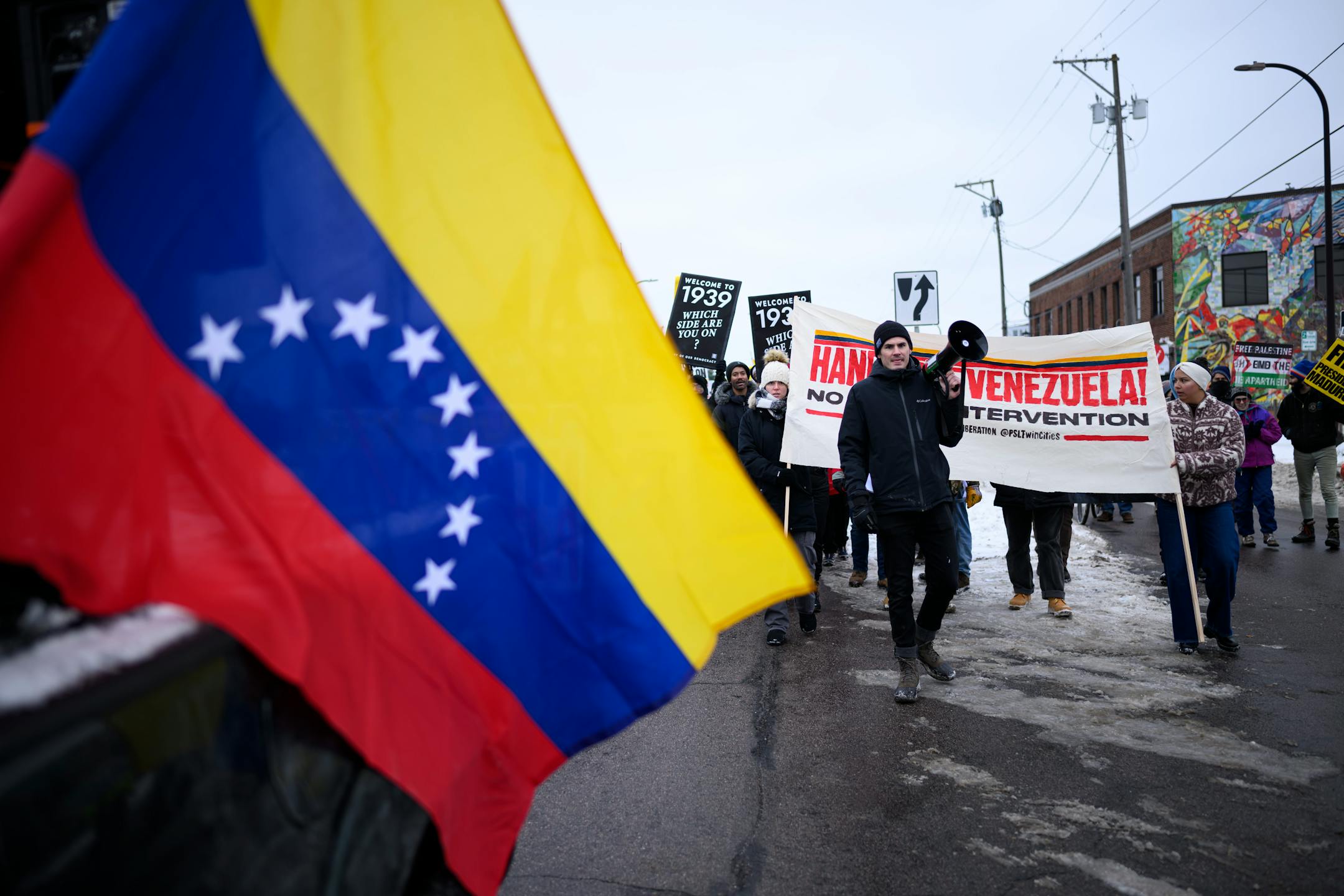
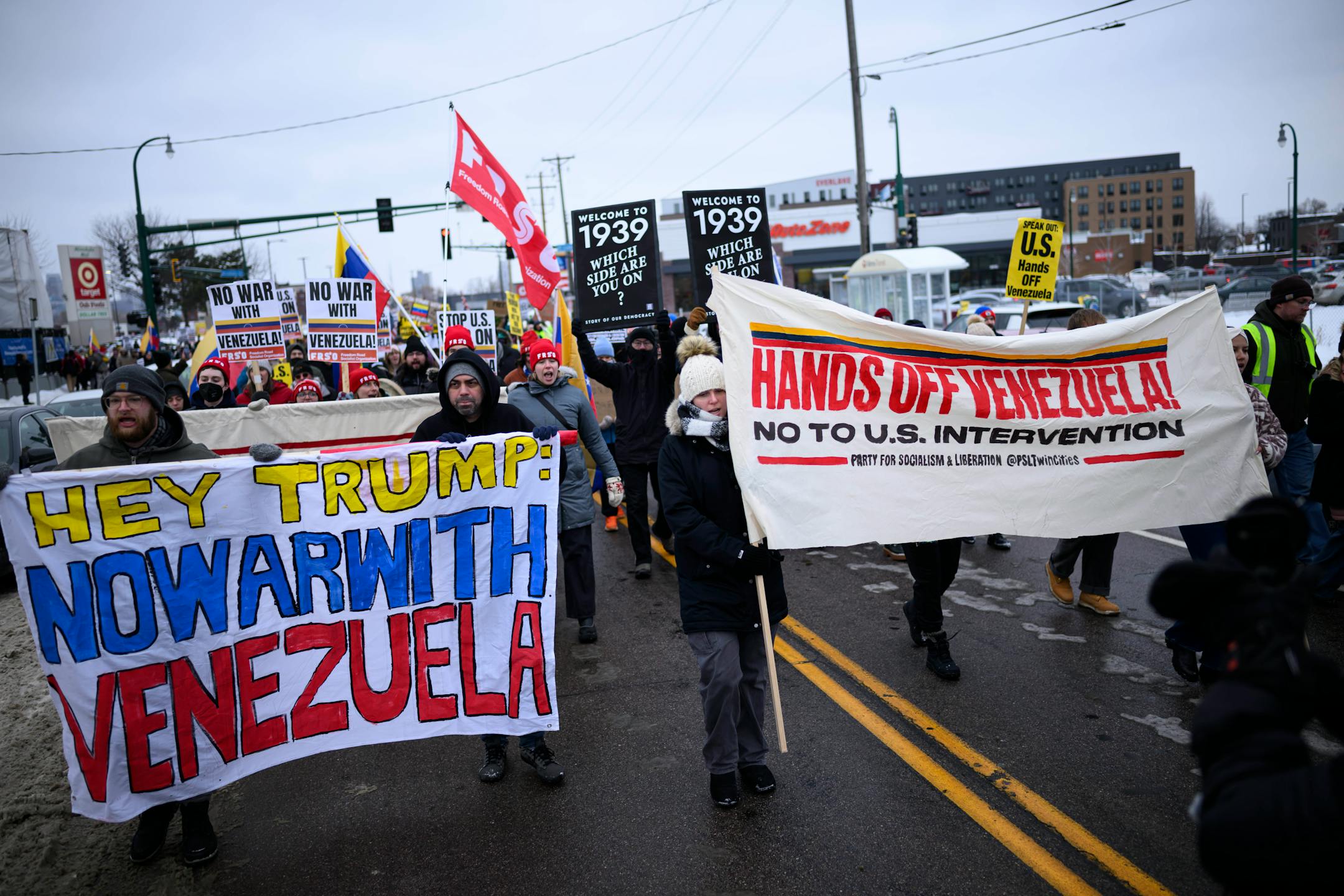
Simon Elliott, an organizer with the Party for Socialism and Liberation, chants on the megaphone while marching down Minnehaha Avenue in Minneapolis during a protest against U.S. military intervention in Venezuela on Jan. 3. A few hundred people joined together in a march organized by the Minnesota Peace Action Coalition on the day President Donald Trump announced the capture of Venezuelan President Nicolás Maduro. (Aaron Lavinsky/The Minnesota Star Tribune)

Years ago, Andrew Josefchak joined thousands of Venezuelans to support the country’s socialist government from the streets of Caracas.

Josefchak mirrored that protest thousands of miles away in Minneapolis on Jan. 3 to protest the violent ouster of President Nicolás Maduro, whom the U.S. captured early that morning as bombs fell on the South American country.

Josefchak, 31, and other members of the Minnesota Peace Action Coalition gathered more than 200 people to line Lake Street with signs and chants to oppose the sudden military incursion.

“The peace movement in this country, in Minneapolis at least, wasn’t going to let that [military action] go by without organizing an emergency demonstration against it to show that people in the U.S. don’t want this,” Josefchak said. “They don’t want war.”

After months of pressure on Maduro, U.S. military personnel dropped bombs across the capital city and infiltrated the country before dawn Saturday. Shockwaves rattled homes, burst windows and unsettled local and international residents as U.S. forces took Venezuela’s leader and his wife to face a narco-terrorism conspiracy indictment in New York.

President Trump said in a news conference the U.S. would temporarily take control of Venezuela and sell “large amounts” of its oil to other countries.
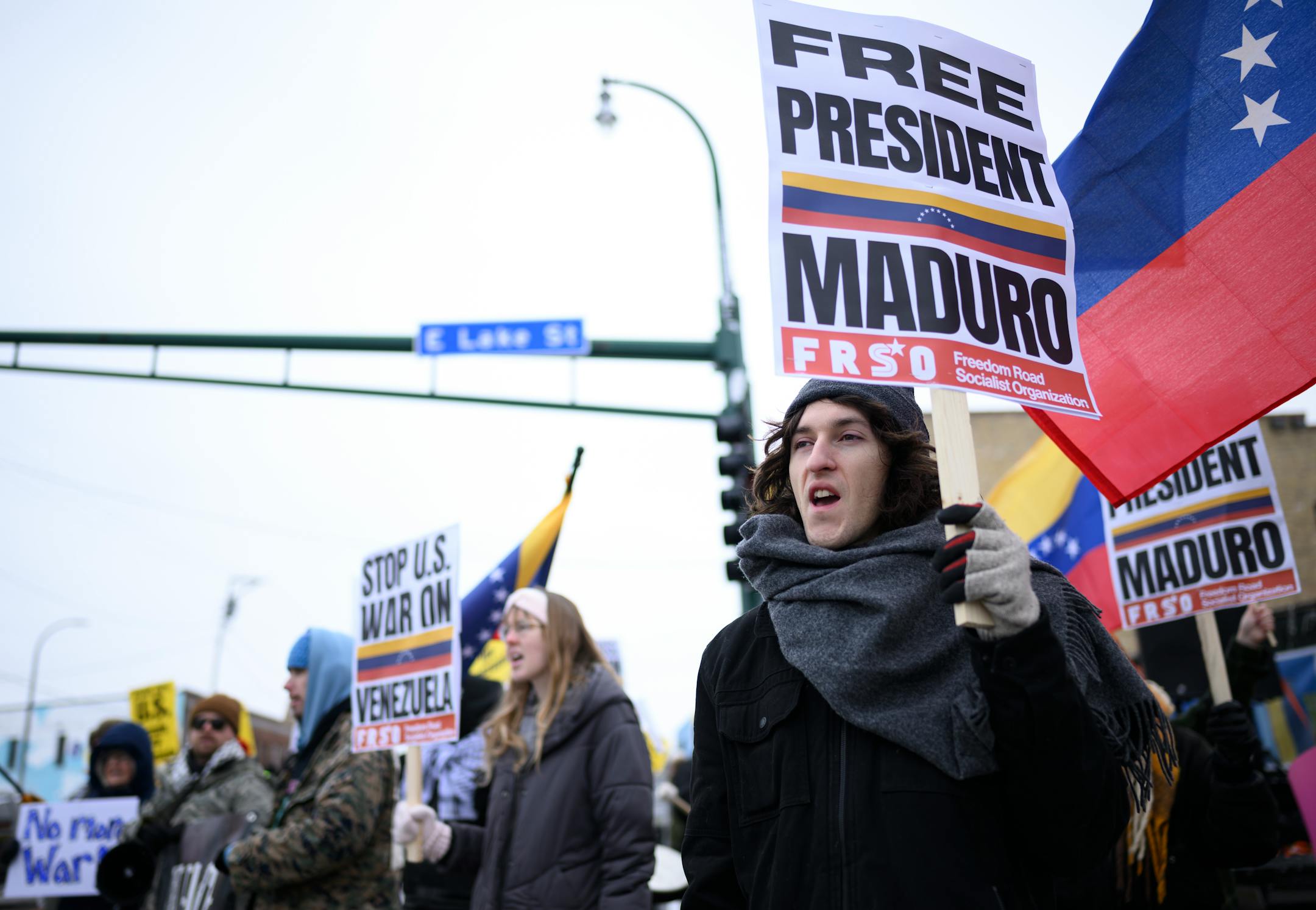
Gabriel Miller of Minneapolis holds a sign calling for the release of Venezuelan President Nicolás Maduro during a protest in Minneapolis on Jan. 3. (Aaron Lavinsky/The Minnesota Star Tribune)

Minnesota Republican Rep. Tom Emmer said in a statement the operation “has just made the United States, the region and the world a safer place.”

“Maduro worked with our greatest adversaries, supported dangerous cartels, and infiltrated our country with drugs, killing Americans,” Emmer wrote on X.

Sen. Amy Klobuchar, a Democrat, said she “strongly opposed” sending forces without a vote in Congress.

“Wars for regime change can lead to unintended consequences,” Klobuchar said in a statement. “Right now, we need a full briefing on how to avoid spiraling instability and a vote to stop this unauthorized action from continuing.”

On Lake Street, protesters hoisted signs while chanting to the beat of a drum: “From Venezuela to the Middle East, we demand justice, we demand peace.”

Michael Runyon, 71, waved the Venezuelan flag and accused the U.S. of committing war crimes. Others, like 81-year-old Lucia Smith, waved flags saying “Women Against Military Madness” and urged peace.

As scores drove past to honk and wave in support, protester CJ Griffin said she hopes Minnesotans see they are not alone.

“Especially with the attacks on our Somali community and families and neighbors, I think it’s important that we stand up and we know that, ‘When they come for one of us, they come for all of us,’ ” Griffin said.

A few hundred protesters marched down Minnehaha Avenue during a protest against U.S. military intervention in Venezuela on Jan. 3. (Aaron Lavinsky/The Minnesota Star Tribune)

‘Not a lot of people support his government’

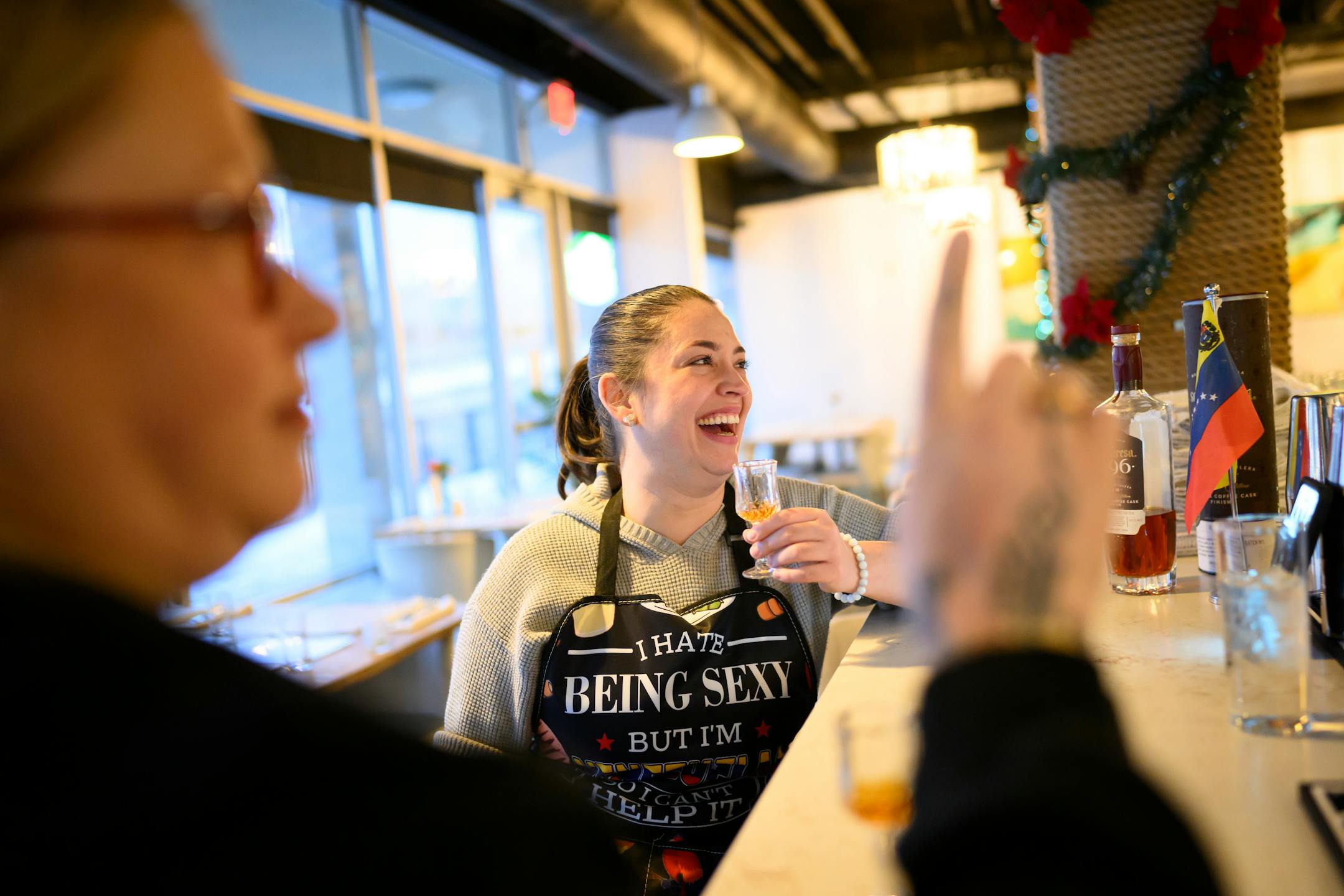
Soleil Ramirez watched footage of explosions across Caracas moments after the strike began, worrying for her mother, who lives near a military base.

Ramirez, chef and owner of the Crasqui restaurant in St. Paul, said her mother is fine — and the military operation was reason to celebrate.

“Let us celebrate this victory because we haven’t been celebrating anything in the last 26 years,” she said.

Ramirez, 39, grew up in Caracas and owned a restaurant there before moving to the U.S. in 2016 for political asylum. Ramirez said she was forced to leave Venezuela when agents of Maduro’s government kidnapped her and threatened to kill her family unless she gave up her restaurant and left the country.

“Not a lot of people support his government. It’s a very big fear to say no to this government,” Ramirez said. “Maduro wasn’t the president of Venezuela. He was the dictator of Venezuela.”

Venezuela-born restauranteur and political asylee Soleil Ramirez laughs with her friend Kate Cheney, left, and bartender Morgan Weaver while celebrating Venezuelan President Nicolás Maduro’s removal from power on Jan. 3 at Crasqui in St. Paul. (Aaron Lavinsky/The Minnesota Star Tribune)

Whether his removal leads to the country’s liberation or not, Ramirez said, the transition will be hard on Venezuelans and incoming leaders.

“I think this is a very big step, but it’s not the end,” she said. “Venezuela is not free yet.”

about the writer

about the writer

Kyeland Jackson

General Assignment Reporter

Kyeland Jackson is a general assignment reporter for the Star Tribune.

See Moreicon

More from Minneapolis

See More
card image
card image