
Minneapolis tree cleanup continues more than two weeks after storm

City crews estimate they've cleared about half the storm debris and downed trees in Minneapolis. They haven't yet started work in city parks.

July 25, 2013 at 8:50PM
icon2:06
(David Brewster/David Brewster)

Piles of brown, dead tree branches still littering south Minneapolis boulevards are visible reminders of the high winds that whipped through the Twin Cities more than two weeks ago, toppling trees onto cars, homes and streets.

That debris, and more than 100 downed trees in parks like the one that Lake Harriet runners dodged Saturday, may still take weeks to clear.

Despite working around the clock since the storm, city crews said Saturday that they're not quite halfway done hauling tree debris.

"It's just a lot of debris," forestry supervisor Randy Windsperger said. "It's like taking a broom and just sweeping it across the city. I know it gets frustrating, but I just want to assure everyone … we're doing everything possible."

The rain and high winds that battered the Twin Cities on June 20-21 knocked out power for days and tore down trees in cities across the west and north metro. In Minneapolis, city officials estimate that more than 3,000 trees toppled or were uprooted in neighborhoods and more than 100 trees were destroyed in parks and on Minnehaha Creek.

"Minneapolis was harder hit than most cities," park board spokeswoman Dawn Sommers said. "It's a big job, considering it impacted much of the city."

Between June 22 and July 3, the city hauled out more than 910 semitrailer truckloads of storm debris. About 2,000 residential trees have been cleared, with crews prioritizing trees that hit homes and blocked emergency routes.

That's left Longfellow residents such as Tim Piotrowski with a stack of brown tree branches piled outside his yard. It may be an eyesore, he said, but he understands city crews are focused on areas with more damage.
"It's annoying," he said. "But I'd rather they take care of people who need it."

At Lake Harriet, yellow caution tape blocked off a large tree that splintered, falling over a path and into the water, forcing joggers and walkers such as Paula Baudhuin off the trail Saturday. She was surprised it still blocked the path, but said she understood the delay.

"You can't pick up the city in a day," she said. "You've got to give them time. We should just be grateful these trees aren't on our houses."

In fact, the city had to hire two large cranes to pull trees off homes and also has contracted with trucking companies, which Windsperger estimates has cost at least $500,000 so far. His 75 employees have worked overtime almost every day.

He said they hope to have all neighborhoods cleared by July 12 and then will start clearing trees at parks and along Minnehaha Creek.

Until then, he urges residents and park visitors to continue to be patient about remaining downed trees and branches.

"Residents see that and think it's not being addressed, but I can assure you we are," he said. In 25 years on the job, "it's probably one of the worst [extent of storm debris] I've seen."

Kelly Smith • 612-673-4141

Twitter: @kellystrib

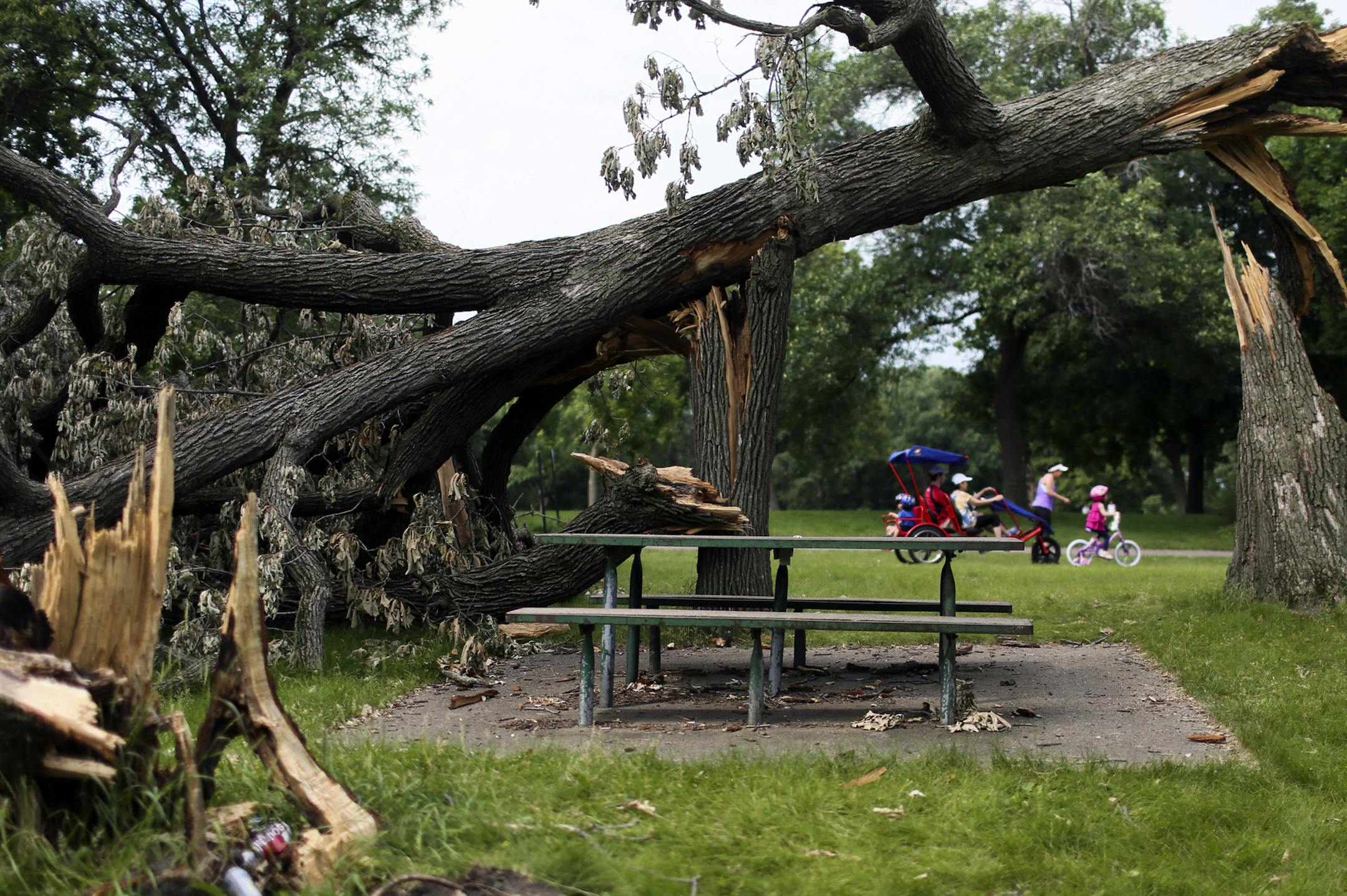
The June storm blew over this tree in a picnic area in Minnehaha Park.
A picnic area in Minnehaha Park remained unusable Saturday, littered with a tree that fell in the late June storms. Two weeks after high winds toppled tall trees and knocked out power for many in Minneapolis, the city says it has removed about 2,000 trees from residential areas. (Star Tribune/The Minnesota Star Tribune)
A tree toppled in the late June storm blocks the walking path on the north end of Lake Calhoun, requiring pedestrians and bicyclicts to share one trail near the downed tree Saturday, July 6, 2013, in Minneapolis, MN. ](DAVID JOLES/STARTRIBUNE) djoles@startribune.com Two weeks after the storm that toppled tall trees across Minneapolis, tree debris still remains on park boulevards. The city says about 2,000 trees have been removed so far from residential areas, but they haven't had time yet to get
A tree knocked down during the June 20-21 wind and rainstorms still blocks the walking path on the north end of Lake Calhoun, requiring pedestrians and bicyclicts to share one trail Saturday. (The Minnesota Star Tribune)
about the writer

about the writer

Kelly Smith

News team leader

Kelly Smith is a news editor, supervising a team of reporters covering Minnesota social services, transportation issues and higher education. She previously worked as a news reporter for 16 years.

See Moreicon

More from No Section

See More
FILE -- A rent deposit slot at an apartment complex in Tucker, Ga., on July 21, 2020. As an eviction crisis has seemed increasingly likely this summer, everyone in the housing market has made the same plea to Washington: Send money — lots of it — that would keep renters in their homes and landlords afloat. (Melissa Golden/The New York Times) ORG XMIT: XNYT58
Melissa Golden/The New York Times

It’s too soon to tell how much the immigration crackdown is to blame.