Minneapolis, St. Paul students contrast on graduation success

Students in the two districts have comparable test scores, but they graduate at very different rates.

December 1, 2013 at 12:33PM
icon1:35
(Steve Brandt/Steve Brandt)

Minneapolis and St. Paul schools are nearly identical when it comes to the shares of their students who are on track academically — about half, according to state tests.

But when it comes to actually getting those kids to graduation, St. Paul is far ahead. Almost two-thirds of its high schoolers graduate in four years, compared with barely half in Minneapolis.

That's just one of the differences that make public education in the Twin Cities — and the yawning gap in academic achievement between white students and students of color — a tale of two cities.

While St. Paul cruised through a sleepy mayoral race this fall, Minneapolis voters ranked schools a top concern, prompting a blizzard of education platforms among mayoral hopefuls.

Meanwhile, a Minneapolis school board where a majority of members face an election next year has ramped up pressure on Superintendent Bernadeia Johnson to accelerate small academic gains, making that its main point in her annual evaluation last month. St. Paul's board has been much gentler with her counterpart, Valeria Silva.

But mountains of data sometimes hide nuances that affect a comparison of how badly the two districts are doing.

Minneapolis has a higher share of black and Indian students, two groups statistically less likely to graduate, and more of its Latino students are newer arrivals learning English.

St. Paul has a much larger share of Asian students — they're that district's biggest group — who have the best graduation rate among students of color. Despite having a higher share of low-income students, the outside factor most strongly associated with lagging learning, as well as a higher share who are learning English, St. Paul graduates much greater shares of those students than Minneapolis.

Yet white students in both Minneapolis and St. Paul test proficient in math and reading at higher rates than white students statewide.

"Something is seriously wrong when we can service certain kids and not others when they're coming into the same building," Minneapolis board member Tracine Asberry said last month after reviewing data that showed Indian students graduating at a 25 percent rate, compared with 70 percent for whites.

Minneapolis a 'punching bag'

In Minneapolis, the attention-grabbing stat is that just 50.1 percent of students who entered ninth grade in 2008 left with a diploma in 2012. The disparity between that rate — up from 46.9 percent a year earlier — and the 66.3 percent rate notched by St. Paul has helped to focus much criticism on the bigger city's schools. Mayoral candidates were full of prescriptions, and the school board bluntly told Superintendent Johnson in a public meeting on her 54th birthday that modest gains need to accelerate.

"I do sometimes feel like we're a punching bag and sometimes I feel those punches personally," she said last week.

Johnson is taking the rare step of introducing some new strategies — most notably two teachers per class in early grades at the most troubled schools — at midyear so that she can assess how well that works before next school year.

She's also troubled enough by the graduation gap with St. Paul schools that she's ordered a review to determine whether the district's accounting for graduating classes needs to be tightened, as the state has suggested. Other educators say graduation rates can be affected by districts setting varying standards for determining whether students have passed classes that the state requires for earning credits or differing in how difficult they make it to recover credits from a class that a student failed.

There's an internal racial achievement gap, as well. Only Asian students approach white students for graduation success, with Latino and black students graduating at barely half the rate of whites. Indian students lag even more, with only one quarter of those in the class of 2012 graduating. One factor that exacerbates that is absenteeism, but even minority students who rarely miss a day of school on average still lag on state reading tests behind whites with much worse attendance, according to district data.

The teacher union's prescription has been fewer students per classroom and more wraparound services.

Johnson has introduced teacher evaluations and instructional protocols that try to pace classrooms similarly across the district and administer common progress tests. Her SHIFT agenda, aimed at changing how the district does business to accelerate learning, would add partnership schools in which teachers would rewrite work rules in a way that makes sense for academic goals.

But she can't forge ahead until there's mutual agreement with the union. She's also waiting to see if the union accepts proposals designed to attract and keep more experienced teachers at struggling schools.

Johnson said she sometimes envies charter school leaders like Eric Mahmoud for their ability to step in unimpeded to make changes to address lagging performance without time-consuming discussions or negotiations. Her challenge is to nudge ahead a district culture reluctant at times to change practices that aren't working.

Bill English has been a longtime liaison for black clergy members with the district — and a frequent critic of it. Despite stubborn gaps, he's supportive of Johnson and said backing from her board in teacher negotiations is critical. "We have to give SHIFT time to work," he said. "If we think that it's going to work in one year, we're nuts."

Progress in St. Paul

In St. Paul, the achievement gap between white and black students isn't being closed nearly quickly enough, and the graduation rate — while higher than in Minneapolis — has yet to reach levels desired by district officials.

But they see progress on both fronts and will promote doubling down on the Strong Schools, Strong Communities strategic plan — which puts new emphasis on neighborhood schools as the heart of the community — as one driver in that progress.

Mayor Chris Coleman backs the plan, now in its third, pivotal year, and supports Superintendent Silva, too. But he also believes the time has passed for incremental gains in closing the gap. In 2013, proficiency rates for white and black students increased by an identical 2 percentage points in math, leaving unchanged what the board's chairwoman has described as a "horrific" 45 percent gap between the two groups.

"Progress needs to be dramatic and it needs to be quick," Coleman said.

For some groups at some schools — Indian students at the American Indian Magnet School on the city's East Side and Asian students at Jackson Elementary in the Frogtown area, for example — student engagement in language and culture courses appears to have helped raise performance.

As for graduation rates, Michelle Walker, the district's chief executive officer, credited early-intervention efforts and heightened awareness among students and parents of options after high school. For two-plus years, the district has run a Parent Academy that includes college and university tours and that has drawn on $300,000 in funding help from the city.

Walker noted that the 66.3 percent graduation rate is below the district's vision of 80 percent, but she didn't offer a timeline other than to say: "It's a goal."

At the mayor's office, Coleman said that an educated workforce is the No. 1 asset to sell a business on St. Paul and that today's "skills gap is a huge challenge."

Jane Eastwood, his education director, said colleges are working more closely with districts now. Their leaders want to help close the achievement gap, too, said the mayor, adding: "It's THE conversation in the Twin Cities right now."

sbrandt@startribune.com

alonetree@startribune.com


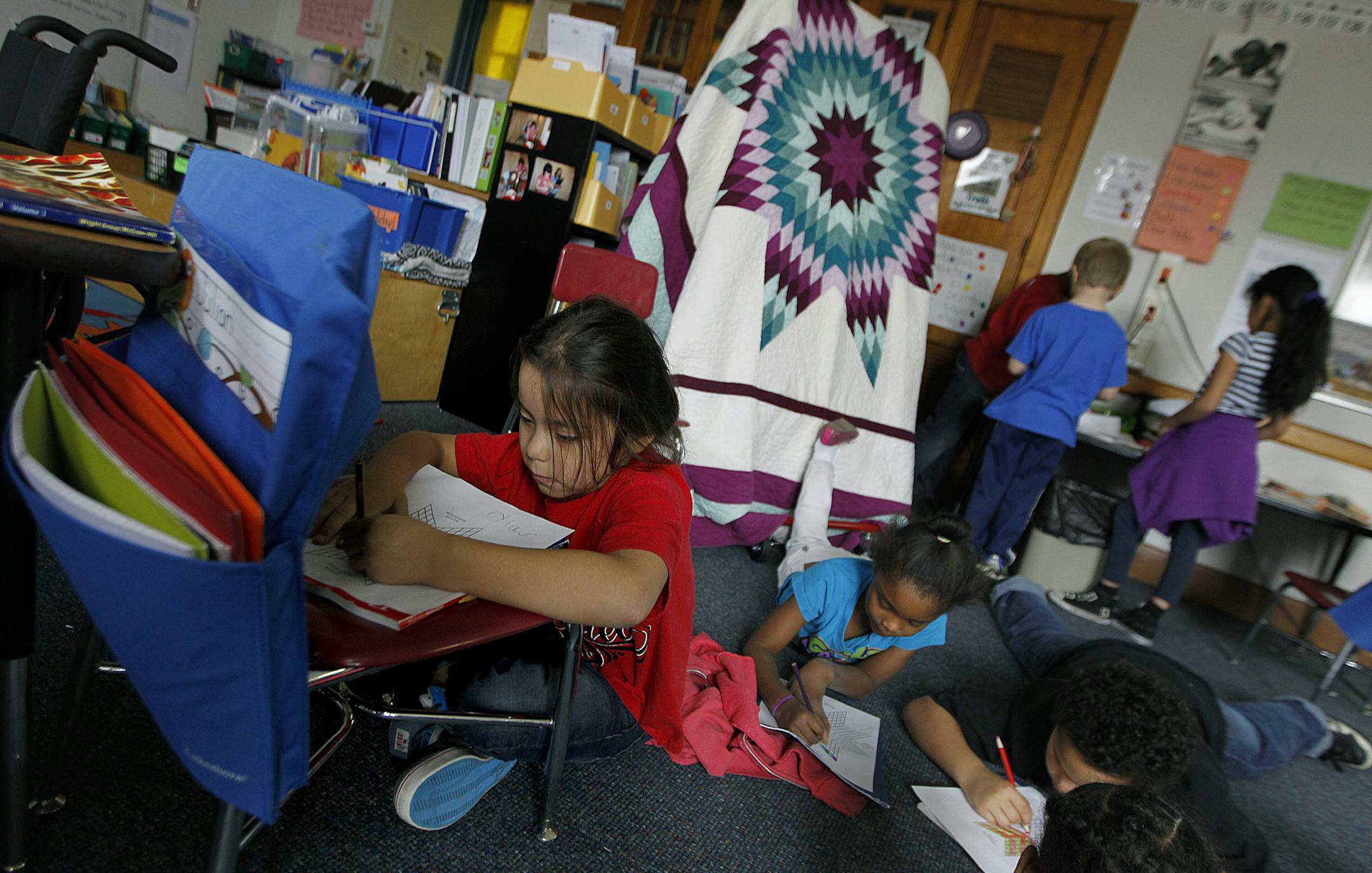
American Indian Magnet School first-grader Cylas Spears worked on creating an Eagle quilt project during class Wednesday, November 27, 2013 in St. Paul, MN. (ELIZABETH FLORES/STAR TRIBUNE) ELIZABETH FLORES • eflores@startribune.com
First-grader Cylas Spears worked to create an eagle quilt project last week at St. Paul’s American Indian Magnet School, where language and culture courses appear to have helped raise student performance. St. Paul officials cite their Strong Schools, Strong Communities strategic plan as among the factors helping to drive progress. (The Minnesota Star Tribune)
American Indian Magnet School teacher Thomas Draskovic, also known as Mr. "D," led his class in a language course, Wednesday, November 27, 2013 in St. Paul, MN. (ELIZABETH FLORES/STAR TRIBUNE) ELIZABETH FLORES • eflores@startribune.com
Teacher Thomas Draskovic, also known as “Mr. D,” led his class in Lakota language. The Lakota and Ojibwe languages and cultures are woven into academic subjects in an effort to make deep connections. (The Minnesota Star Tribune)
American Indian Magnet School teacher Becky Simondet read to her first-grade class, Wednesday, November 27, 2013 in St. Paul, MN. (ELIZABETH FLORES/STAR TRIBUNE) ELIZABETH FLORES • eflores@startribune.com
Becky Simondet read to her first-graders at the American Indian Magnet School. In addition, the Hmong Dual Language program at Jackson Elementary also has apparently helped students improve. (The Minnesota Star Tribune)
about the writer

about the writer

Anthony Lonetree

Reporter

Anthony Lonetree has been covering St. Paul Public Schools and general K-12 issues for the Star Tribune since 2012-13. He began work in the paper's St. Paul bureau in 1987 and was the City Hall reporter for five years before moving to various education, public safety and suburban beats.

See Moreicon

More from No Section

See More
FILE -- A rent deposit slot at an apartment complex in Tucker, Ga., on July 21, 2020. As an eviction crisis has seemed increasingly likely this summer, everyone in the housing market has made the same plea to Washington: Send money — lots of it — that would keep renters in their homes and landlords afloat. (Melissa Golden/The New York Times) ORG XMIT: XNYT58
Melissa Golden/The New York Times

It’s too soon to tell how much the immigration crackdown is to blame.