

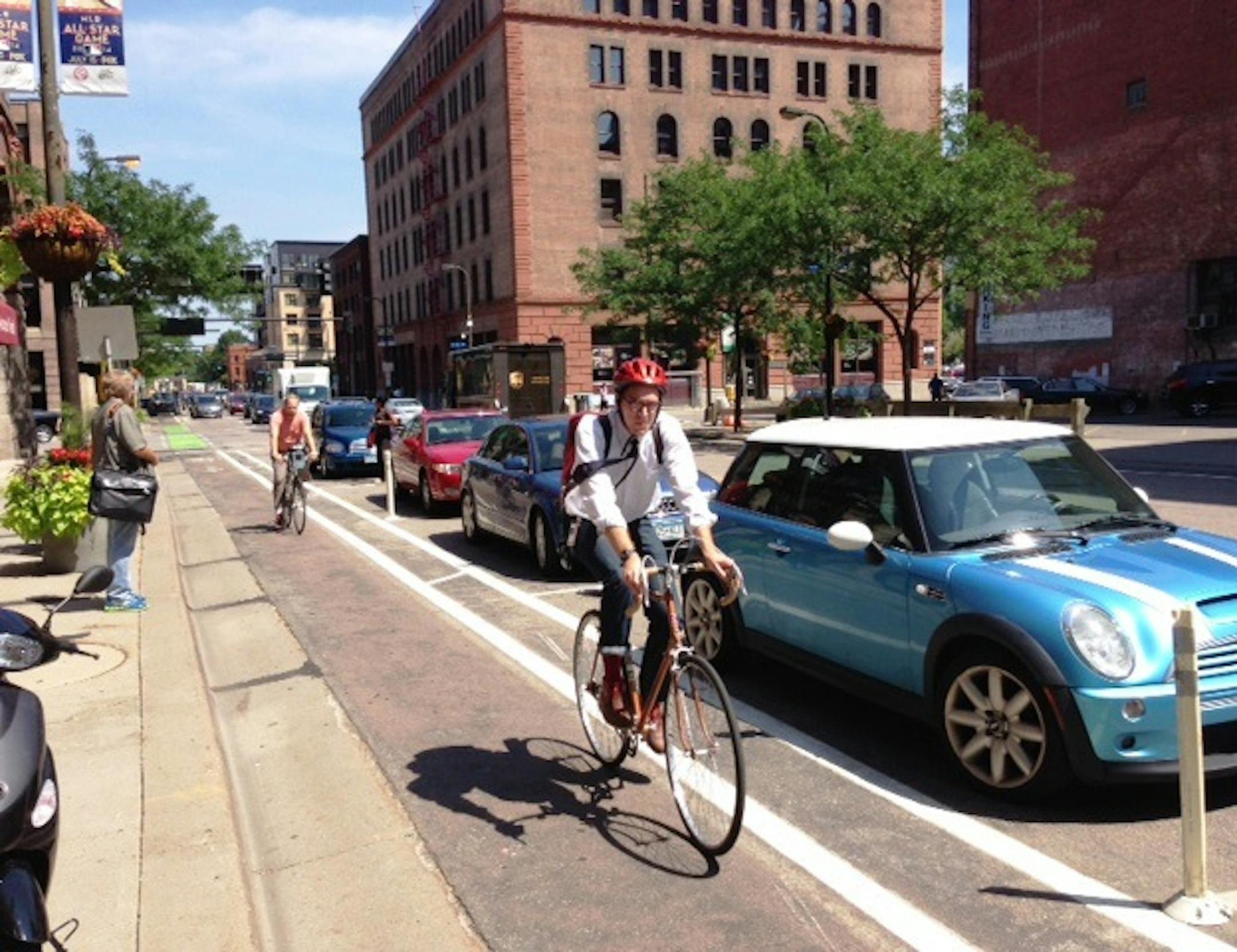
Despite widespread community pride in being a bike-friendly city, Minneapolis is falling behind other big cities in one of the newest tools to encourage biking: protected bike lanes.
Mayor Betsy Hodges is trying to fix that by proposing $750,000 for protected lanes next year that better isolate cyclists from motorists.
"Our intent is to create a bike system not just for recreation and exercise, but for commuting as well," the mayor said at her budget address last week, noting that she has gone from being only an occasional bike rider to a recreational cyclist.
Biking advocates say such lanes are vital if the city is to entice residents out of their cars and onto bikes.
Minneapolis already has one six-block lane buffered from traffic, plus a short lane on a bridge. But that is far less than other major cities: Chicago has 19 such lanes totaling more than 19 miles, while New York has 35 segments for almost 45 miles.
Protected bike lanes are part of the roadway, but separated from motorists, sometimes by a row of parked cars. That puts the cyclists between parked cars and the sidewalk, as on six blocks of 1st Avenue N. Plastic or metal poles also can separate cyclists and parked cars. The protected lanes also can be raised next to the street, as on a short segment of Washington Avenue to be installed next year in downtown.
The number of protected lanes has quadrupled nationally since 2010, according to the Green Lane Project, which has supplied technical help to a dozen cities nationally. Minneapolis applied twice, but was rejected both times because it had no money set aside for those kinds of lanes, according to project director Martha Roskowski.
Minneapolis now has a goal of building 30 miles of protected bikeways, which will include bike greenways and other off-street trails.


