The lowly crosswalk has a short life span in Minneapolis. But that may be about to change.
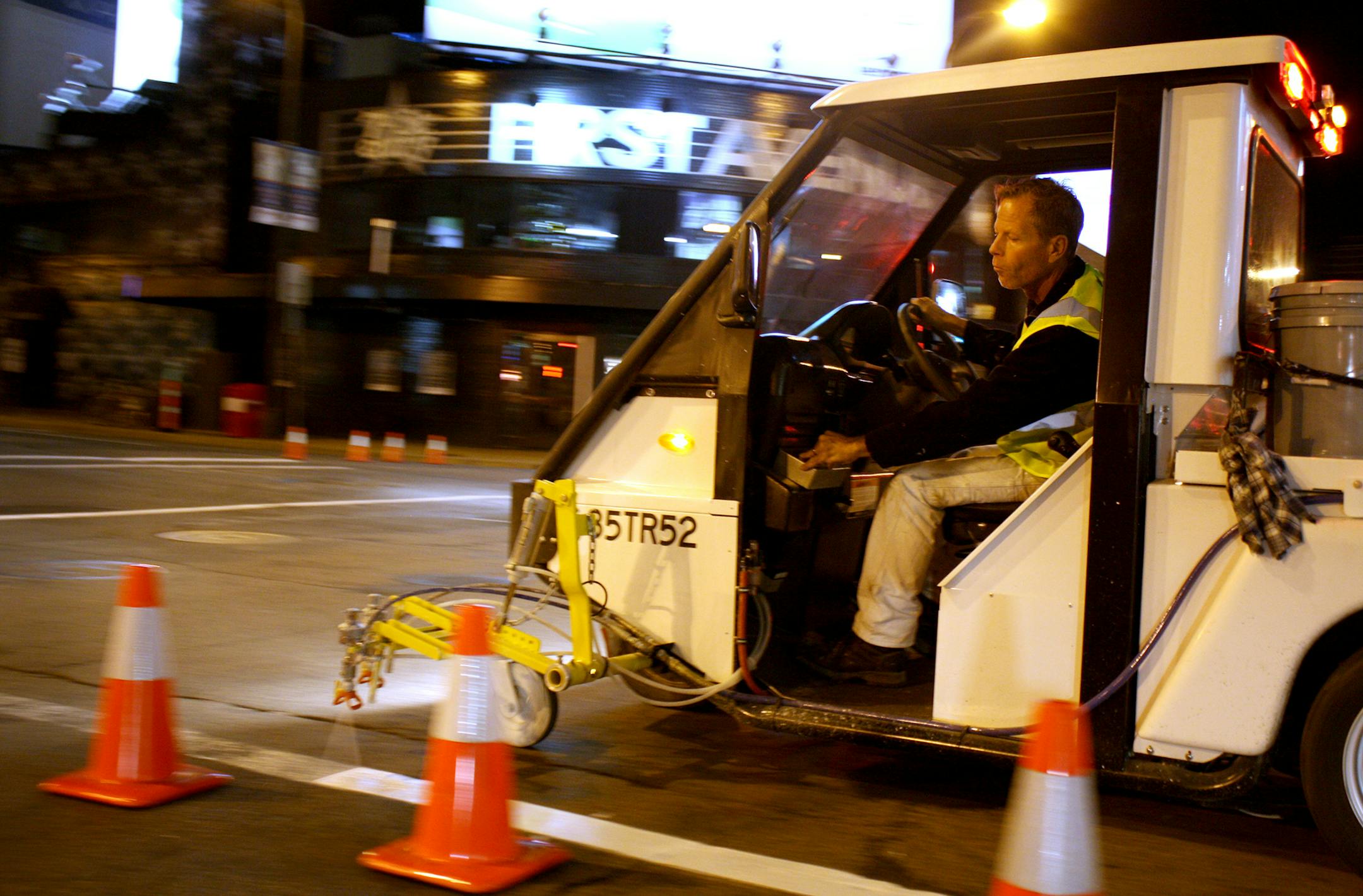
The city's 4,000 markings must be repainted nearly every year, a somewhat Sisyphean task carried out by a jovial crew of public works employees in the dead of night. But salt, ice and plows from the recent harsh winter wasted no time erasing last year's work, then the cold delayed resumption of painting this spring — leaving many intersections barren.
Just ask Scott Engel, a member of the city's pedestrian advisory committee, who has been taking pictures of faded lines across the city.
"This year it's worse than normal," he said of the crosswalks, a tiny refuge of safety for pedestrians on bustling streets otherwise dominated by cars.
At the advisory committee's urging, city leaders are now considering whether to transition from latex paint to the use of more durable — and expensive — materials. These heavy-duty crosswalks would be melted onto the street with heaters, in some cases, or just glued there.
"I think it absolutely should be a priority," said City Council Member Kevin Reich, chairman of the city's transportation and public works committee, who is pushing for extra funding in next year's budget. "In the end it's one of those things where I think you invest some now. I think we can reap benefits later."
Most Midwestern cities still rely on paint for crosswalks, although Minneapolis uses it more than others. Ninety-eight percent of Minneapolis' markings are painted, compared with 80 percent for St. Paul's 2,000 marked crosswalks. Milwaukee, Madison and Des Moines each hovered around 80 percent in a recent Minneapolis survey of other cities.
But the story is very different in New York City, which uses heated plastic to create longer-lasting lines at nearly every one of the city's 100,000 crosswalks. San Francisco, Philadelphia, Denver and Portland, Ore., also rely almost exclusively on durable materials.