

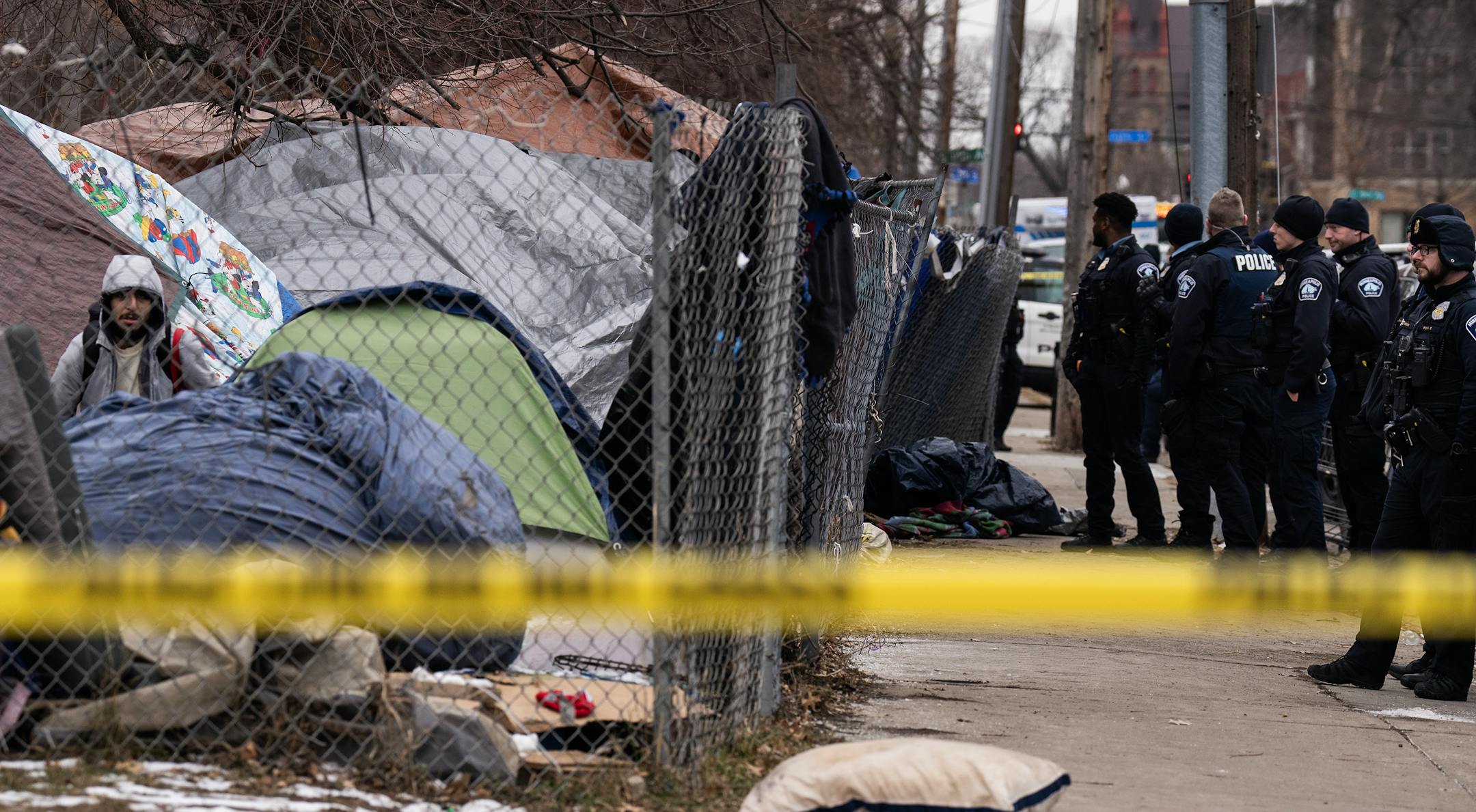
Following a divided public hearing earlier this week, a similarly divided Minneapolis City Council on Thursday approved new homeless encampment policies that would provide toilets, collect trash and give more notice before forcing out inhabitants, among other changes.
Mayor Jacob Frey opposes the plan and might veto it. Opponents say the ordinance would be more humane than the status quo.
“Encampments are not a suitable place for anybody to live, right?” said Council Member Jamal Osman. “But when you have 100 people there, as a city, as leaders, you are responsible to provide basic things. Where do you think people are going to go to the bathroom?”
The ordinance, approved by an 8-5 vote, requires the city to provide:
- Public health measures within 10 days of an encampment forming, including toilets, fire extinguishers, naloxone for reversing overdoses and trash collection;
- A seven-day notice prior to closing an encampment, provided to its occupants and service providers;
- Storage for encampment residents’ belongings at locations easily accessible by public transportation in both north and south Minneapolis.
Frey issued his statement of opposition immediately afterward: “We’ve seen what happens when encampments grow, and I can’t support an ordinance that encourages more of them. They’re not safe or healthy for anyone involved, and they end up hurting the very people we’re trying to help.”
Using city resources to equip encampments with bathrooms and waste collection has been a sticking point for the Frey administration, which characterizes these services as enabling. In St. Paul, although the city does not endorse camps, the city provides portable toilets and dumpsters at major encampments.
Council Member Andrea Jenkins challenged the ordinance’s supporters on whether they’ve considered the perspectives of residents who live close to an encampment, ”Whose houses have been burned down, whose properties have been stolen, damaged, destroyed.”
Council Vice President Aisha Chughtai responded that the public health provisions in the ordinance are intended to mitigate some of the problems that neighborhoods experience when encampments move in.


