

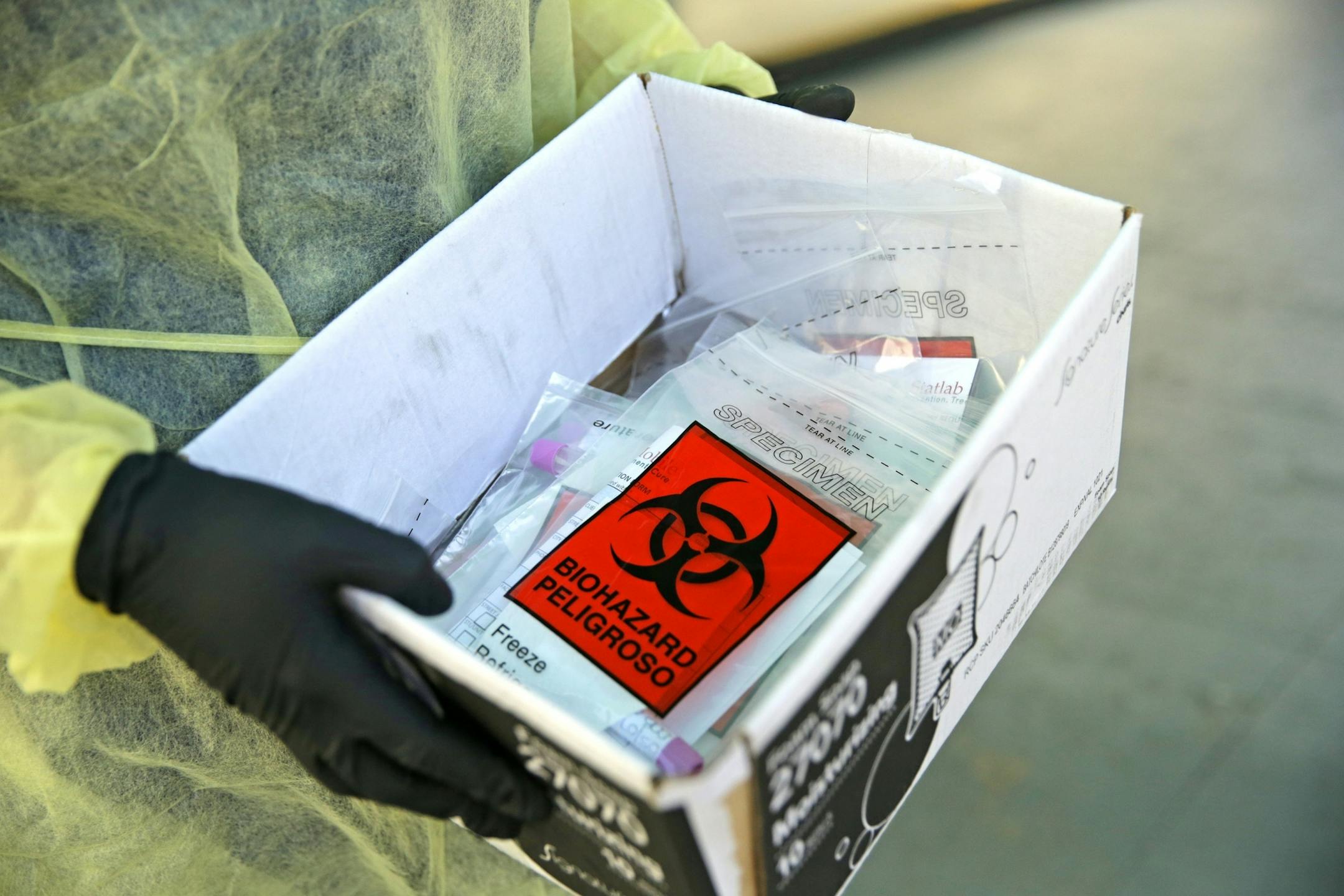
Federal officials are cracking down on the proliferation of unauthorized antibody tests for COVID-19 in the United States, as lab directors say the embattled form of testing still has an important role to play in public health.
A Minneapolis company, Premier Biotech, is one of four firms under investigation by a U.S. House subcommittee over concerns their tests are not as accurate as what's claimed on their labels. The company stands behind the China-made test and says its accuracy has been validated by outside researchers. An independent researcher said in an interview that the Premier Biotech test is widely used because it is accurate.
But the House Subcommittee on Economic and Consumer Policy is relying on non-peer-reviewed data to lambaste the tests, which are supposed to tell whether someone has had COVID-19 by detecting antibodies to the virus. The subcommittee took credit last week for prompting the Food and Drug Administration to reverse course and tighten up policies that had allowed more than 150 unauthorized antibody tests for COVID-19 to flood the U.S. market.
Under the revised guidelines, all commercial manufacturers of antibody tests have until May 18 to submit the results of a clinical study on their tests to the FDA, an FDA official confirmed. The FDA wants commercially manufactured tests to score 90% accuracy in positively identifying a single kind of antibody in a sample and 95% accuracy in identifying samples that don't contain that antibody.
Because of the error rates, antibody tests can't provide definitive evidence that someone has had COVID-19. But public health officials say high-quality, well-characterized tests can still be valuable in determining how widely the virus has spread in a given community.
The body naturally makes antibodies to fight off a COVID-19 infection, so antibody tests can be used to tell who has had the disease. Theoretically, if enough people in a community had antibodies to COVID-19, then "herd immunity" could protect those who lack the antibodies.
Governors such as Minnesota's Tim Walz and New York's Andrew Cuomo have talked about using antibody tests to measure antibody prevalence to help decide when it's safe to open shuttered businesses. But such hopes have been dashed by a lack of strong evidence backing the tests, and the major unanswered question of how well antibodies protect against re-infection.
On Sunday, the Minnesota Department of Health reported 481 new confirmed cases of COVID-19 in the state, bringing the state's tally to 11,271.


