

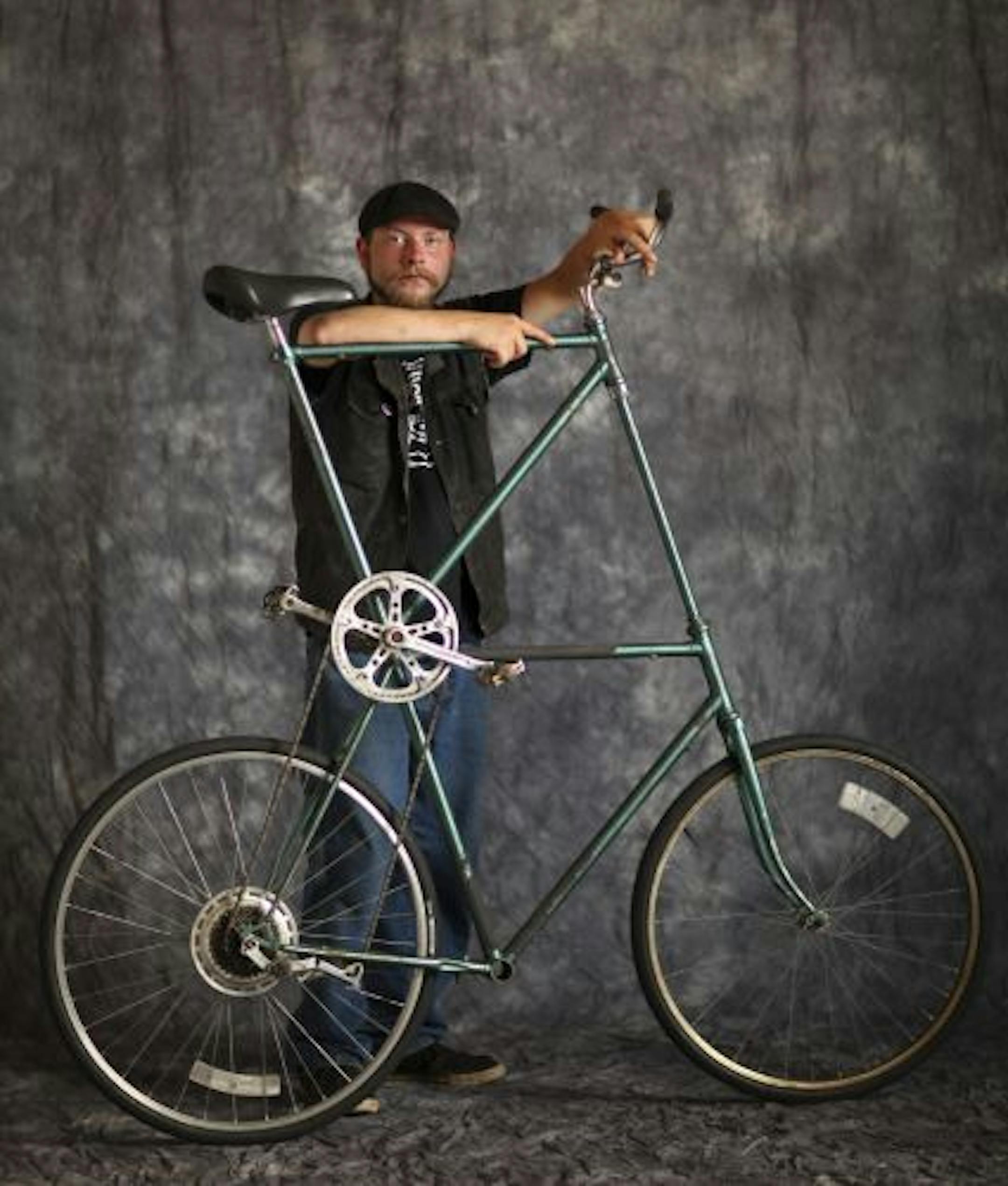
Don't be alarmed if Tim Hanson uses the roof of your car as a footrest the next time he pulls up next to you at a stoplight. If he didn't, he wouldn't be able to stay on his bike.
The bike is as tall as he is -- 5-foot-6 -- so he has to hold on to something or risk falling over when he stops.
Hanson is a member of the Black Label Bike Club, a group of about 30 Twin Cities-area riders of tall bikes. The club, which has expanded to include chapters around the world since it was founded in Minneapolis in 1992, is just one example of a subculture within the city's growing cycling community.
"This is pretty much the best city I've ever been to for bikes," said Hanson, who joined the club in 1998.
Minneapolis estimates that more than 10,000 cyclists ride every day on the city's more than 55 miles of dedicated bike lanes and 84 miles of off-street bicycling paths. It's ranked as the United States' No. 1 bike city by Bicycling magazine and the No. 2 bike city by the U.S. Census Bureau.
Clearly, Minneapolis is no ordinary city for bicycles. Or maybe, it's a city of no ordinary bicycles. Beyond the ubiquitous upright bicycles, there are dozens of kinds of bikes that break away from the norm to fit a variety of lifestyles.
Recumbent bikes make one of the biggest departures from traditional bike design, replacing an uncomfortable seat with a reclined chair. Their design makes them more comfortable for riders spending the day on a bike, but have had a stigma attached to them since they became popular in the early '80s.
"I really honestly think it's just people not being able to look past the idea that they have in their mind of what a bike should be," said Jon Nielsen, a local bike mechanic who owns a recumbent. "If you do anything a little bit different, people are going to look at you like you're a weirdo."

