Minn. high school teams racing to Eco-Marathon

Teams from two high schools set out to create the best eco-friendly vehicle.

March 30, 2016 at 1:46AM

Typical teenagers go through drivers' tests and practice hours before the grand prize: getting to drive the family car.

But students at St. Thomas Academy in Mendota Heights and Braham Area High School are skipping the hurdles and building their own rides.

Teams at the two schools have set out to do-it-themselves for months over the school year, hoping their labors will pay off at an April competition in Detroit. Their cars are special because they aren't run-of-the-mill gas guzzlers; they're energy-efficient.

The high-schoolers have been building eco-friendly cars for the Shell Eco-Marathon in Detroit in late April, bringing together teens and college students from across the continent. Unlike many competitions involving cars, the international challenge isn't a test of speed; it tests students' energy efficiency.

These are two schools out of 100 selected nationwide after sending in applications with drawings of cars and details of the electric systems, said St. Thomas adviser Mark Westlake. Competitors choose to build prototype cars for maximum efficiency or UrbanConcept road-designed cars, and choose from seven different fuel types, including battery-electric, ethanol and hydrogen-powered.

But before the April competition, there are kinks that still need to be fixed. St. Thomas Academy's UrbanConcept car, named the Charlie Taylor Experience, was newly painted and after getting the back wheels in, the students still had to install brakes and a front luggage compartment called the "frunk."

Westlake watched as the back wheels slid in last Friday; he's been advising teams at the school for the past 20 years.

"All right, good luck," he said. "Get this in."
Two teams, two cars

Electric cars have climbed in popularity since gas prices skyrocketed during the economic recession. Since these modern electric cars became available in 2011, more than 400,000 electric vehicles have been sold in the U.S., according to Jukka Kukkonen, founder of the electric vehicle consulting firm PlugInConnect and an electric vehicle manager at Fresh Energy.

Of the students who compete on St. Thomas' team, about 75 percent go on to engineering or related fields, Westlake said. Luke Becker, who oversees the Braham team designing an ethanol urban concept car and an electric prototype car, said at least two students there plan to go into welding or machining.

Not many area high schools run teams to experiment with car designs. Braham and St. Thomas Academy are the only two schools in the state competing in this year's challenge.

"Electric cars are probably the future of the world," said Mitchell Gross, a senior on the St. Thomas team.

St. Thomas has been working on its car, powered by lithium batteries, for about half a year. To make the fully formed car, the team crafted a full-size car model out of polyurethane foam and made a fiberglass mold from the model, and finished the final parts with carbon fiber and polyurethane foam in the fiberglass mold.

"Nothing is ever perfect that you do, but it's about how you fix those mistakes and how minimal you can make those mistakes that make the result as it is today," Gross said.

Westlake estimated paying retail for the car would total $10,000, which the team gets funded through sponsorships, as most competing teams do, he said.

Braham is Detroit-bound after winning a perseverance and spirit of the competition award last year, competing with five members and three cars. People at the competition were floored, Becker said.

Braham junior Jacob Lindgren said his favorite part is working together and "just putting everything together and seeing how far we came."

The joy of the ride

The sun shone through a window in the St. Thomas Academy gym as sophomore Sam Westlake mounted an experimental prototype vehicle plastered with National Geographic decals that had been driven through Manhattan streets in October to promote a new series on the channel. The team had competed with the same car at the Texas Motor Speedway last summer. Their entry this year, the Charlie Taylor Experience, wasn't driving yet.

Sam's dad is the team's adviser, so he's seen the program in action since age 6. "It's had a huge impact on my whole life, really," Sam said.

Above a whirring noise in the back, Sam took the wheel and started to accelerate, talking about the touchy throttle of the car.

"It's surprisingly comfortable," he said.

He effortlessly looped around the gym in the sleek, solar-powered vehicle, just a kid joy riding on his spring break before he bounded back to work on the next car.

Beena Raghavendran • 612-673-4569


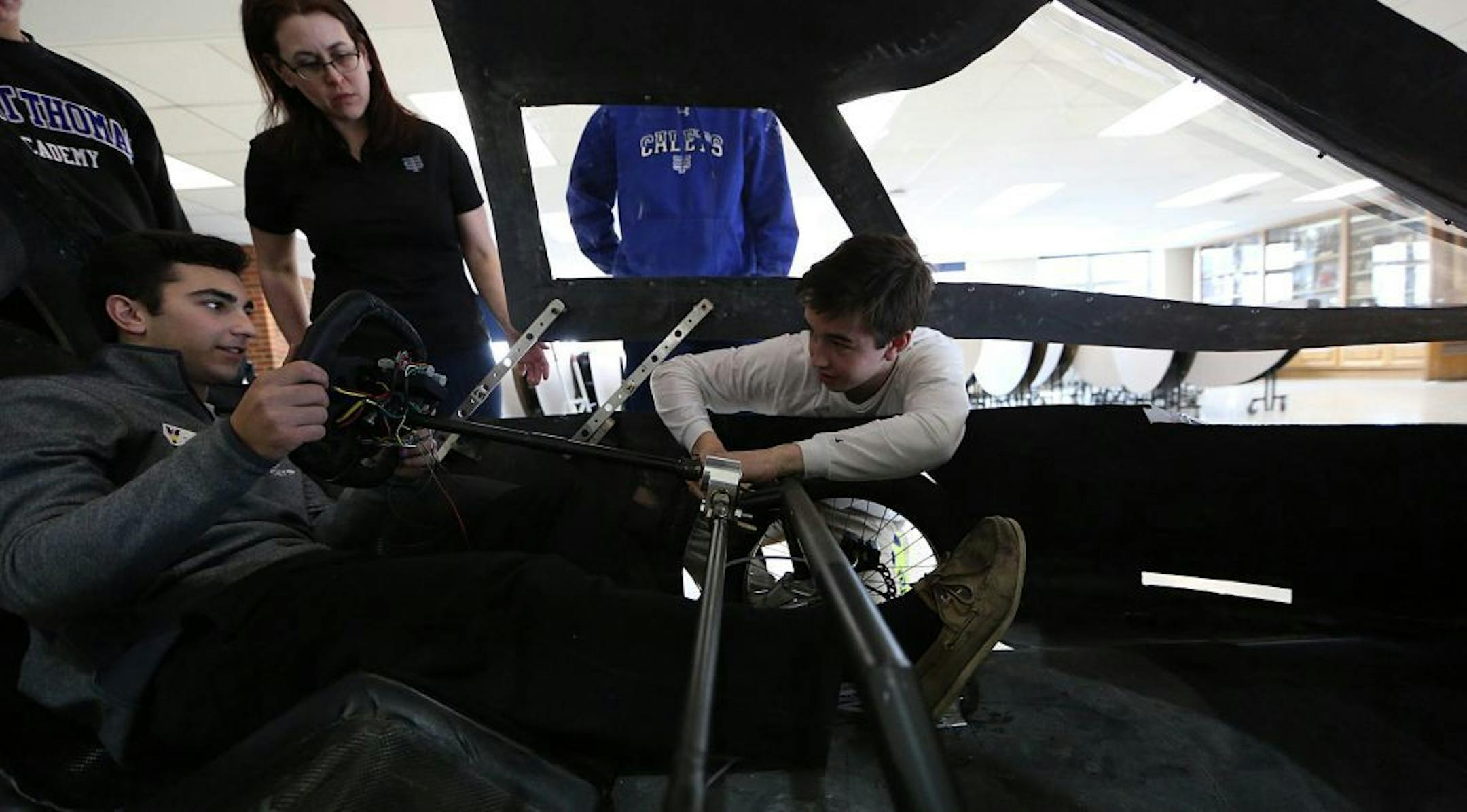
Tim D'Agostino, lower right, and Patrick Gaylord secured the top portion and windshield to the main body of the vehicle they were building for the Shell Eco-Marathon.
Tim D'Agostino, lower right, and Patrick Gaylord secured the top portion and windshield to the main body of the vehicle they were building for the Shell Eco-Marathon. (Star Tribune/The Minnesota Star Tribune)
Tim D'Agostino, behind the wheel, consulted with Patrick Gaylord as he made some adjustments. Faculty adviser Caroline Little is in middle.
Tim D'Agostino, behind the wheel, consulted with Patrick Gaylord as he made some adjustments. Faculty adviser Caroline Little is in middle. (Star Tribune/The Minnesota Star Tribune)
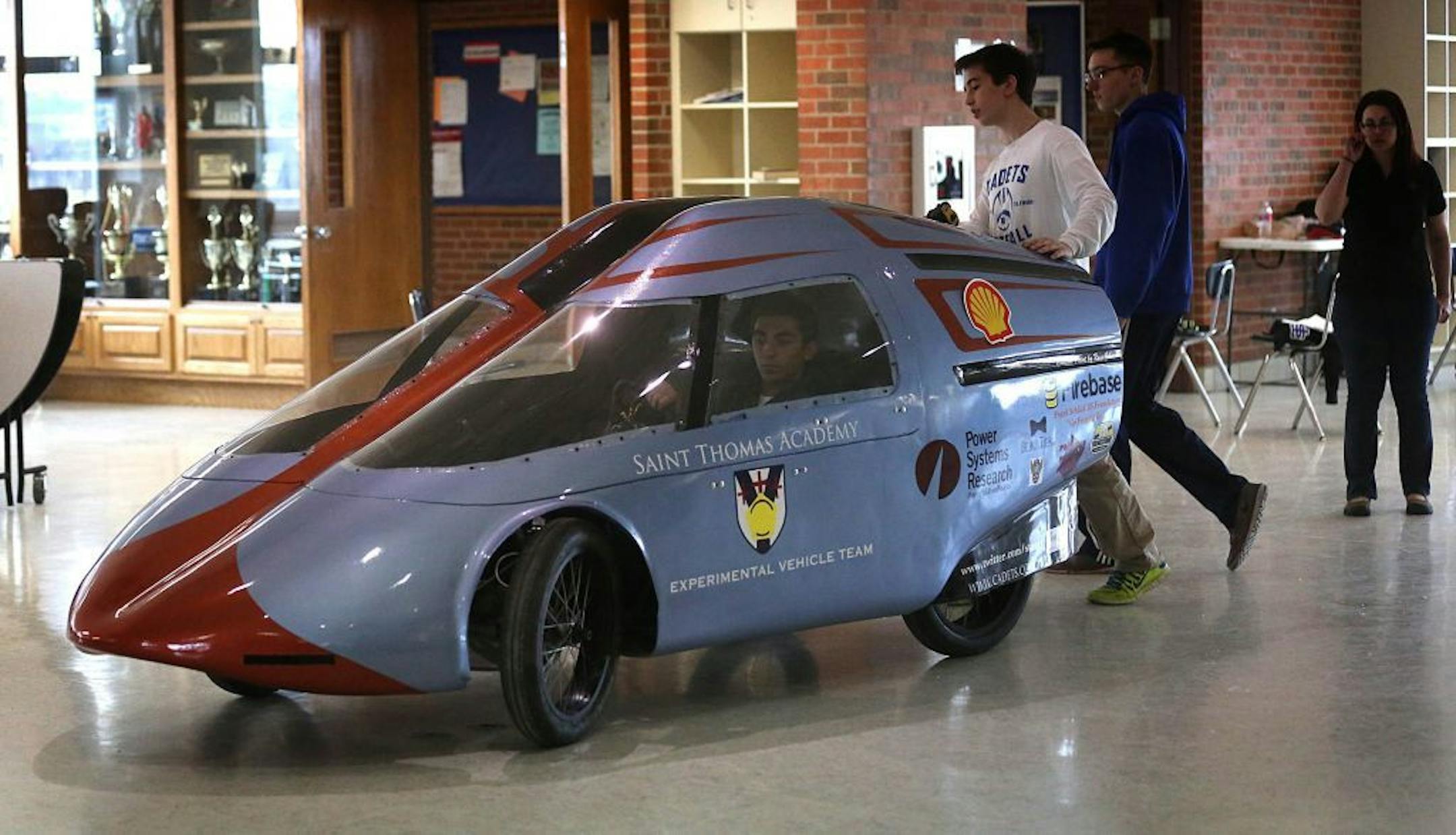
Patrick Gayord, left, and John Ingebrigtsen pushed the experimental car as faculty adviser Caroline Little monitored the work. Behind the wheel is Tim D'Agostino.
Patrick Gayord, left, and John Ingebrigtsen pushed the experimental car as faculty adviser Caroline Little monitored the work. Behind the wheel is Tim D'Agostino. (Star Tribune/The Minnesota Star Tribune)
Davis Hesdorffer (left) and Jack Kotok lifted the front portion of the car, including wind shield, into place. ] JIM GEHRZ ï james.gehrz@startribune.com /Minneapolis, MN / March 25, 2016 1:30 PM - BACKGROUND INFORMATION: The Shell Eco-Marathon tests students' design and construction skills, asking them to create energy-efficient vehicles which can look like the furthest thing from traditional cars. Two Minnesota schools are competing in the challenge in April and are immersing themselves in
Davis Hesdorffer, left, and Jack Kotok lifted the front portion of the St. Thomas Academy team’s super-efficient car, including windshield, into place. (The Minnesota Star Tribune)
Patrick Gayord (left) and John Ingebrigtsen pushed the experimental car as faculty advisor Caroline Little monitored the work. Behind the wheel is Tim DíAgostino.] JIM GEHRZ ï james.gehrz@startribune.com /Minneapolis, MN / March 25, 2016 1:30 PM - BACKGROUND INFORMATION: The Shell Eco-Marathon tests students' design and construction skills, asking them to create energy-efficient vehicles which can look like the furthest thing from traditional cars. Two Minnesota schools are competing i
“Nothing is ever perfect that you do, but it’s about how you fix those mistakes … that make the result.” Mitchell Gross, a senior on the St. Thomas team. Above, Patrick Gaylord and John Ingebrigtsen pushed Tim D’Agostino. At right is adviser Caroline Little. (The Minnesota Star Tribune)
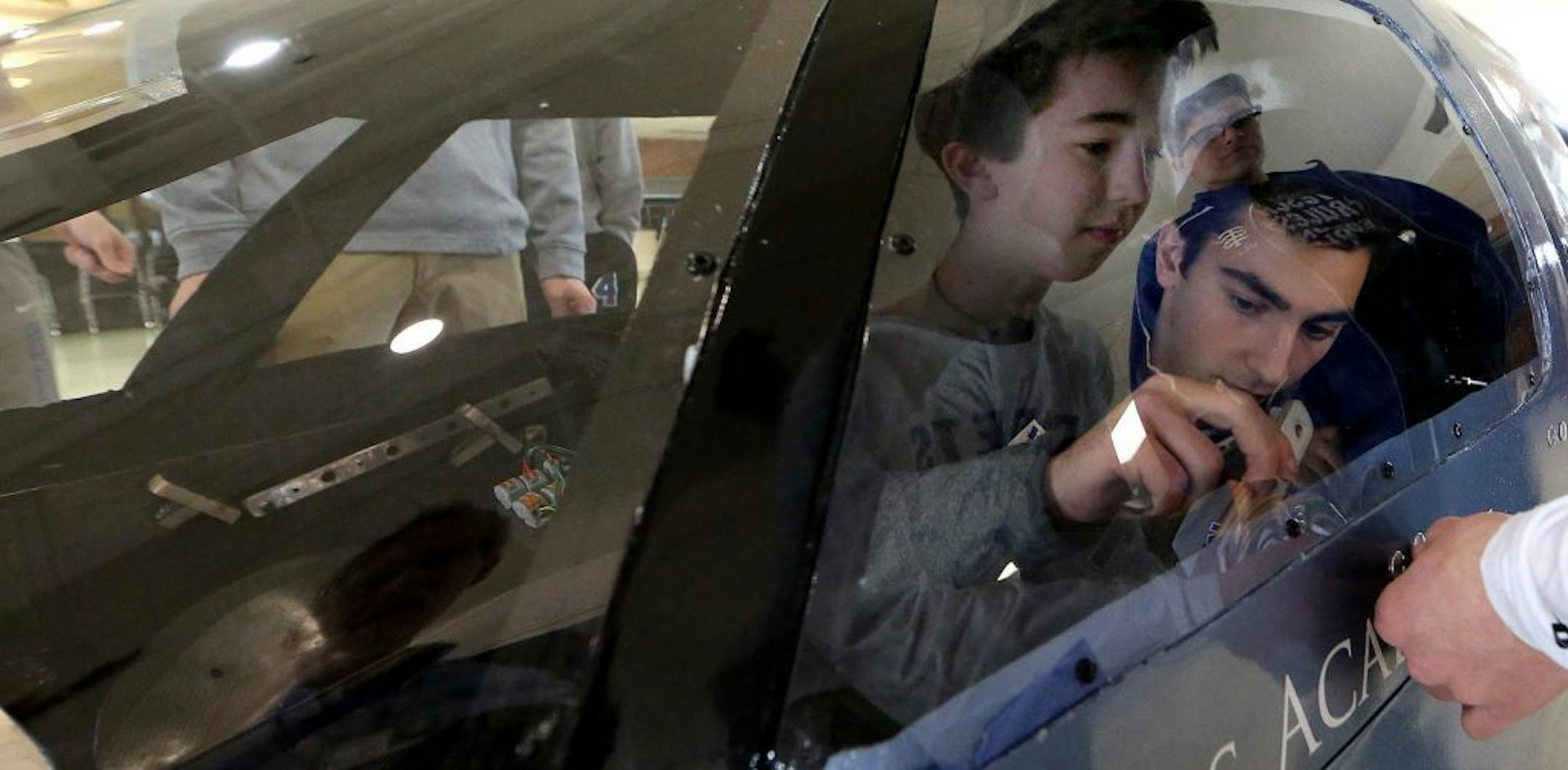
Members of the experimental vehicle team worked on the car in preparation for competition.] JIM GEHRZ ï james.gehrz@startribune.com /Minneapolis, MN / March 25, 2016 1:30 PM - BACKGROUND INFORMATION: The Shell Eco-Marathon tests students' design and construction skills, asking them to create energy-efficient vehicles which can look like the furthest thing from traditional cars. Two Minnesota schools are competing in the challenge in April and are immersing themselves in a different type of
Members of the experimental vehicle team at St. Thomas Academy in Mendota Heights worked to prepare for competition. The Shell Eco-Marathon tests students’ design and construction skills. (The Minnesota Star Tribune)
about the writer

about the writer

Beena Raghavendran, Star Tribune

More from No Section

See More
FILE -- A rent deposit slot at an apartment complex in Tucker, Ga., on July 21, 2020. As an eviction crisis has seemed increasingly likely this summer, everyone in the housing market has made the same plea to Washington: Send money — lots of it — that would keep renters in their homes and landlords afloat. (Melissa Golden/The New York Times) ORG XMIT: XNYT58
Melissa Golden/The New York Times

It’s too soon to tell how much the immigration crackdown is to blame.