

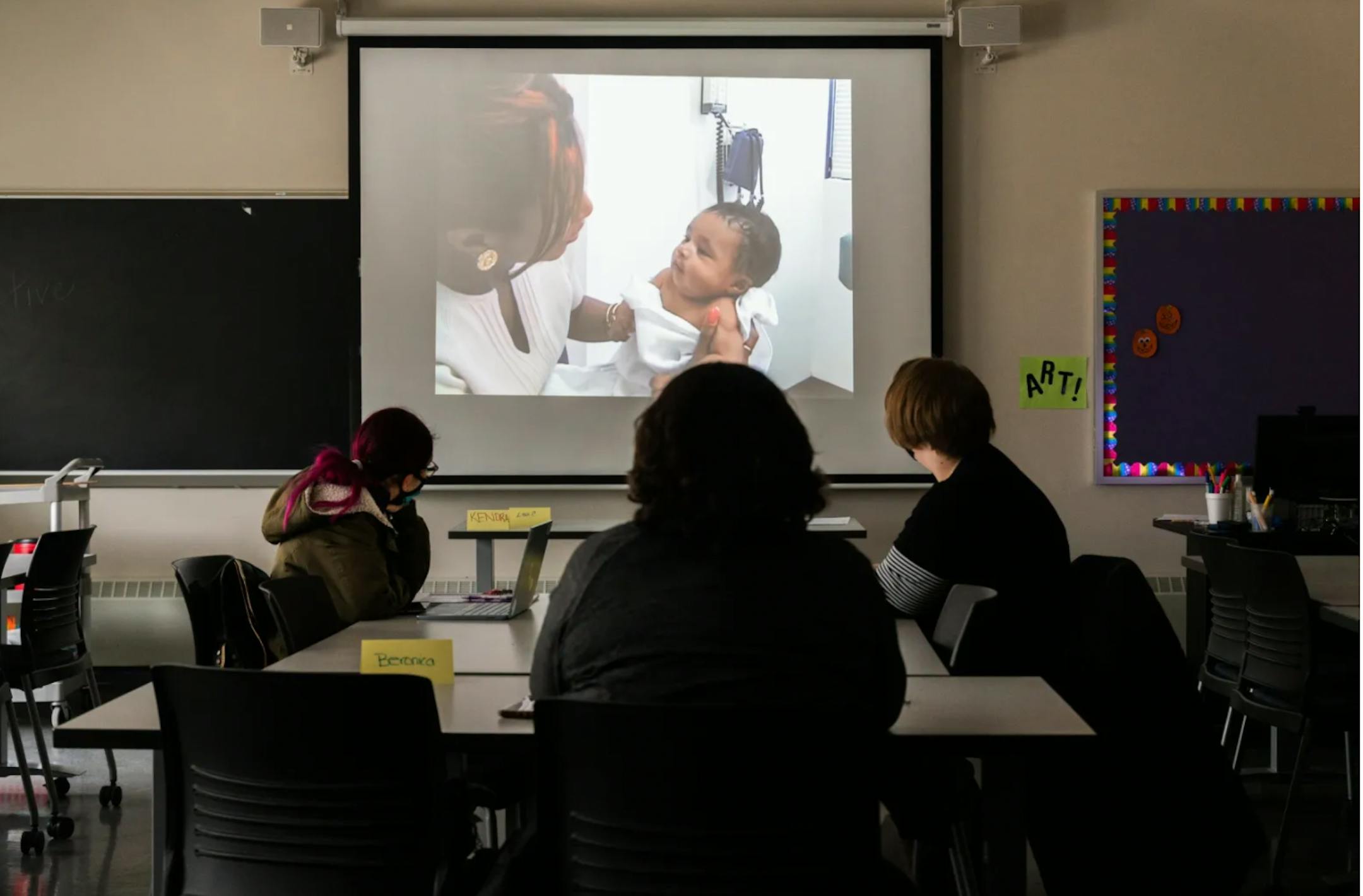
MILWAUKEE, Wis. — In a dimly-lit classroom in downtown Milwaukee, nine aspiring early childhood teachers scribbled notes as they watched a video about the capabilities of 4-month-olds.
Babies at that age "can now follow an object 180 degrees," the narrator explained, as a baby on screen watched a small toy move from side to side.Yvette Ardis, an instructor at Milwaukee Area Technical College (MATC), hits pause. "What I'm hoping you don't do in your classrooms is put the kids in those exersaucers or swings," she said, motioning toward the screen where a baby had just been shown sitting in such a device. "You are there to be engaged with your kids."
At a table in the front of the classroom, Molly Scharninghausen, 18, nodded and typed some notes on her computer. Scharninghausen is still in high school, but three times a week she rides the bus downtown to attend classes at MATC as part of the first, small cohort of a new early childhood education dual enrollment program. The program is an effort to address a growing crisis — the shrinking early childhood workforce — that has worsened nationwide during the pandemic.
To spark interest in early childhood careers among a younger generation, the dual enrollment initiative was created as a partnership between local high schools, MATC, the state Department of Workforce Development and Next Door, a Milwaukee-based early childhood provider and nonprofit. It also aims to create a pipeline of early childhood educators from the local community.
Child care programs nationwide are hemorrhaging teachers and other workers. Between January 2020 and January 2022, around 120,000 child care workers left the industry. Former child care employees and current program directors say the departures are often for jobs with better pay and benefits. At the same time, it has become increasingly difficult to attract new workers into early ed. The jobs are physically demanding and require deep knowledge of child development, yet often pay less than positions in retail or restaurants.
Normally when industries experience a worker shortage, industry officials know there's "a group of willing workers who are graduating now," said Rebecca Berlin, chief learning officer at the early childhood nonprofit Start Early. "But that doesn't exist" in early childhood, she added. "As I begin to think about this pipeline, I really think you're going to start seeing the early childhood system crumble."
Public-private partnerships and early ed workforce development initiatives, like the dual enrollment program in Milwaukee, offer a model for tackling the nation's persistent early childhood workforce problems. Though the dual enrollment program is starting with just a few students, officials involved with the work in Wisconsin say this and other workforce programs have the potential to produce graduates who are able to fill empty teaching positions in child care centers across the state, and nationwide.
At a time when classrooms are sitting empty due to a lack of teachers, including at Next Door's centers, even just a few new, qualified graduates can result in a child care classroom being able to open, or stay open. That could mean up to a dozen or more families now have reliable child care.


