
Military exercises to test U.S., North Korean restraint

U.S.-South Korean military exercises begin Monday.

Tribune News Service
August 19, 2017 at 9:09PM
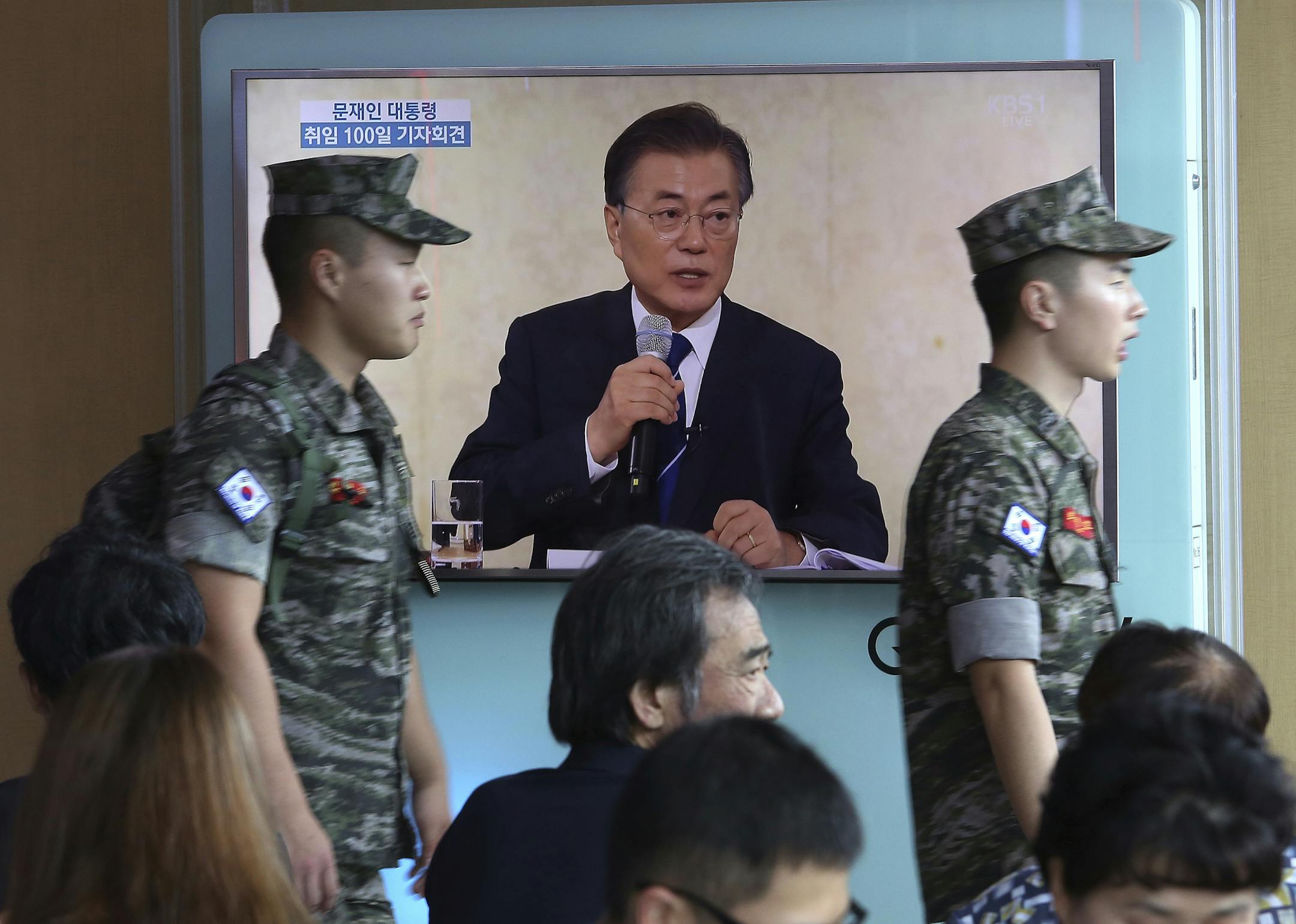
South Korean marines walk by a TV screen showing the live broadcast of South Korean President Moon Jae-in's press conference, at the Seoul Railway Station in Seoul, South Korea, Thursday, Aug. 17, 2017. In an effort to jumpstart diplomacy, South Korean President Moon said Thursday he would consider sending a special envoy to North Korea for talks if the North stops its missile and nuclear tests. (AP Photo/Ahn Young-joon)
South Korean marines walked by a TV screen showing South Korean President Moon Jae-in, who wants to revive diplomacy. (The Minnesota Star Tribune)

WASHINGTON – Are tensions cooling in the Korean Peninsula? The U.S. and South Korea will find out Monday, when the two allies are scheduled to start joint military exercises that are known to anger North Korea, sometimes triggering a show of force.

This year's war games come at a delicate moment. There have been exchanges of war rhetoric between President Donald Trump and North Korea's Kim Jong Un.

Amid the rhetoric, the U.S. and South Korea's military will simulate war with North Korea through Aug. 31, well aware that North Korea may respond with another missile test.

"Over the course of the next two weeks I expect tensions to escalate," said Scott Snyder, a Korea specialist with the Council on Foreign Relations who previously was the Asia Foundation's representative in Seoul. "This is always a sensitive issue, but it is more hair-trigger as the North Koreans are very sensitive to the additional nuclear-capable aircraft flyovers."

The United States says biannual exercises are defensive in nature, but North Korea and China have long criticized them as a provocation and an affront to regional security.

"There certainly will be some reaction," said J.D. Williams, a retired Marine colonel and defense policy researcher at the RAND Corporation in California. He wouldn't be surprised if North Korea conducted some kind of missile launch — not a test, but a defiant demonstration of might.

North Korea this month threatened to fire four missiles toward Guam, a U.S. territory, a rebuttal to Trump's "fire and fury" remarks of Aug. 8. North Korea's Kim later backed off that threat, saying he'd watch "the foolish and stupid conduct of the Yankees" before deciding on the launch, a decision that Trump tweeted was "very wise and well reasoned."

The exchange suggested that cooler heads were prevailing in the latest U.S. standoff with North Korea. But this week's war games could rekindle hostilities. On Thursday, North Korean state media declared that the military exercises will "further drive the situation on the Korean Peninsula into a catastrophe."

Held every fall in South Korea, the Ulchi-Freedom Guardian war games are the world's largest computerized command and control exercise. Roughly 30,000 U.S. soldiers and more than 50,000 South Korean troops usually take part, along with hundreds of thousands of first responders and civilians, some practicing for a potential chemical weapons attack.

The exercise, along with one in March, often triggers antiwar protests in South Korea and condemnation from China. While Chinese President Xi Jinping has been noticeably cool toward Kim and has been critical of North Korea's development of nuclear weapons, China has long wanted the United States to shrink its military footprint in Asia, including 12 bases in South Korea and Japan.

North Korea has been known to react strongly during the biannual war games. In 2014, the north fired off scud missiles during the March exercises held by the U.S.-South Korean command.

During the 2015 summer exercises, North Korea and South Korea exchanged fire over their border. That exchange came after two South Korean soldiers were maimed stepping on land mines in the Demilitarized Zone. South Korea accused North Korean soldiers of sneaking across the border and planting the mines.

China and Russia have been urging the United States to consider a "freeze for freeze" agreement to reduce tensions. In such a deal, Pyongyang would agree to suspend its tests of missiles and nuclear weapons, and Washington and Seoul would agree to suspend large-scale military exercises.

U.S. military experts say that such a deal would give a lopsided advantage to North Korea, which could continue its military training even as the U.S.-South Korea exercises were suspended. "It is hard to imagine why the United States would accept that because of the vulnerability it would create," said Bruce Bennett, a defense researcher at RAND.

about the writer

about the writer

Stuart Leavenworth

More from No Section

See More
FILE -- A rent deposit slot at an apartment complex in Tucker, Ga., on July 21, 2020. As an eviction crisis has seemed increasingly likely this summer, everyone in the housing market has made the same plea to Washington: Send money — lots of it — that would keep renters in their homes and landlords afloat. (Melissa Golden/The New York Times) ORG XMIT: XNYT58
Melissa Golden/The New York Times

It’s too soon to tell how much the immigration crackdown is to blame.