

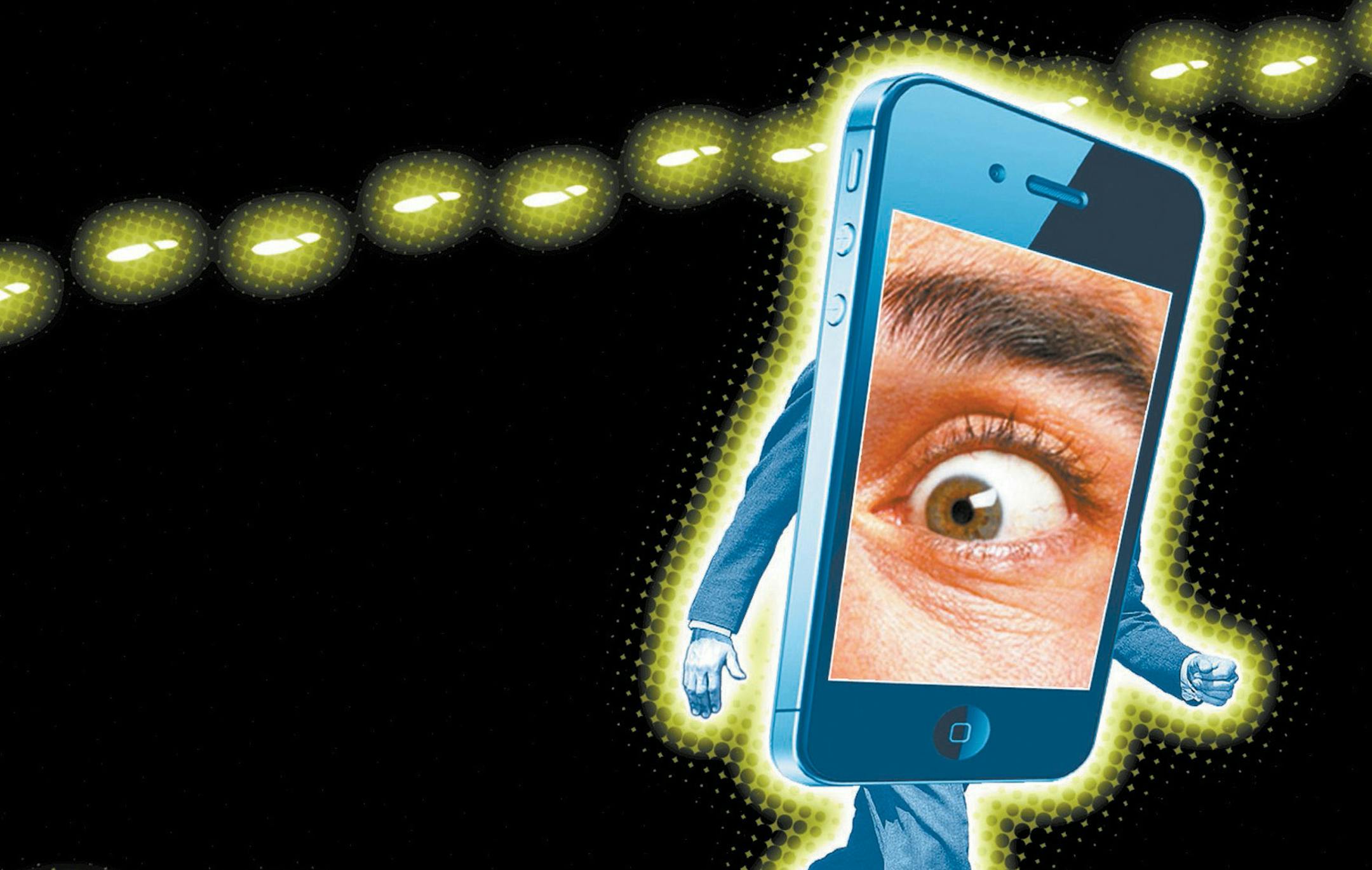
Every once in a while, life serves up a jolt of future shock that gets me thinking about classic science fiction of the 1940s, 1950s, and early 1960s. We're living in the future those stories imagined, and at times they feel spookily close to prophecy. I play a game sometimes in which I consider which of those past visions of the future offer useful perspectives on contemporary life.
Take the proliferation of "screen zombies," for instance. I experienced one of those science-fiction jolts the other day when my 10-year-old daughter reported that there was nobody to play with after school because all the kids on the playground were sitting around looking at their phones.
It makes sense; that's the behavior adults model for them. There are moments when I'm out in public — walking down the sidewalk, riding the T — when everyone around me has nose to screen in the devotional stoop that has grown common in our time. Passing unseen among them, I can't decide if I'm an insubstantial ghost or they are. It's as if we all inhabit parallel universes.
So which classic science fiction stories does the screen zombie bring to mind?
I start with "Mimsy Were the Borogoves" (1943) by the great C.L. Moore and her husband, Henry Kuttner. In it, two children discover a time-traveling box of educational toys from the future and learn how to depart their parents' world, never to be seen again. Appropriately dark as the outcome may be, with the children disappearing into the technology, I think the story is in some ways too optimistic to serve as the template for understanding screen zombies.
The educational toys in "Mimsy" offer complex lessons in logic and problem-solving that shape the two children's brains in fresh and exciting ways. You can't really say that's what's happening in your typical case of phone-staring. If those inert fifth-graders were watching, say, a live feed from a Mars rover or from inside an erupting volcano, I would accept that there's a genuine choice to be made between gee-whiz novelty and traditional playground pleasures. But they're mostly just text- ing each other (talking is "awkward") to say the usual text-message things: I'm here; you're there.
Then there's Isaac Asimov's "It's Such a Beautiful Day" (1954), which imagines a 22nd-century future in which everyone gets around by teleportation machine, a shrewd figure of the way that cars, TV and other technology were increasingly pulling Americans in from the outdoors. But Asimov adds a dissenting twist to his fable: When one family's gadgetry malfunctions, a little boy is forced to walk to school and grows to like the outdoors, which leads to the intervention of a psychiatrist, who is himself eventually converted to walking.
Asimov had a point. If a phone-disabling pulse could somehow be unleashed on the playground, the kids would no doubt get back to climbing and running around.


