
Merle Haggard: A music critic remembers 'jazz guitar player' who 'loved to play country'

Our pop music critic reflects on the late legend through interviews spanning four decades.

April 9, 2016 at 7:29PM
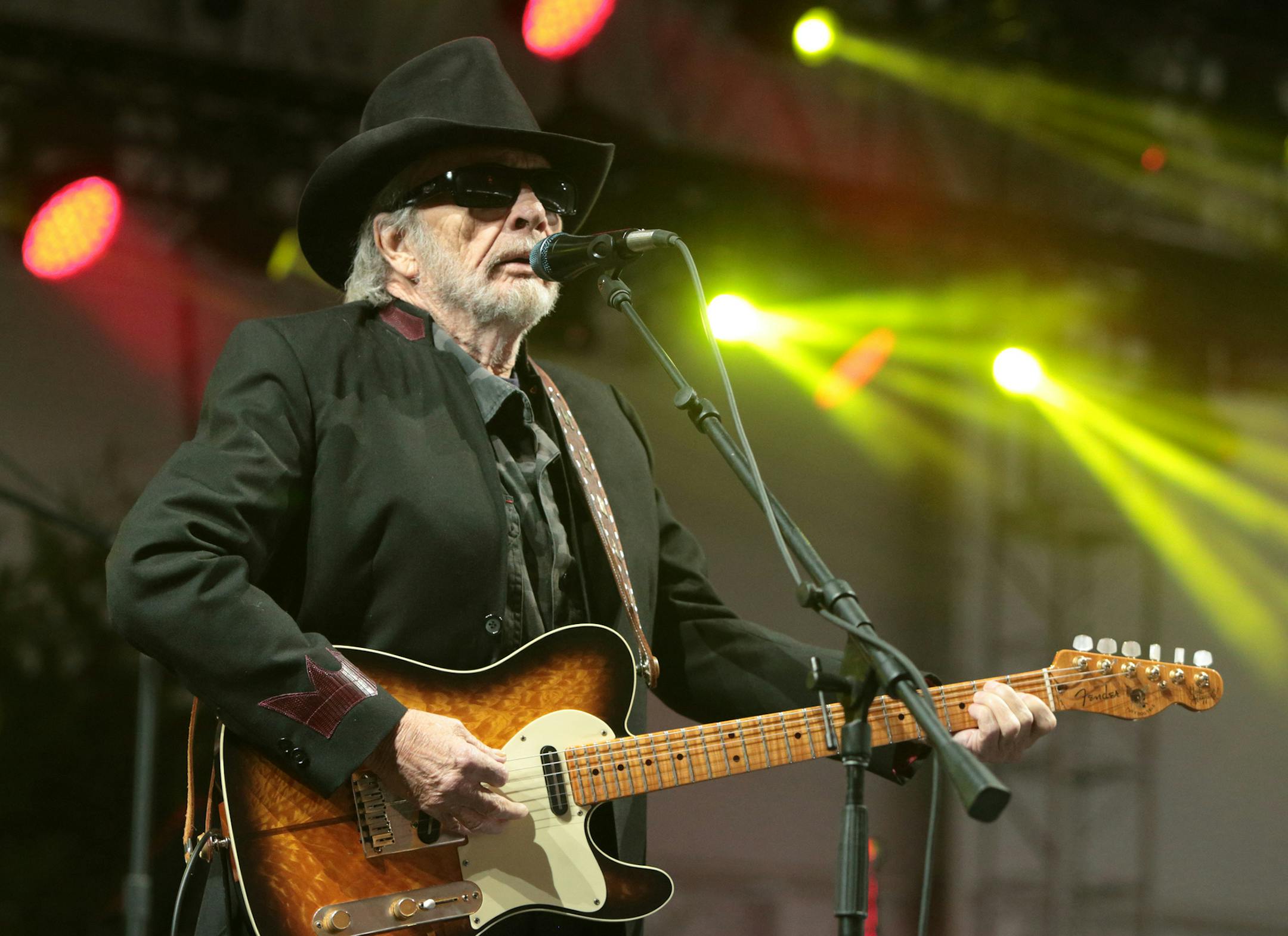
Merle Haggard, shown in 2015, said “I’ve been an example as what not to do, and also an example of what can be done in America.”
Merle Haggard, shown in 2015, said “I’ve been an example as what not to do, and also an example of what can be done in America.” (The Minnesota Star Tribune)

The lines in his face look like a road map to hard times. The lines in his songs speak of hard times for common folks like him.

I made those observations talking to Merle Haggard back when he was only 48. Those keen blue eyes had seen enough for three lifetimes by then — a mostly fatherless childhood, several years in reform school, nearly three years in a state penitentiary and three marriages that ended in divorce.

By the last time I'd talked to Hag, via phone in 2011, the bad times were pretty much over. OK, he was on Wife No. 5 by then, but the greatest songwriter in country music — and arguably the greatest songwriter about American life — was enjoying a well-deserved rebirth.

A pillar of country music, Hag was also receiving widespread recognition beyond the world of three chords and the truth. He was touring with the Rolling Stones and Bob Dylan, earning Kennedy Center Honors with Oprah Winfrey and Paul McCartney, and landing in the California Hall of Fame with Barbra Streisand and Serena Williams.

"Merle Haggard has always been as deep as deep gets," Dylan told Rolling Stone in 2009. "Totally himself. Herculean. Even too big for Mount Rushmore. No superficiality about him whatsoever."

Haggard, who died Wednesday of double pneumonia on his 79th birthday, was real — and the real deal. He was straightforward, smart, aware, thoughtful, funny, poetic, no-nonsense and as easy to talk to as your next-door neighbor.

When I asked him to recommend something in pop culture to the readers of the Star Tribune, he contemplated for a minute and then said "the Bible," touting a televangelist he watched regularly. "When you become 74 years old," the singer said, "the next big event might be your funeral. So I'm trying to make some preparation."

Not that Hag walked the straight and narrow. No quote encapsulated the man better than his answer to a question about how he, as a well-known pot smoker, felt about the legalization of medical marijuana in California, where he lives. "There's no way I'm going to smoke somethin' that's legal, so I quit," he said, perhaps tongue-in-cheek. "But I think it's like onions: You ought to be able to grow it if you want it."

His songwriting was the same way: simple but deep.

"Wish a Ford and a Chevy/ Could still last ten years, like they should," he sang in 1982 on "Are the Good Times Really Over for Good." "Is the best of the free life behind us now?/ Are the good times really over for good?"

Ultimate American story

His most famous song is "Okie From Muskogee," a 1969 pronouncement of patriotism and denouncement of war protesters.

"It's just a song. It doesn't necessarily say anything about me," Haggard said five years ago. "A man could kill himself trying to live up to his material. I believe in America and I believe in the right to disagree. We probably do 'Muskogee' with a different attitude and different message than when we first wrote it.

"I was as dumb as a rock [when he wrote it]. I didn't know much about what I was talking about. But I knew more than the hippies knew. We've come to terms with each other. I've got a lot of hippies in my audience. And I'm pretty much a hippie myself. A short-haired hippie."

Haggard was often misunderstood. He sang about commoners like himself: blue-collar workers, farmers, railroaders, prisoners, drinkers, lovers and losers. His story — going to prison as a young man, seeing Johnny Cash perform there and becoming a country star himself, getting pardoned by then-California Gov. Ronald Reagan — has made him seem larger than life. But he didn't get above his raising.

"I've been an example as what not to do," he said in 1986, "and also an example of what can be done in America. I think that nowhere in history that I can find has there been anyone who has taken advantage of the American system to the extreme I have. I have gone about as far as you can go in both directions. I doubt that there's any place else in the world where a man has been sent to prison and been made man of the year by the same community."

Haggard never sold as many records as his pal and duet partner Willie Nelson. He was never as flashy and friendly as Garth Brooks, though Hag played an expressive guitar. He was not as revered by the masses as Johnny Cash. But as Esquire magazine once put it: "No one is better than Haggard at capturing in metaphor the bleary-eyed angst and dark revelations of the soul that lie beyond the second six-pack."

In that in-person interview in 1986, when I thought that Haggard, approaching 50, might be getting too old for the road, I asked the clichéd question about how he wanted to be remembered. He didn't say anything like "the poet of the common man," as he was often introduced. Instead, he kept it plain and simple, with a typical Hag twist.

"I'd like it to say: 'He was the greatest jazz guitar player in the world that loved to play country.' "

Jon.bream@startribune.com

612-673-1719

Twitter: @jonbream

about the writer

about the writer

Jon Bream

Critic / Reporter

Jon Bream has been a music critic at the Star Tribune since 1975, making him the longest tenured pop critic at a U.S. daily newspaper. He has attended more than 8,000 concerts and written four books (on Prince, Led Zeppelin, Neil Diamond and Bob Dylan). Thus far, he has ignored readers’ suggestions that he take a music-appreciation class.

See Moreicon