

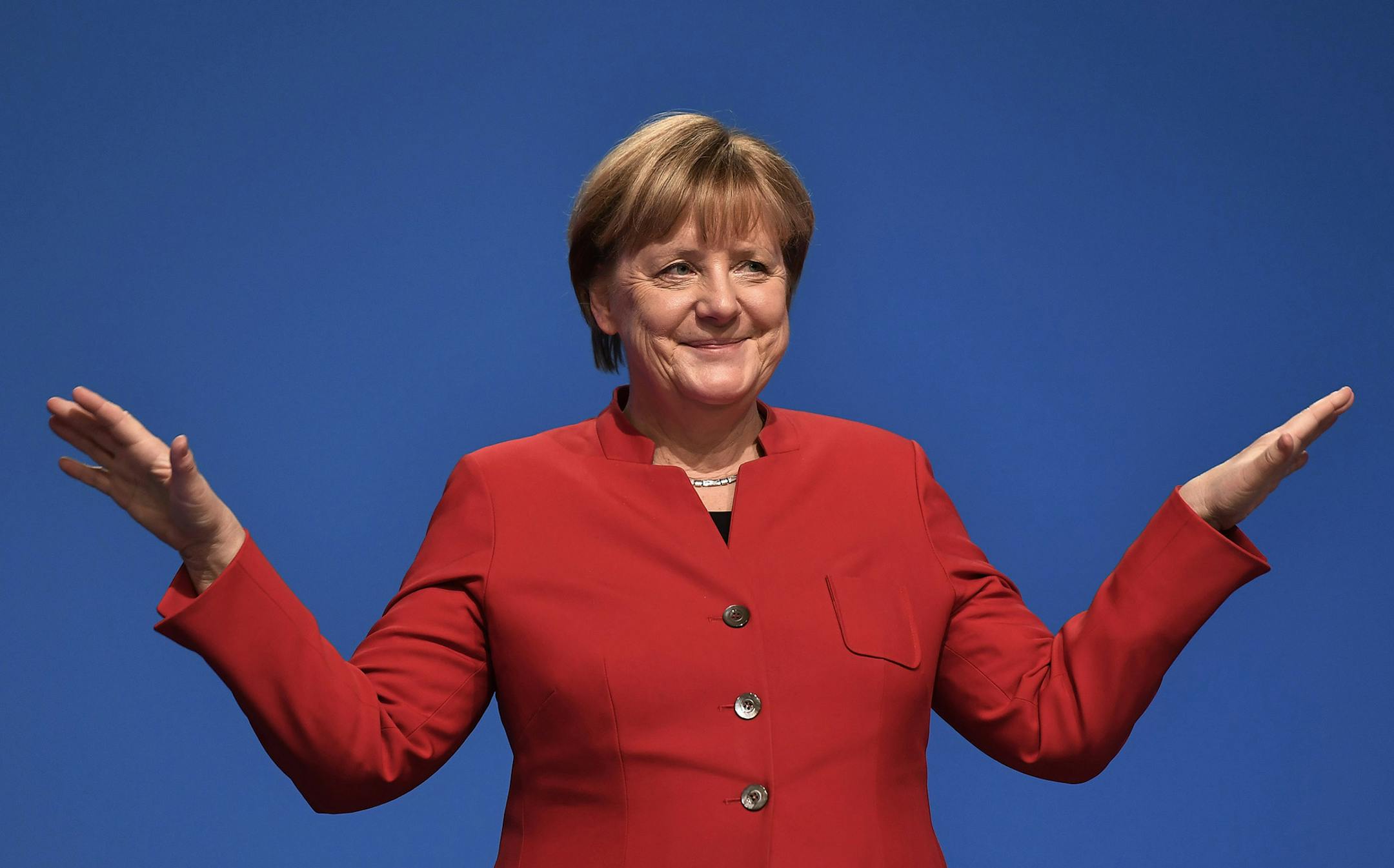
One of the most iconic pictures of 2016 is a photo taken at the May G7 summit in Japan. It shows Barack Obama, Francois Hollande, David Cameron and Matteo Renzi smiling and waving at the camera, while Angela Merkel looks on, fingers steepled, in her signature pose exuding both serenity and self-restraint. The men in the picture seemed nervous, and had every reason to be. By year's end, their political careers would all be over, having been forced to make way for populist movements in their respective countries.
Only Merkel has enjoyed staying power, which seems for some reason to have also granted her some moral privilege. A consensushasemerged among foreign-policy elites that the departure of her peers has left her as the only person capable of upholding the tenets of the global liberal order. The last hope for the free world, they suggest, rests on Merkel's reelection in the fall of 2017.
Those hopes are dangerously misguided. Giving Merkel the mantle of moral leadership is based on a misreading of her past 11 years in office. It assumes that Merkel's three coalitions in Germany and her active steering of the European Union have been unqualified successes. They have not.
Rather, supporters of the liberal order should root for an alternative coalition to take shape during next year's German elections, expected in September 2017, which excludes both Merkel and her Christian Democrats from government. A so-called red-red-green coalition - comprised of the Social Democratic Party (SPD), left-wing Die Linke, and the Greens - offers the best way forward for German democracy, a recalibration of the European Union, and the future of the liberal world.
Since the global financial crisis of 2008, Merkel's leadership has been tested on four different fronts: the eurozone debt crisis, the military conflict between Russia and Ukraine, the Schengen crisis over refugees and intra-EU migration, and the creeping authoritarian tendencies of governments in Hungary and Poland. In all four crises, Merkel's governments have dithered and German leadership has fallen short.
First, during the euro crisis, German insistence on fiscal austerity and structural reform pushed the burden of adjustment of the crisis squarely onto debtor countries, with disastrous consequences for the monetary union's cohesion as a whole. Unlike the United States after the global financial crisis, Germany refused to provide the regional public goods the eurozone needed for a swift recovery. While the United States responded to the global panic in 2008 with a fiscal stimulus package and allowed the Federal Reserve to be the global lender of last resort, Germany's role during the euro crisis was austerity for all and a refusal - during the first three years of the crisis - to let the Frankfurt-based European Central Bank use its balance sheet to calm financial markets.
Merkel and Finance Minister Wolfgang Schäuble's tough stance vis-à-vis Athens was motivated by the exposure of German banks to the euro periphery, a strict adherence to ordoliberal economic ideas touting balanced budgets and fiscal restraint, and a populist refrain that touted the continent's northern saints and southern sinners. A Greek fiscal crisis quickly turned into a full-blown sovereign debt crisis as a result of German insistence on following dysfunctional fiscal and monetary rules. While Germany's economy has fared well since 2010, this has come at the cost of declining living standards, record unemployment, and increased Euroskepticism across the EU's southern periphery. With no hope of economic recovery, the future of the common currency remains fragile at best.
Second, in the military conflict between Russia and Ukraine, Germany has put all its faith in NATO and economic sanctions and cobbled together a fragile Western coalition. Whatever its moral merits in the abstract, it has had little practical merit. While a brittle truce between Ukraine's warring parties has been upheld so far, the sanctions have given Putin's regime in Moscow the chance to tighten its grip on power at home, without improving Ukraine's hopes of reasserting sovereignty over eastern Ukraine or Crimea. Merkel will now have to contend with U.S. President-elect Donald Trump, who has clearly signaled a desire for a rapprochement with Russia. Trump is less interested in continuing the synchronized U.S.-EU economic sanctions regime imposed on Russia, and has signaled his doubts over NATO's ironclad commitment to mutual defense.


