

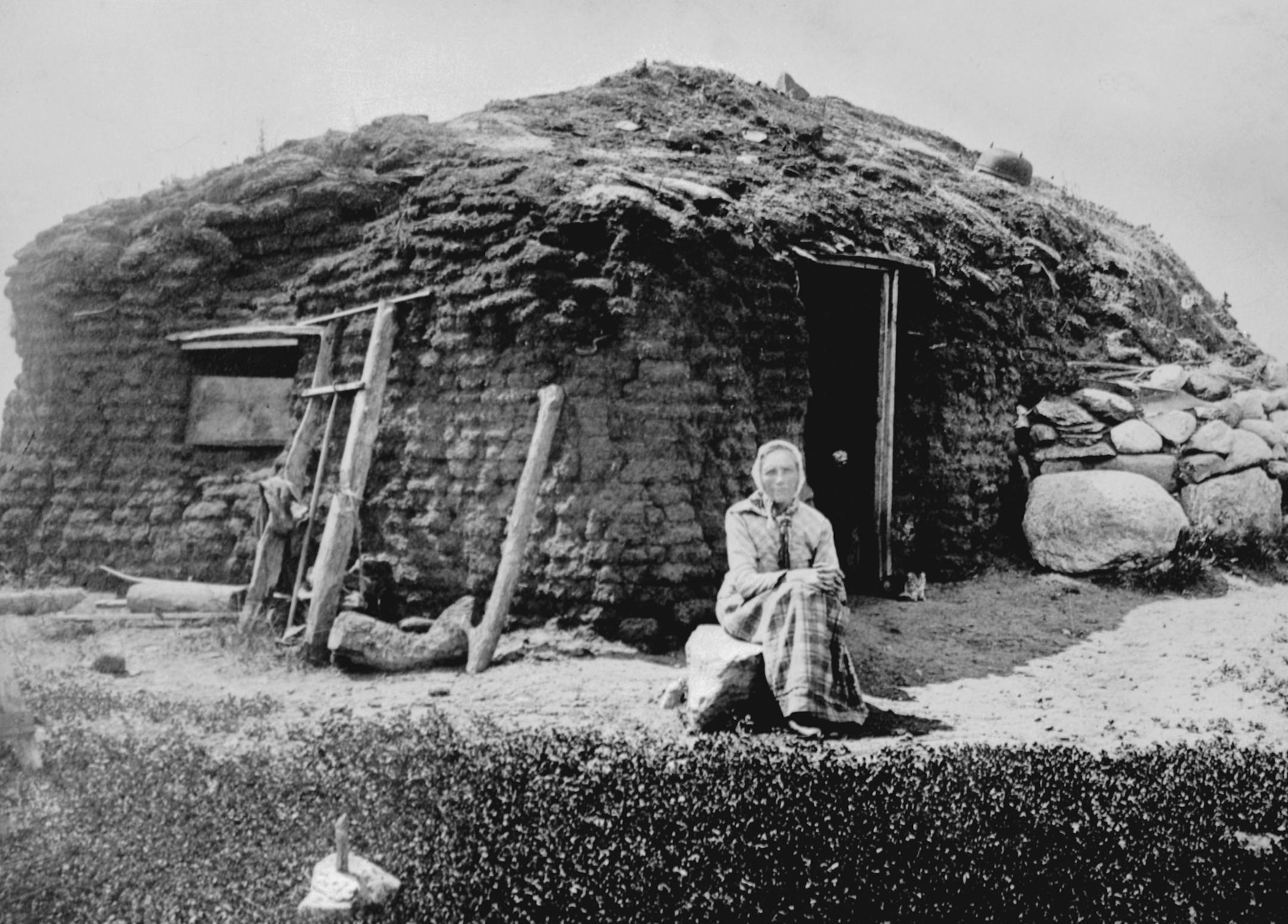
At 90, Carol Hagebak Olson is losing her eyesight. But one image remains clear in her memory: It hangs over the computer in the guest room of her apartment in the western Minnesota town of Madison, surrounded by other family pictures.
The photo shows Olson's great-great-grandmother, Beret Olsdatter Hagebak, stoically sitting on a rock in front of her sod shanty in Lac qui Parle County. An overturned kettle is perched on the roof; a cat, its ears frozen off, guards the door. A scarf covers Hagebak's own apparently big ears (more on that later).
"She had to be a very strong woman — emotionally and physically," Olson says. "And resilient."
Hagebak spent 31 of her 93 years in that soddy out on the prairie, 140 miles west of Minneapolis. Her photo has been widely published in books and newspapers, and copies are preserved at the Minnesota Historical Society and the Lac qui Parle History Center in Madison. Google her name and the image pops up.
"The picture of her sitting in front of the sod house has been reprinted many times, but I don't know if her story has been told," said Barb Redepenning, curator of the museum.
Thanks to a file at the museum, and exhaustive research by some of Hagebak's 250-plus living descendants around the world, it's possible to retell the story of the gritty woman behind the ubiquitous photograph.
A pipe-smoking midwife, rural doctor of sorts and pioneer postal clerk, Beret Olsdatter Svinaas was born Feb. 22, 1810, in Selbu, Norway. She adopted the name Beret Hagebak in the United States.
She didn't emigrate to the New World until she was 57, sailing with her husband, John Haldorson, four of their children and a couple of grandchildren to Quebec on the ship Neptunus before the overland trek to Brooklyn Center, Minn.


