2:03
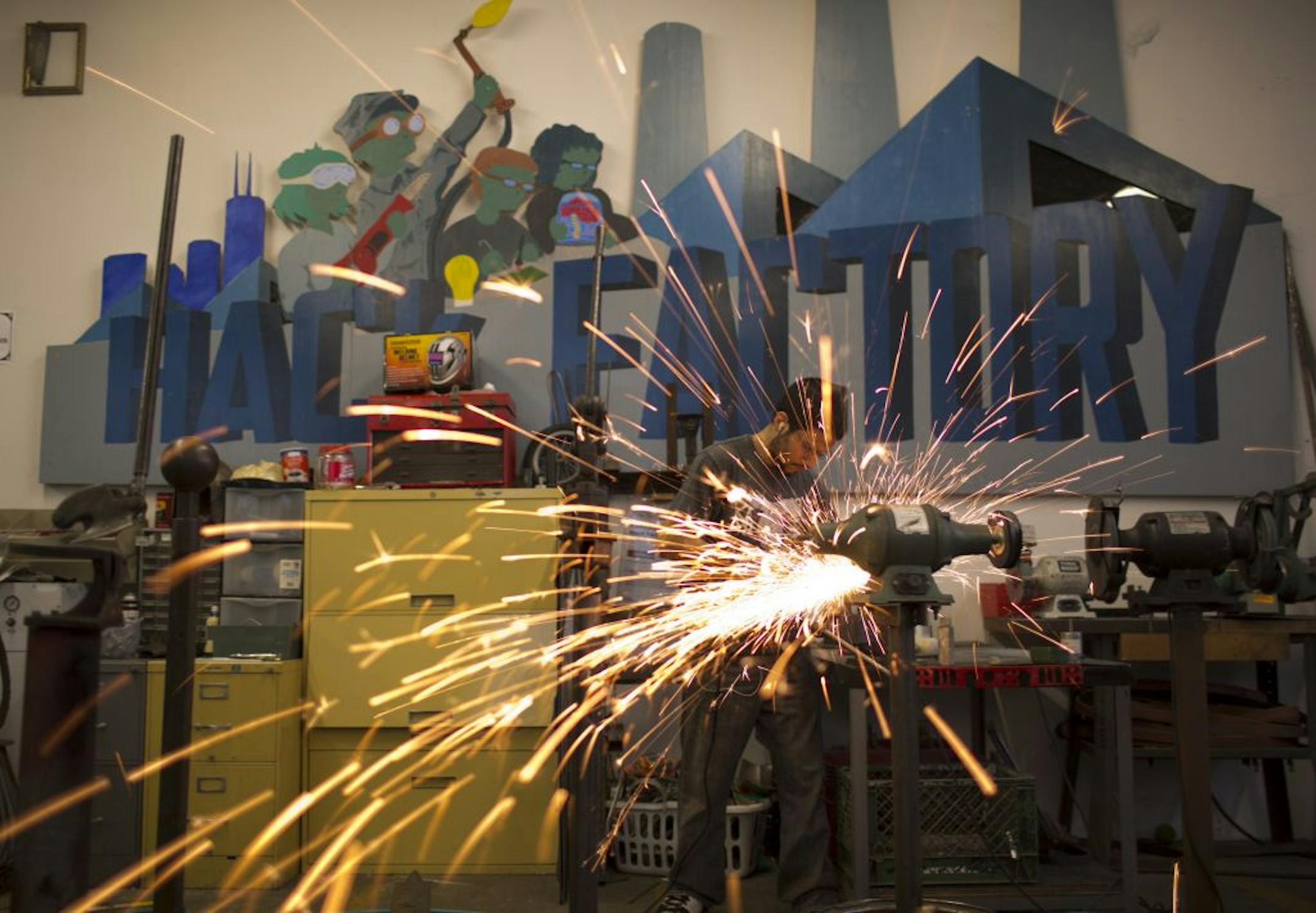
2:03Riley Harrison holds up his favorite bow. "It's got red oak on the belly and hickory on the back and the handle is layered of walnut and red oak," he said, barely audible over the grind -- saws splitting wood, hammers bouncing off anvils, drills pressing through metal sheets.
The bow Harrison holds is one he shaped with his own hands. The hours of work it took, however, to bend, smooth and laminate the wood were not spent in his garage or basement, but at the Hack Factory, a community workshop in Minneapolis' Seward neighborhood.
The Hack Factory is what's known as a "maker space." Operated by Twin Cities (TC) Maker, the Hack Factory is a community-shared workspace that offers a cornucopia of tools and machinery for members like Harrison to take their do-it-yourself urges to the extreme.
TC Maker is one of two such operations in the metro area. The Mill, in northeast Minneapolis, opened early this year.
The two organizations are part of a larger maker movement, a broad term that refers to individuals from varied creative and technological interests who are united by their insatiable desire to create -- anything.
"There is this drive among makers to always be kind of creating something," said Brian Boyle, president of the Mill, "making something better, tweaking it for their use. Whether it's a bit of computer code. Whether it's a footstool."
The movement is growing nationwide. The first Maker Faire in San Mateo, Calif., where people from around the country congregate to learn techniques and showcase their work, had an attendance of 22,000 in 2006. By 2011, attendance had reached nearly 100,000, according to Make Magazine, the quarterly publication that puts on the event.
People who make things have always been around, according to Michael Freiert, development coordinator for TC Maker. What's new is the creation of spaces where these wild minds are set free.