

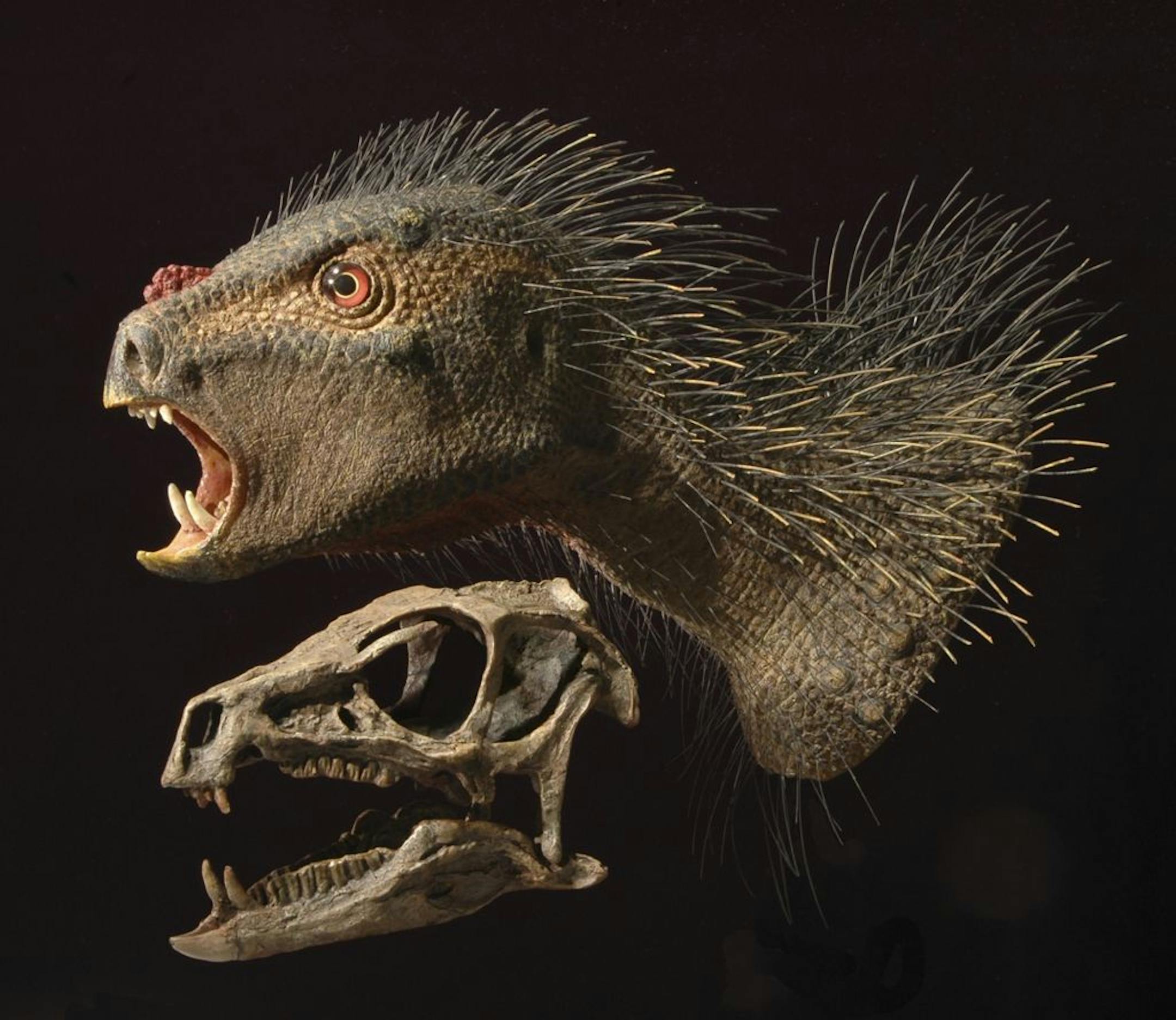
Not every dinosaur grew up to be a mighty predator like Tyrannosaurus rex or a hulking vegan like Apatosaurus. A few stayed small, and some of the smallest dinosaurs that ever lived -- tiny enough to nip at your heels -- were among the first to spread across the planet more than 200 million years ago.Fossils of these miniature, fanged plant-eaters known as heterodontosaurs, or "different toothed reptiles," have turned up as far apart as England and China. Now, in a discovery that has been at least 50 years in the making, a new and especially bizarre species of these dwarf herbivores has been identified in a slab of red rock that was collected in the early 1960s by scientists working in South Africa.
In a report published Wednesday in the online journal ZooKeys, Paul C. Sereno, a paleontologist at the University of Chicago and a dinosaur specialist, described the strange anatomy of the newfound member of the heterodontosaur family and gave the new species the name Pegomastax africanus, or "thick jaw from Africa."
He also apologized for not getting around sooner to this piece of research. When he first viewed the specimen at a Harvard laboratory, Sereno said, "My eyes popped, as it was clear this was a distinct species."
The creature in the lab drawers
Embedded in the rock were remains of a creature with a short parrotlike beak, 1-inch jaws, sharp teeth and a skull no less than 3 inches long. It was two-legged, had grasping hands "and was mostly tail and neck," Sereno said. The entire body was less than 2 feet in length and probably weighed a bit more than a typical house cat.
"I'm embarrassed to say how many years ago that was -- 1983," he said. "But I was an enterprising graduate student then at the American Museum of Natural History. All the while since then, I wondered if anyone else might spot the creature hiding among the lab drawers."
The fossils were eventually returned to the South African Museum in Cape Town, the true nature of the one slab still undiscovered, Sereno said. The main researcher responsible for collecting the fossils was Alfred Crompton, a Harvard professor now retired. Part of Sereno's research was supported by the National Geographic Society, where he also is an explorer-in-residence.
What big teeth you have


