

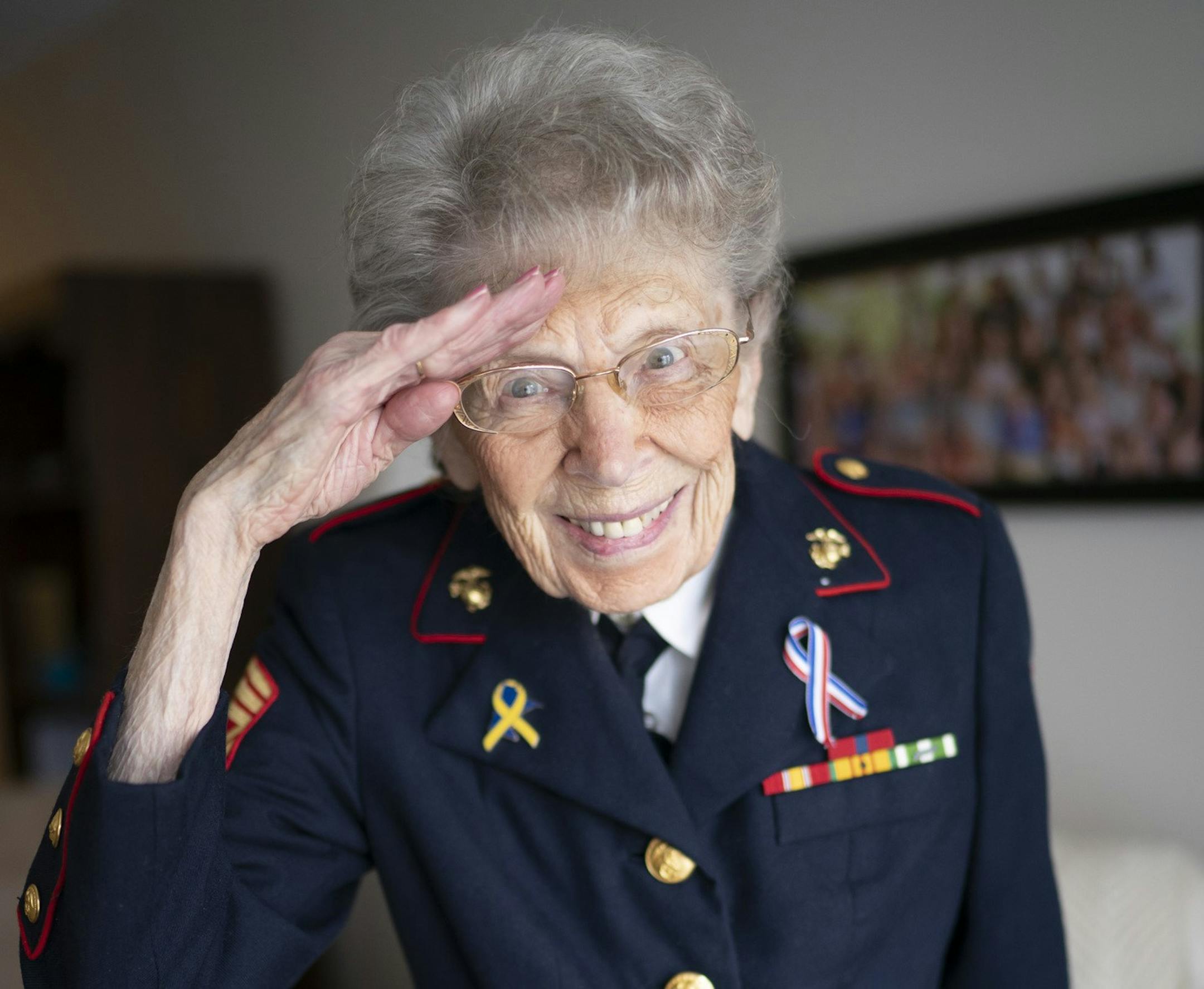
Buttoned up in dress blues, June Fremont was treated like a celebrity at the annual Marine Corps birthday ball near Washington, D.C., in 2017. The still-visible bruise on her right hand is proof of the hundreds of handshakes she received that night, many from young female Marines thanking her for her example and inspiration.
That same hand, Fremont will proudly tell you, shook Eleanor Roosevelt's in the 1940s. (If she thinks you're gullible, she might quickly add a line about not washing that hand a single time since).
"Because of my [military service], I have done so many things I never thought possible," Fremont said on a recent afternoon in her apartment at Woodbury Senior Living.
Fremont will turn 98 on Aug. 20, which isn't as unusual as it might seem. According to the Women Marines Association, nearly 60 of the organization's 3,000 members are age 98 or older, including a 102-year-old woman living in Hastings. Many of them, like Fremont, joined up during WWII, shortly after the United States Marine Corps authorized a Women's Reserve in 1943.
Spurred by an intense patriotism and desire to help her country during wartime, Fremont (then June Schwark) enlisted in the Marine Corp that year. She was 21 and living in Chicago.
"I picked it because it was the hardest for a woman to get into," she said.
By the end of the war in 1945, more than 18,000 female Marines had served, including 820 officers. The women served in noncombat roles and worked primarily in clerical positions. In 1950, however — two years after women were made a permanent part of the regular Marine Corps through the Women's Armed Services Integration Act — the Marine Corps Women's Reserve was mobilized for the Korean War.
The military "taught me to be persistent … And I became much more aware of the world," Fremont said.


