
Mayor, council clash over Rochester’s plans for sports complex

The City Council’s decision to move forward with an outdoor sports complex has drawn the ire of DFL lawmakers.

The Minnesota Star Tribune
December 23, 2025 at 4:57PM
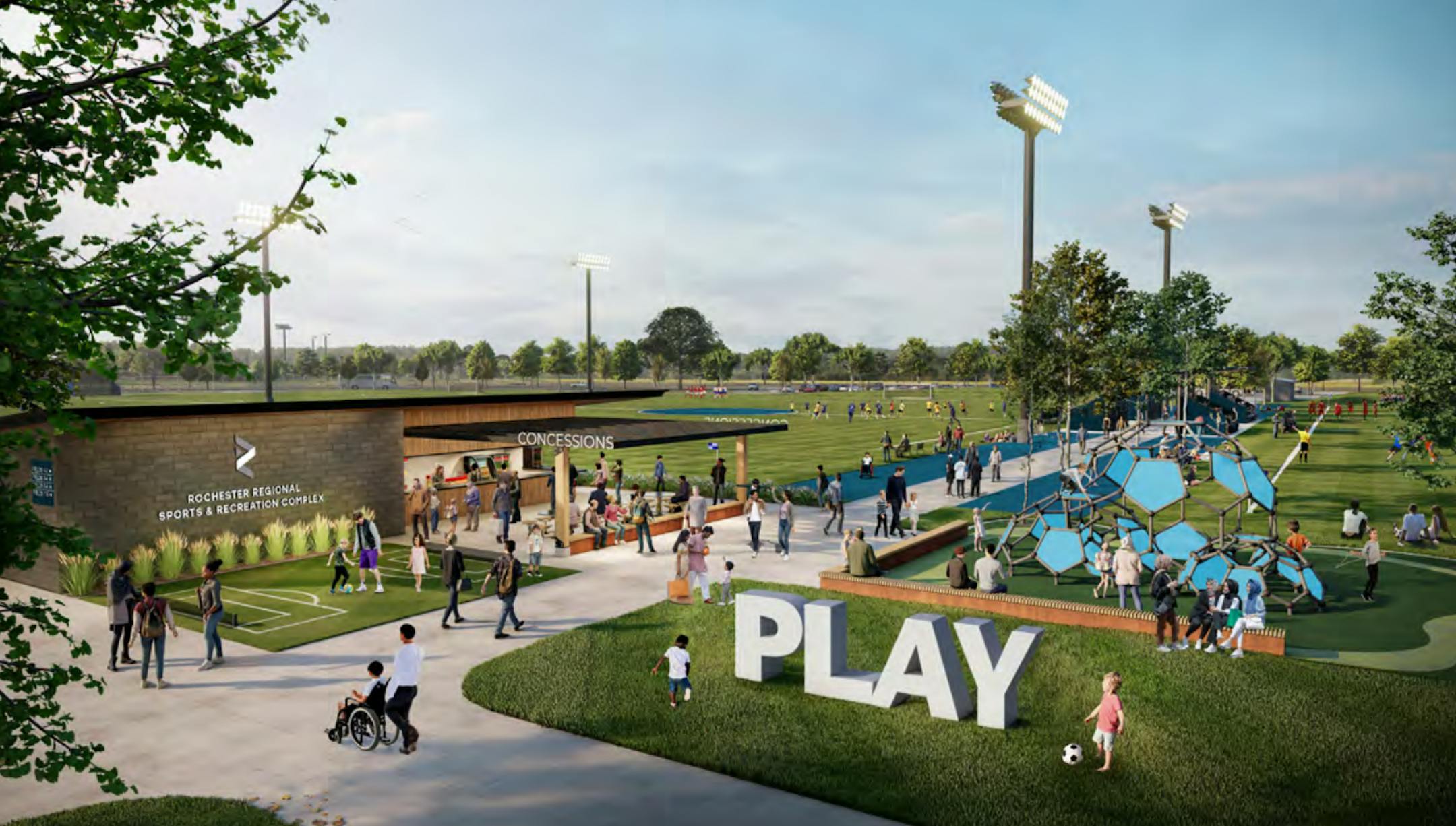
Renderings released by the city of Rochester in 2023 show the potential for both outdoor and indoor facilities in a new regional sports complex. For now, the city is focusing on outdoor fields only.

ROCHESTER – The city is moving ahead with plans to build a big outdoor sports complex, overriding mayoral vetoes on the project and ignoring state legislators’ warnings that they will try to kill funding for it.

The Rochester City Council voted Dec. 22 to continue with plans to hire an operator and use more than $52 million in local sales tax funding to build the complex of high-end ball fields that officials hope will draw tourism to the area through tournaments.

Mayor Kim Norton had issued two vetoes on the project, which was originally designed to include both indoor and outdoor components but was scaled back after officials learned that projected costs had jumped from $65 million to $120 million.

The council and city staff are now aiming to add an indoor recreation center later using grants and state bonding money.

Voters and some officials criticized the new plan, saying it is not what the community approved in a 2023 sales tax referendum extension.

“I have been very clear all along that there wasn’t enough community engagement done and that what we told people we were going to do is not what it looks like we’re doing at this point,” Norton said in an interview before the council override votes.

It all came on the heels of state lawmakers vowing on Dec. 18 to revoke Rochester’s sales tax authorization for the project because the outdoor complex wasn’t what local officials brought before the community or the Legislature.

The plan now is to build eight artificial-turf baseball/softball diamonds, two rectangular fields and 12 pickleball courts on a 160-acre plot on farmland southeast of town.

Rochester resident Wyatt Ryan, who told the council he had voted in local elections for nearly 12 years, said he supported the referendum specifically because the indoor center could replace the YMCA that closed in 2020.

“Because the indoor facility is not included, my vote for yes is no longer reflected in this motion,” Ryan said.

Other residents said the proposed outdoor complex doesn’t serve community needs for pickleball, basketball, volleyball and other indoor activities.

Sports boosters and members of Rochester’s Chamber of Commerce urged the council to move forward with the outdoor complex, arguing the project would draw more youth tournaments.

Emma Esteb, an engagement director at the chamber, said the complex aligns with Rochester’s economic development goals.

“An asset like this enhances the region’s quality of life,” she said.

City officials and local boosters have considered building a sports complex since the Rochester YMCA closed in 2020, just before the COVID-19 pandemic hit.

The city hired consulting firm ISG, which after 15 community meetings came back with a $65 million proposal based on an indoor/outdoor recreation center built in Bettendorf, Iowa.

To extend the city’s sales tax, officials had to do two things: secure approval from the Legislature and get voters to approve it via a referendum.

State lawmakers historically haven’t considered sales tax money for a project like a sports complex unless it benefits the region.

Former Council Member Ed Hruska, who presented the project to the Legislature as part of his work with the Rochester Sports Foundation, said the city’s proposal was clear that the complex was meant for regional tournaments with opportunities for community use at other times.

Yet the city also highlighted indoor activities as part of its pitch to lawmakers and voters.

After discovering the cost discrepancies, which they blame on the consultant, the city recommended splitting the project into two phases, with an outdoor complex built first to help draw in tournaments and regional use while the city sought funding for the indoor portion.

Norton tried to veto the referendum before it was brought to voters in 2023, arguing the complex should be split off from other major infrastructure needs as the city hadn’t made much progress planning it out. She said in a recent interview she hasn’t seen enough from the city to change her mind.

Norton said she felt this was her “last chance” to speak for the community on the project.

City officials are negotiating with Rochester Community and Technical College in hopes of leasing part of its indoor center.

Council President Randy Schubring, who is working with Norton on the college agreement and was elected after the referendum passed, said he believed Rochester officials set unrealistic expectations for voters.

“It was a mistake,” Schubring said. “It needs to be righted.”

Schubring was one of five members to override Norton’s veto, however. He argued the city is trying to make the best of the situation and called for more community input.

DFL lawmakers from the area, Reps. Kim Hicks, Tina Liebling and Andy Smith, along with Sen. Liz Boldon, said in a statement before the council meeting that they planned to introduce a bill to revoke the city’s sales tax authorization for the project if officials voted to continue with their plans for just an outdoor complex. Hicks said after the meeting that the bill is ready to go.

Rochester’s “current plan does not align with the legislative intent that was shared with us, nor what community members voted for,” Hicks said.

about the writer

about the writer

Trey Mewes

Rochester reporter

Trey Mewes is a reporter based in Rochester for the Star Tribune. Sign up to receive the Rochester Now newsletter.

See Moreicon

More from Rochester

See More
card image

The City Council’s decision to move forward with an outdoor sports complex has drawn the ire of DFL lawmakers.

card image
card image