

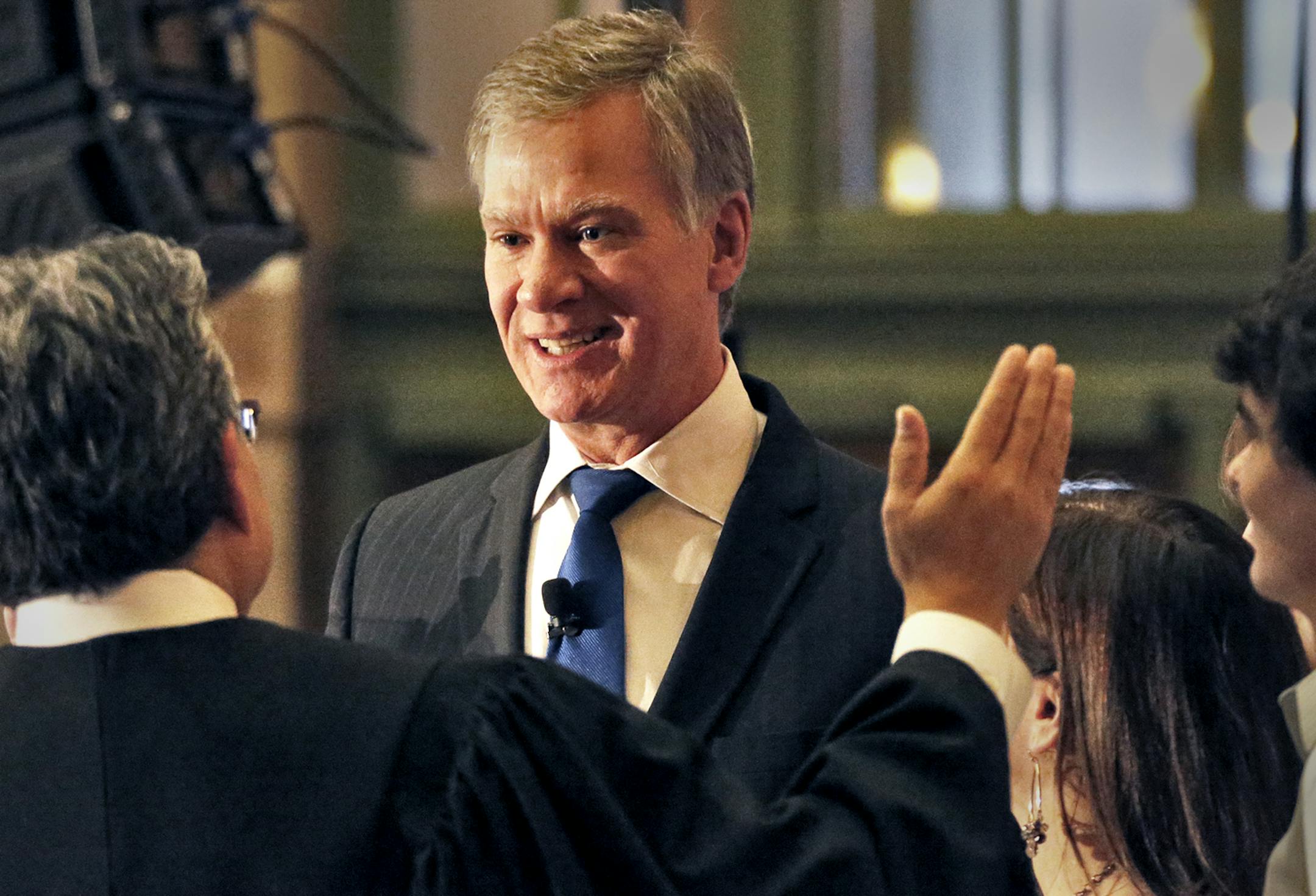
Chris Coleman on Friday dedicated his third term as St. Paul mayor to closing the achievement gap between white and minority students, saying that goal "will be the true measure by which my administration and our city will be judged."
Coleman focused on education in his inaugural address after taking the oath of office for a third time before a large crowd at the Union Depot. The glittering setting provided by the grand downtown train station, recently refurbished by Ramsey County, was symbolic of the strides that Coleman said the city has made in transit and infrastructure in his eight years as mayor.
Among those attending the event were Minneapolis Mayor Betsy Hodges and her predecessor, R.T. Rybak, as well as former St. Paul Mayor George Latimer, and city leaders from the business, educational and nonprofit spheres.
Coleman, 52, who won re-election in November with 78 percent of the vote, was sworn in by Hennepin County District Judge Daniel Moreno as his wife, Connie, and children Molly and Aidan looked on. He begins his new term while also serving as president of the National League of Cities, making him one of the nation's most influential urban advocates.
In his 19-minute address, Coleman spoke about the need for public investments such as the light-rail transit service that begins this summer along University Avenue to downtown St. Paul, saying that such amenities draw private money and that they are necessary to build cities attractive to young talented workers.
He heralded the end of St. Paul's traditional rivalry with Minneapolis, committed the city to environmentally sound practices and pointed to the annual Red Bull Crashed Ice competition — to be held again next month on the hill below the Cathedral of St. Paul — as proof of a city "willing to take chances and test limits."
But Coleman focused most of the speech on education as he has throughout his time in office, despite the fact that the St. Paul mayor has no direct authority over schools.
He said St. Paul continued to struggle with the challenge, "as old as the country itself," of ensuring equality of opportunity for all citizens regardless of race or color.


