
Advertisement

Mayo's airborne blood bank celebrates 30 years

One man's dramatic story of survival might have ended differently without the rescue service.

October 12, 2014 at 12:35AM
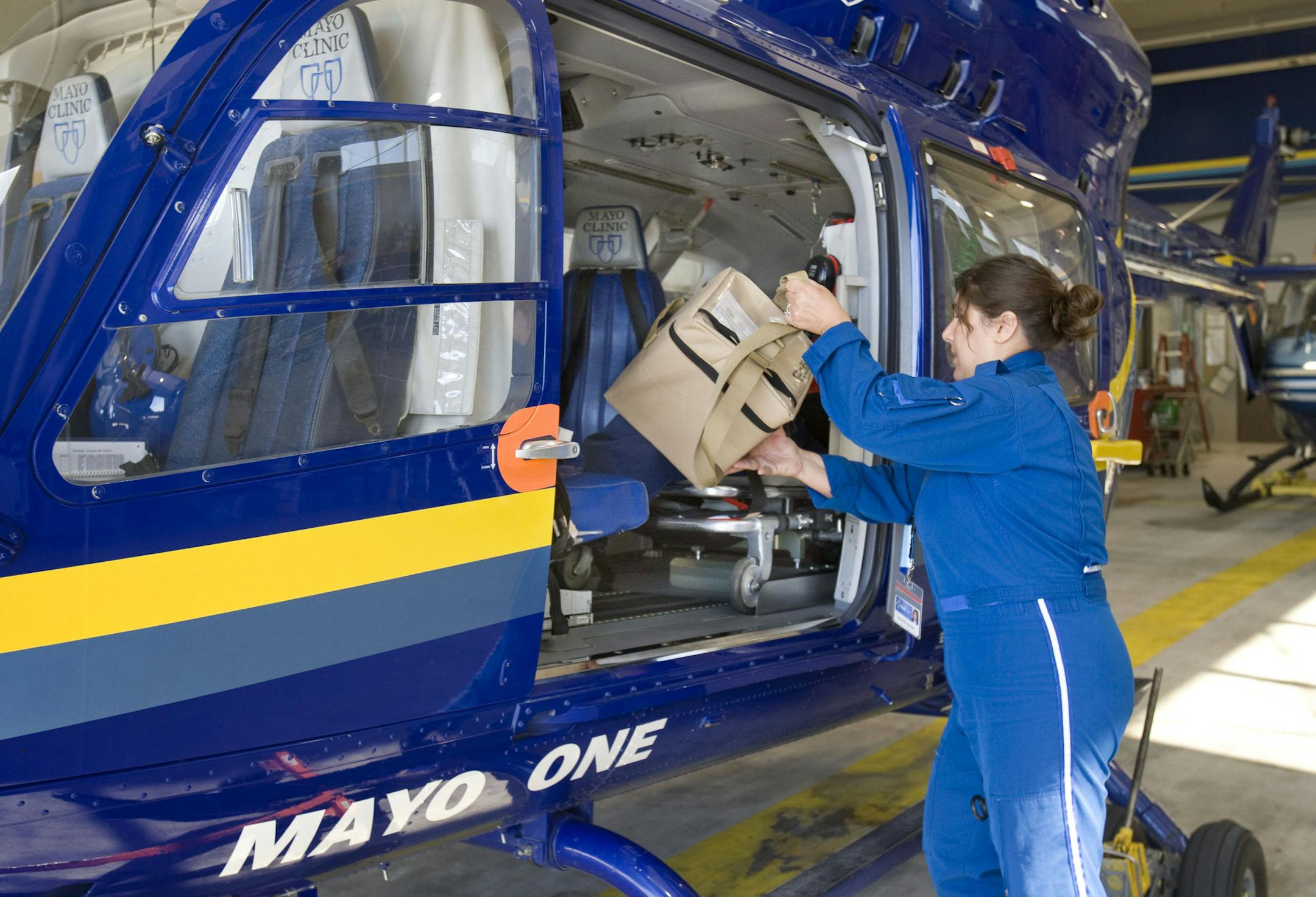
ADVANCE FOR USE SATURDAY, OCT. 11 - In this photo taken on July 22, 2014, Mayo One paramedic Jessica Fite loads a refrigerated supply of plasma and blood onto the Mayo One helicopter in Rochester, Minn. The temperature-controlled blood is brought along on every run. Mayo flew it's first patient by helicopter 30 years ago. (AP Photo/The Rochester Post-Bulletin, Jerry Olson)
Mayo One paramedic Jessica Fite loaded a refrigerated supply of plasma and blood onto the helicopter in Rochester, Minn. (The Minnesota Star Tribune)
Advertisement

ROCHESTER, Minn. – On May 20, 2012, Nels Gunderson hung in the balance between life and death.

His survival depended on access to first responders, rapid medical stabilization and an airborne blood bank carried by the Mayo One medical helicopter.

It also depended on the helicopter conveying him quickly from his back yard in Osseo, Wis., to the Mayo Clinic Hospital, Saint Marys Campus, about 90 miles away, where a surgical team was working on him less than two hours after his son dialed 911.

Thirty years ago this month, Mayo One flew its first patient. To celebrate its anniversary, the airborne service offered a glimpse inside the flying hospital.

Split-second mistake

While working in his back yard in Osseo, Wis., Gunderson knew he should have protected himself by shutting down the industrial equipment he was using. He's been the local fire chief for 30 years and has seen more than his fair share of trauma cases.

Even so, Gunderson made the mistake that trips up so many farmers and rural homeowners. He skipped a safety step — and paid dearly for that split-second decision.

"I was planting sweet corn with a commercial rototiller, walked up to the rototiller to repair a pin that was acting up, without shutting it off, which I should have known better," he said.

"The rototiller decided to jump up — was on the back of a small diesel tractor — and landed on the end of my work boot. And before we could get it shut off, it cut my leg off three times; sucked me into the rototiller."
Advertisement

His son, who was nearby, dove to shut down the power.

"I'm laying on the ground with my leg off — cut off about 4 inches below my knee — and he's grabbing his phone to dial," Gunderson said in a recent interview. He was bleeding profusely, and whether he lived or died depended on each next step going just right.

Coordinated response

The saving grace, Gunderson said, was a "textbook" coordinated response by rural Osseo first responders, including his son's initial actions, and evacuation by Mayo One.

Gunderson's brother is the local EMS director and was for many years a flight paramedic for Mayo Clinic. He arrived shortly after the incident.

The local ambulance service had discontinued the use of tourniquets but began using them again about two months before the accident, owing largely to tourniquet lessons learned by the U.S. military in Iraq and Afghanistan.

"If you don't have a blood supply, nothing else matters," Gunderson said. "So we put tourniquets back into the system and I was the first patient to see the benefit of that. So when my first first-responder showed up, they had a tourniquet, applied that and controlled the bleeding."

Advertisement

The Mayo One medical helicopter, coming out of nearby Eau Claire, Wis., landed in his back yard minutes later.

"They were going in the air before we even dispatched them, because they heard the call," Gunderson said. "Fortunately for me, they had whole blood on the helicopter. I think I took about 7½ pints of blood in the process of getting over to Mayo and getting into surgery."

Back home in five days

Mayo One increasingly acts as a mobile blood bank, carrying both temperature-controlled blood and platelets, which help the blood clot.

Gunderson received both, and they helped save his life.

"I came out of the hospital on the fifth day after the accident because everything went so well," he said. Today, he uses a prosthesis.

He had told the surgeon that he'd like to be able to return to work, to continue serving as fire chief and to continue activities such as hunting, fishing and snowmobiling.

Advertisement

"Are there challenges? Yes. Did it change my life? Absolutely. But the reality is, if you decide you're not gonna let it get you down, you can usually stay ahead of it pretty well," he said.

"There are times it frustrates you. But you just have to deal with that. It's like everything else in life."

Since his injury, Gunderson has participated in all three of the activities he told the surgeon about before he was taken to surgery — thanks in large part to the airborne Mayo blood bank.

"I'm living proof of how important that is," he said. "Because, without it, I may or may not have been here."

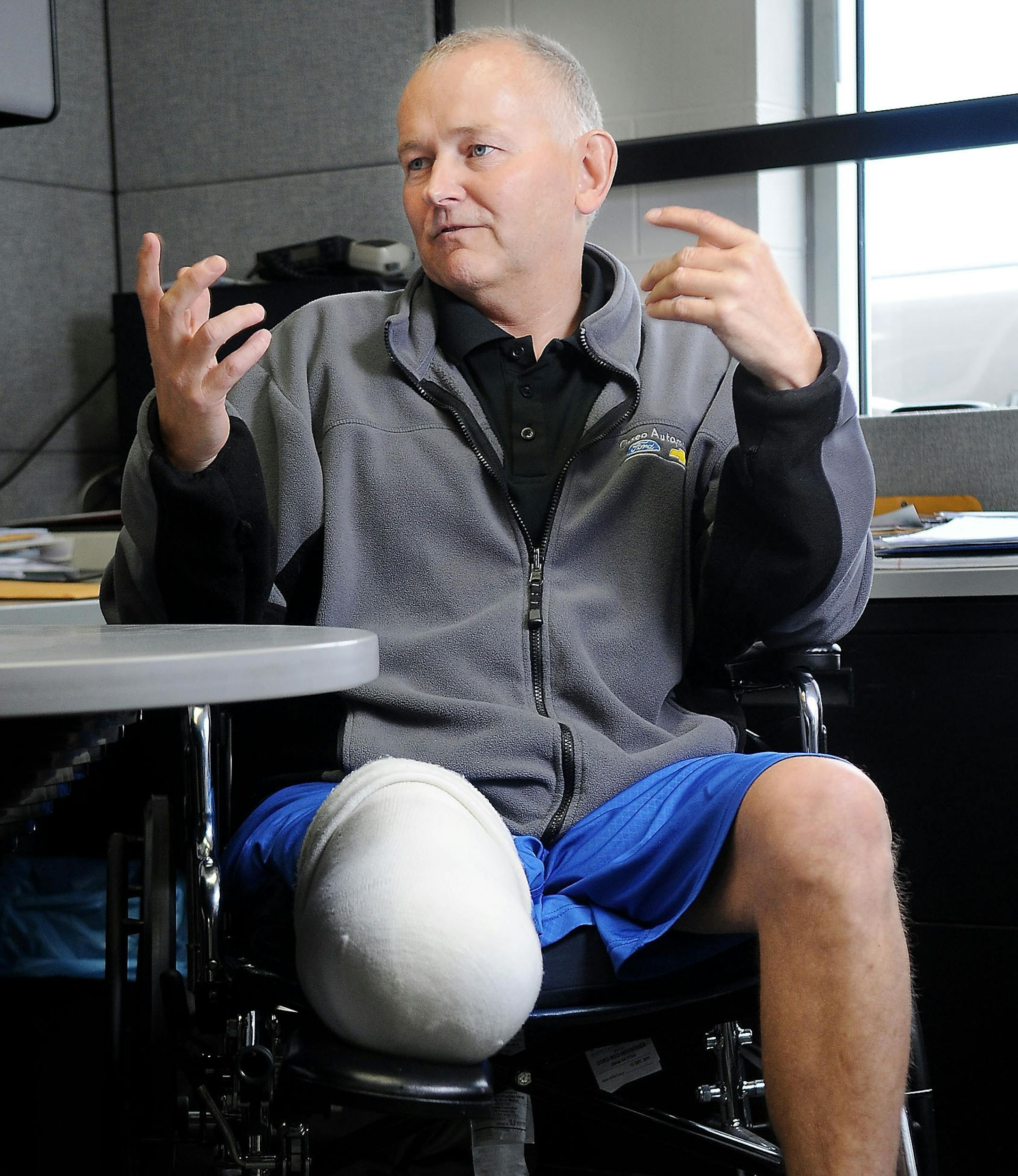
CORRECTS SOURCE - ADVANCE FOR USE SATURDAY, OCT. 11 - In this photo taken on June 14, 2012, Nels Gunderson of Osseo, Wisc. speaks about the tiling accident in which he lost his leg. Gunderson credits his life to the quick response of a Mayo One medical helicopter out of Eau Claire, Wisc. Mayo flew it's first patient by helicopter 30 years ago. (AP Photo/The Rochester Post-Bulletin, Dan Reiland)
Mayo One helped save Nels Gunderson’s life after a 2012 tilling accident severed the leg of the Osseo, Wis., man. (The Minnesota Star Tribune)
about the writer

about the writer

JEFF HANSEL, Post-Bulletin

Advertisement