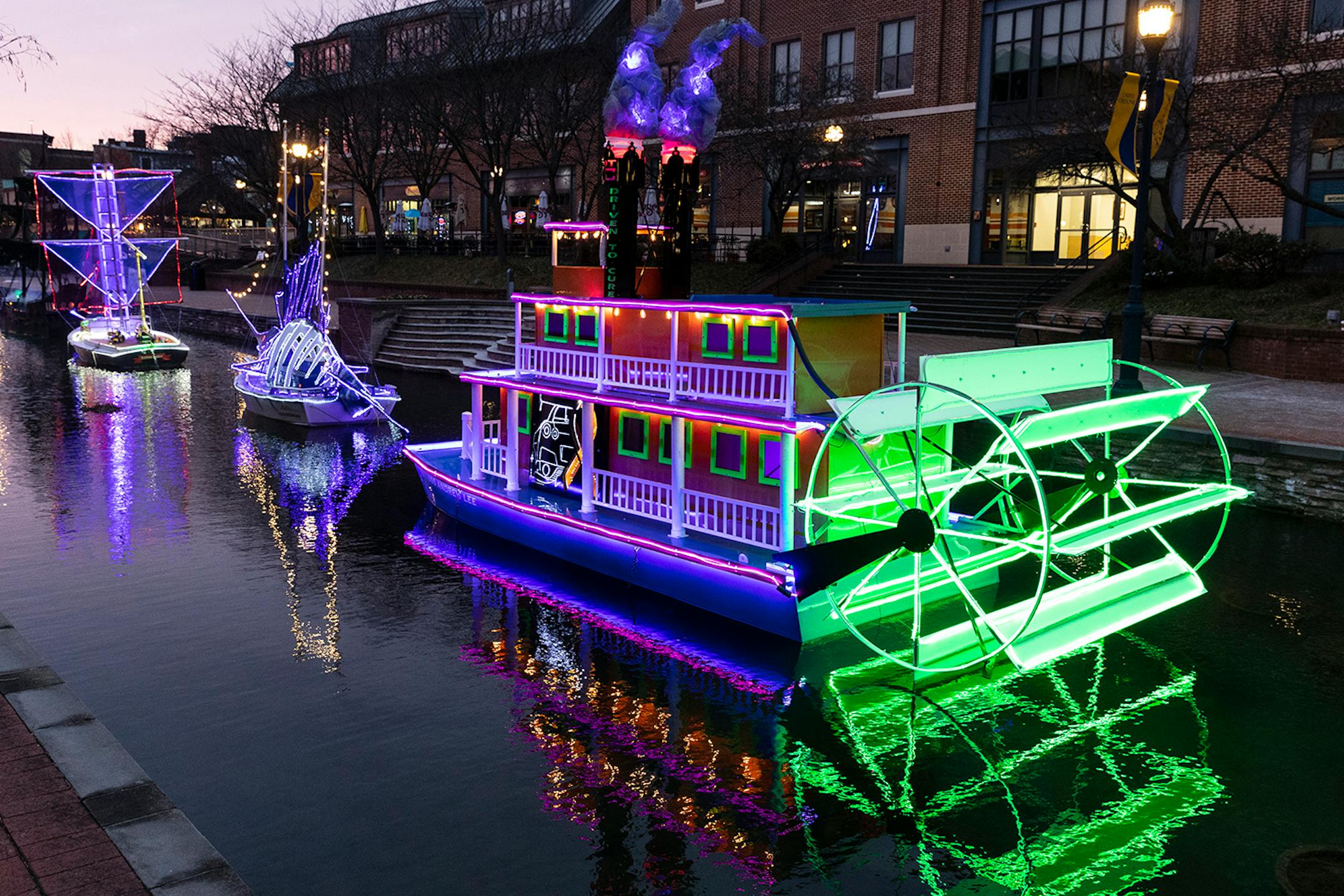
Prone to flooding, Carroll Creek flows through Frederick, Md., on its way to the Monocacy River, which empties into the Potomac River. A major storm 50 years ago left the streets of the historic city several feet underwater. When it happened again just four years later, officials began to search for a solution.
An early proposal centered around an open cement trough cutting through town. It would have solved the flooding problem but would also have left an unsightly scar across a city dominated by early 19th-century Federal and Greek Revival architecture, primarily rendered in brick. The plan that was ultimately adopted was much more ambitious: moving stormwater underground through two pairs of concrete conduits more than a mile long, each of them big enough to drive a bus through. Combined, the conduits can hold up to 5.7 million cubic feet of water. Levees, floodwalls and four pumping stations are also part of the system.
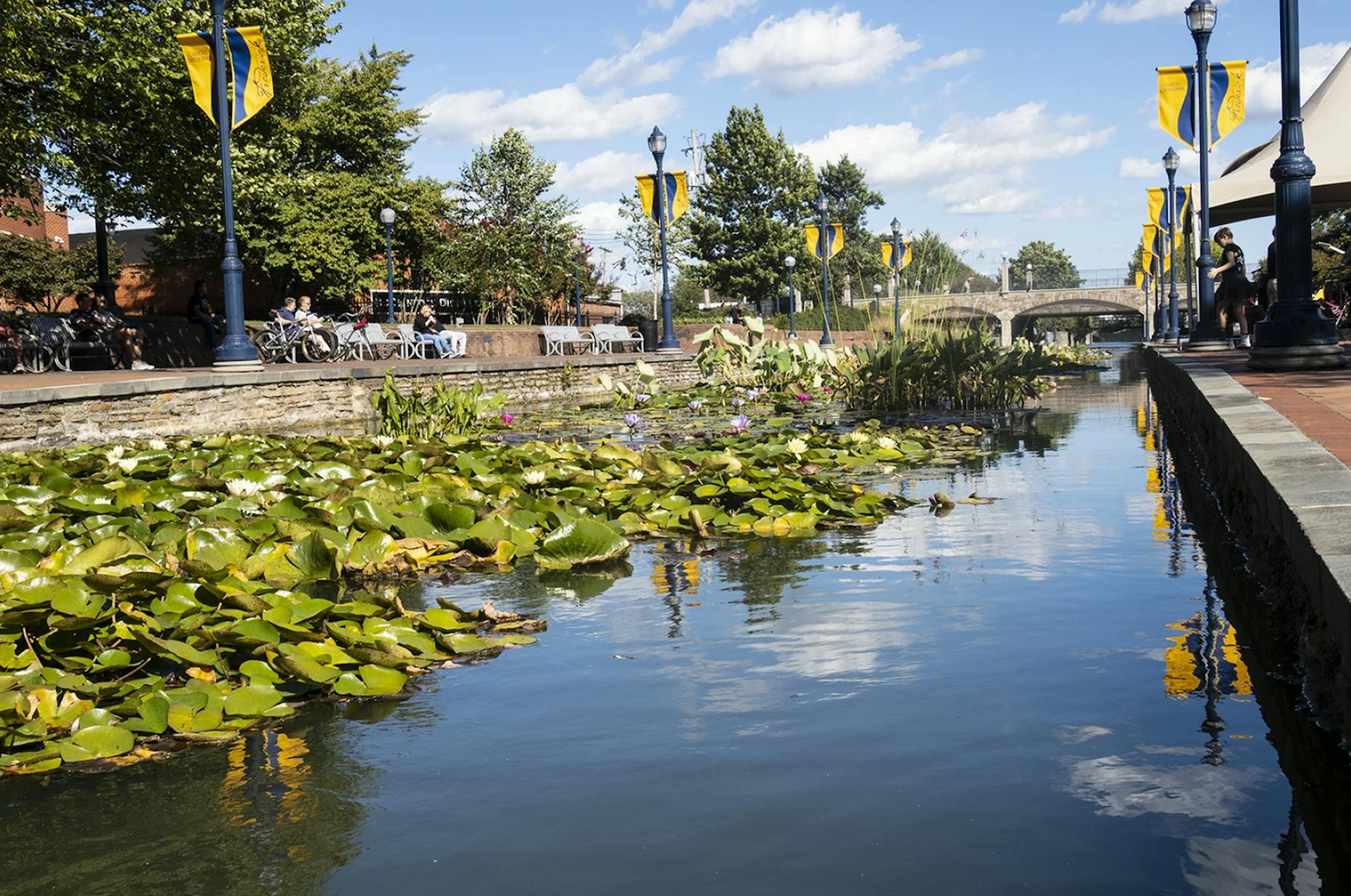
Nestled above and between the pairs of conduits, a shallow, 40-foot-wide canal serves as the new version of Carroll Creek, which is flanked by wide brick pathways, landscaping, fountains, several pedestrian bridges and a 350-seat amphitheater. Costing $60 million, construction on the flood control project commenced in 1985 and took eight years to complete. The $15 million linear park that sits atop the underground conduits wasn't dedicated until the summer of 2006, 28 years since its conception in the 1970s.
With flooding no longer a threat, more than 400 buildings in the area were declared free from the floodplain, spurring millions of dollars in private investment. What was once a moribund industrial area has been transformed into office, retail, residential and community gathering space as well as a major tourist attraction, with Carroll Creek Linear Park as its centerpiece. But for all the time and money expended on the public works project, it took the efforts of an army of volunteers to make the park and its surroundings the success that it is.
While water moved as intended beneath the new park's wide sidewalks, the decorative canal above presented an unforeseen problem. The low flow rate, shallow depth and abundance of nutrients from upstream runoff resulted in a creek filled with algae blooms and a foul smell. The problem persisted for years, in spite of the city's many attempts to clear the water.
Dr. Peter Kremers, a member of the local Men's Garden Club, has been an avid water gardener for some time, building a garden pond beside his home. "I kept reading in the paper about all the issues here with the algae," he says. "I thought, why don't we just turn this into a water garden?"
He approached the city in 2012 with his idea of a floating canopy of plants that would block the sunlight that algae needs to grow. Once Kremers was given permission to proceed, he and his friend Lisa Collins placed 20 pots of aquatic plants in the creek as an experiment.
"They had spent $300,000 on all sorts of nonsense to try and mitigate the algae growth and hadn't been successful," Kremers explains. "I don't think they really thought [my idea] would work. But at least we were trying something."