
Souhan: Local skateboard artist Mark Rivard becomes big deal in golf world

The Brooklyn Park native is gaining international notoriety by painting some of the most famous golf holes in the world.

Columnist Icon
The Minnesota Star Tribune
February 8, 2026 at 8:00PM
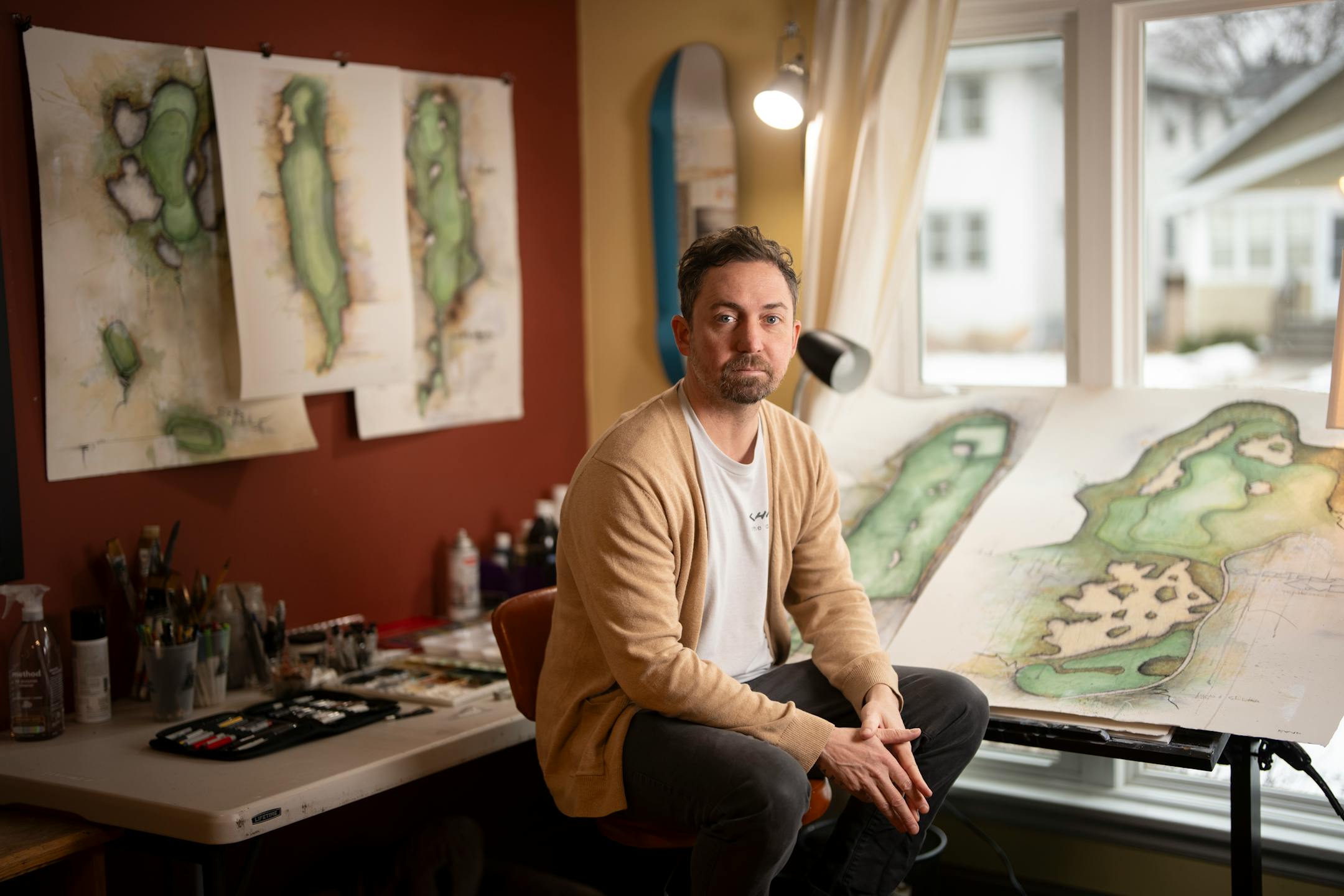
Mark Rivard started as a skateboard artist and evolved to producing high-end artwork of famous golf courses all over the world. He is photographed in his home studio in Minneapolis, Minn., on Friday, January 16, 2026. ] RENEE JONES SCHNEIDER • renee.jones@startribune.com (Renée Jones Schneider)

Mark Rivard bent over his workstation by the front window of his compact home in South Minneapolis. His rescue dog, Wilson, curled in a bed at his feet.

As Rivard painted a famous golf hole, the former underemployed skateboarder and ski bum tracked a batch of his suddenly-expensive artwork on a plane to New Zealand.

These are heady times for Rivard, who’s proved that good can come from living in your mom’s basement without the internet.

Rivard is a partner in, and the artist behind, Charcoal Golf, which produces artwork based on some of the top holes and courses in the world. He’s also worked as a public speaker who helps students relate to art (as part of Do Rad Things), and traveled the world speaking at Air Force bases.

Rivard grew up in Brooklyn Park and skateboarded around Minneapolis just about every summer night of his youth. He attended Champlin Park High School. “I was not a great student,” he said. “I figured if I failed math but got an A in drawing, I could get out of school with a 2.1 GPA. So I did.”

He would ski for his high school team in the winter, and became a fixture at Pinewski’s Ski Shop in Anoka. After he and his buddies moved to Breckenridge, Colo., Rivard would ski, and extreme ski, 150 days a year.

In 2003, he suffered a major knee injury and had to come back to Minnesota to get surgery under his insurance plan. He found himself sedentary, bored and reliant on prescription drugs.

“When I talked to adults on Air Force bases, this gets to suicide-prevention stuff,” Rivard said. “I was in that basement for about a year, and there is a dark side to it. You don’t have an outlet. I didn’t even have the internet, an email address or Netflix.”

ADVERTISEMENT

What he did have in that basement was a stack of old skateboards and his high school art supplies. “That was pretty serendipitous,” he said.

He picked up a Sharpie marker, grabbed the first skateboard he ever owned and drew the Minneapolis skyline. Pinewski’s hung it in the store, on sale for $100. “That was a light-bulb moment,” Rivard said. “I was broke, so $100 was a big deal.”

Rivard went back to Colorado to work for Palmer Snowboards, but quit after he realized his job confined him to a cubicle. He headed back to Breckenridge, which was the subject of his next skateboard art.

This one went up behind the bar where Rivard worked in Breckenridge, and soon tourists were asking about it. “That’s when I started putting two and two together,” he said. “There’s a lot of power in art, because you’re storytelling. And as a bartender, I learned how to tell my story in a way that was inspiring and interesting. I was making sympathy tips left and right.”

Rivard found an investor and began selling his skateboards all over town. Media outlets began telling his story, and he worked for a local TV station. That’s when his aunt, who worked for a business-supply company, mentioned her talented nephew to her Sharpie representative.

“I get a call one day from a woman named Susan Wassel, who was the marketing director at Sharpie,” Rivard said.

Soon, Rivard was part of Sharpie’s promotional team, the “Sharpie Squad,” a group of 100 artists worldwide.

In 2011, the company began a campaign entitled, “It starts with Sharpie,” featuring four worldwide spokespeople. Rivard was one of them.

Sharpie gave him notoriety and some money, and the company loved it when he began using his art as a way of communicating with students.

He told Sharpie that he wanted to make sure every teacher he dealt with would never need to spend a dollar on markers. Soon, a Sharpie truck was pulling up outside of his business and unloading 12 pallets of the markers. He had 750,000 markers to share.

So how did a guerrilla-marketing skateboard artist get to a point where a golf course in New Zealand was commissioning his work?

Some of Rivard’s income disappeared during COVID because he couldn’t visit schools. He’s taken other financial hits because of tariffs and reductions in federal grants to schools. “One day I woke up and all of my bookings were gone,” he said.

Golf had become his sport of choice because it didn’t further damage his frequently-fractured body, and because he loved the beauty of golf courses. In February 2025, he painted a golf hole for the first time. He chose the 17th hole at Edinburgh, his home course.

He posted the painting on social media, and was deluged with requests.

One of his childhood friends, Patrick Jacobson, works for a golf publication. Another, Russ Olson, is a “master printer” who owned his own print shop.

“Pat had ordered a painting of the sixth at White Bear Yacht Club,” Rivard said. “We’re talking one night and he said, `This is a business.’ He was right. We have a dream team.”

Rivard painted a hole for a member at Prairie Dunes, an elite course in Kansas. The course called him, asking why he was profiting by painting a hole on their course. Rivard explained the work was commissioned, and asked if they wanted more.

They hired Rivard, and the more golf courses Rivard painted, the more demand grew. “When you lock down Prairie Dunes as a partner, you’ve made a splash in the golf world,” Rivard said.

He’s been contacted by six of the top 100 courses in the world and is currently working on 15 paintings, including a few famous ones he can’t announce yet. Golden Valley Country Club was one of the first Minnesota courses to hire Charcoal Golf.

“This has been a wild ride,” Rivard said. “Somehow, the three of us rolled into something special.”

about the writer

about the writer

Jim Souhan

Columnist

Jim Souhan is a sports columnist for the Minnesota Star Tribune. He has worked at the paper since 1990, previously covering the Twins and Vikings.

See Moreicon

More from Sports

See More
card image
Carlos Gonzalez/The Minnesota Star Tribune

The Wolves didn’t appear engaged at either end of the floor and lost for the third time in four games.

card image
card image