

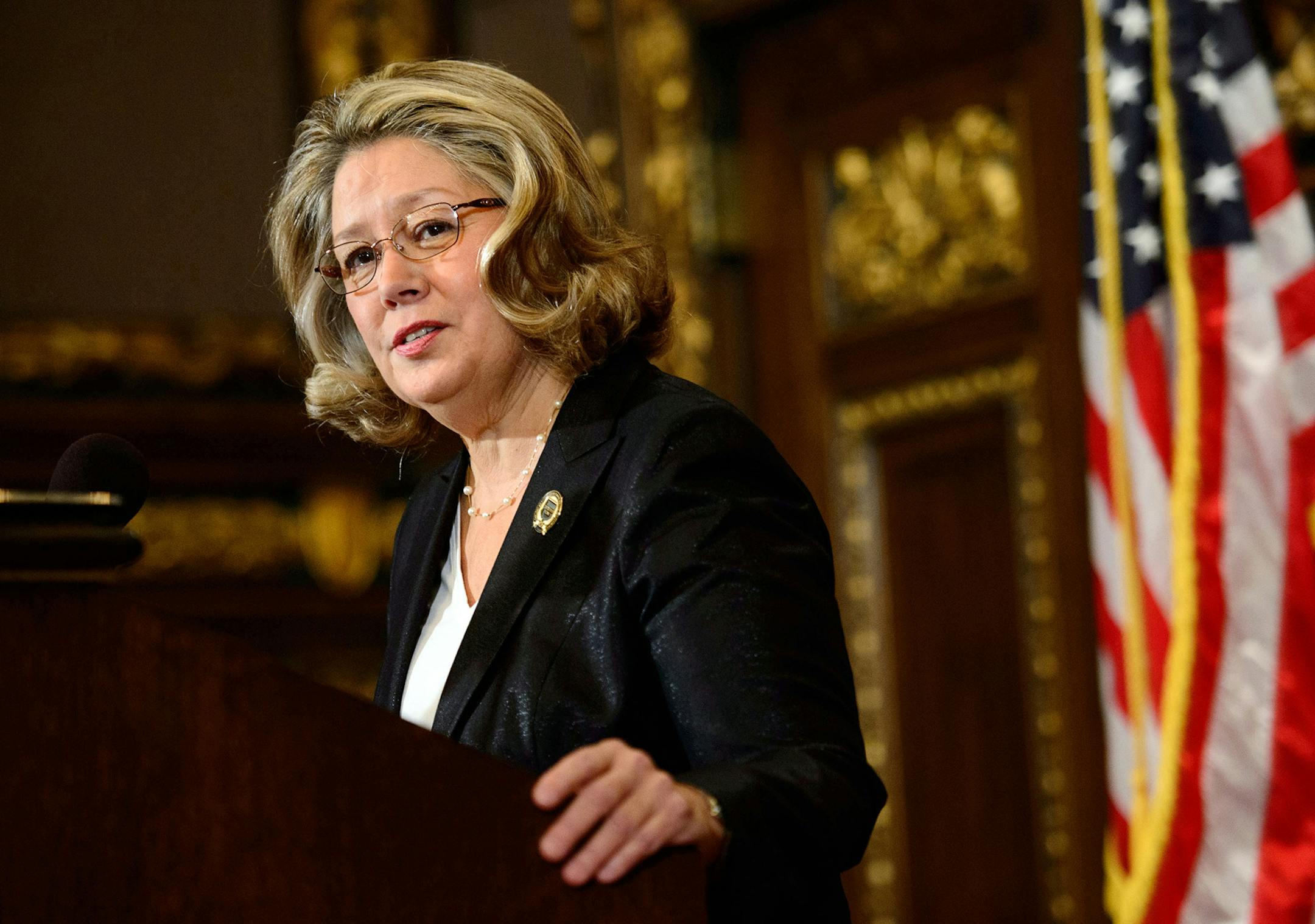
As she announced Tuesday that she would not seek a second term, Lt. Gov. Yvonne Prettner Solon took pains not to fault Gov. Mark Dayton, her political partner for the past three years. She praised him as caring and committed to serving Minnesotans.
But Prettner Solon's disappointment at not playing a more significant role in the Dayton administration couldn't be entirely contained. "I think I expected to be more involved in certain policy initiatives," she said, then quickly added, "and I found a way to do that" through various activities of her own choosing.
Indeed, Prettner Solon deserves Minnesota's thanks as she plans to end a 25-year career in public service at the end of this calendar year. As lieutenant governor, she has been an advocate for seniors, veterans, the disabled and Greater Minnesota. She led planning efforts to improve Capitol security, housing options for the disabled and government services for seniors. She also has led a number of health care and energy policy exchanges to Germany, organized by the Center for German and European Studies at the University of Minnesota.
A former state senator and City Council member from Duluth, Prettner Solon has kept regular office hours in Duluth and occasionally in other Greater Minnesota cities. She continued some of the policy work on human services she had started as a state senator, succeeding her late husband, Sen. Sam Solon, in 2002.
But her work as lieutenant governor has not been widely visible. It's been hampered by the structure, funding and history of the $78,197-a-year position. It has no budget independent of the governor's office. Resources including staff are allotted to "the office of the governor and the lieutenant governor."
Governors and lieutenant governors ran separately for the first 116 years of Minnesota's statehood. During that era, lieutenant governors served as presiding officers in the state Senate. When the office was tied to the governor's on the ballot and its Senate duties were stripped away in the mid-1970s, it lost influence, becoming an often underutilized appendage of the governor's office. It has no constitutional or statutory job description, other than to be prepared to succeed the governor should he or she resign or die in office.
Others who have held the office in the modern era have similarly chafed at its limitations. One was briefly a chief of staff; one was a commissioner of transportation. Neither of those roles was a good fit for someone chosen primarily as a political asset. Capitol gossips tend to attribute lieutenant gubernatorial discontent to personality clashes between the governor and the lieutenant governor. But the pattern of frustration — administration after administration — points to a structural problem with the office itself.
State Rep. Phyllis Kahn is among several legislators through the years who have backed a constitutional change abolishing the office. Five of the 50 states function without the position.


