

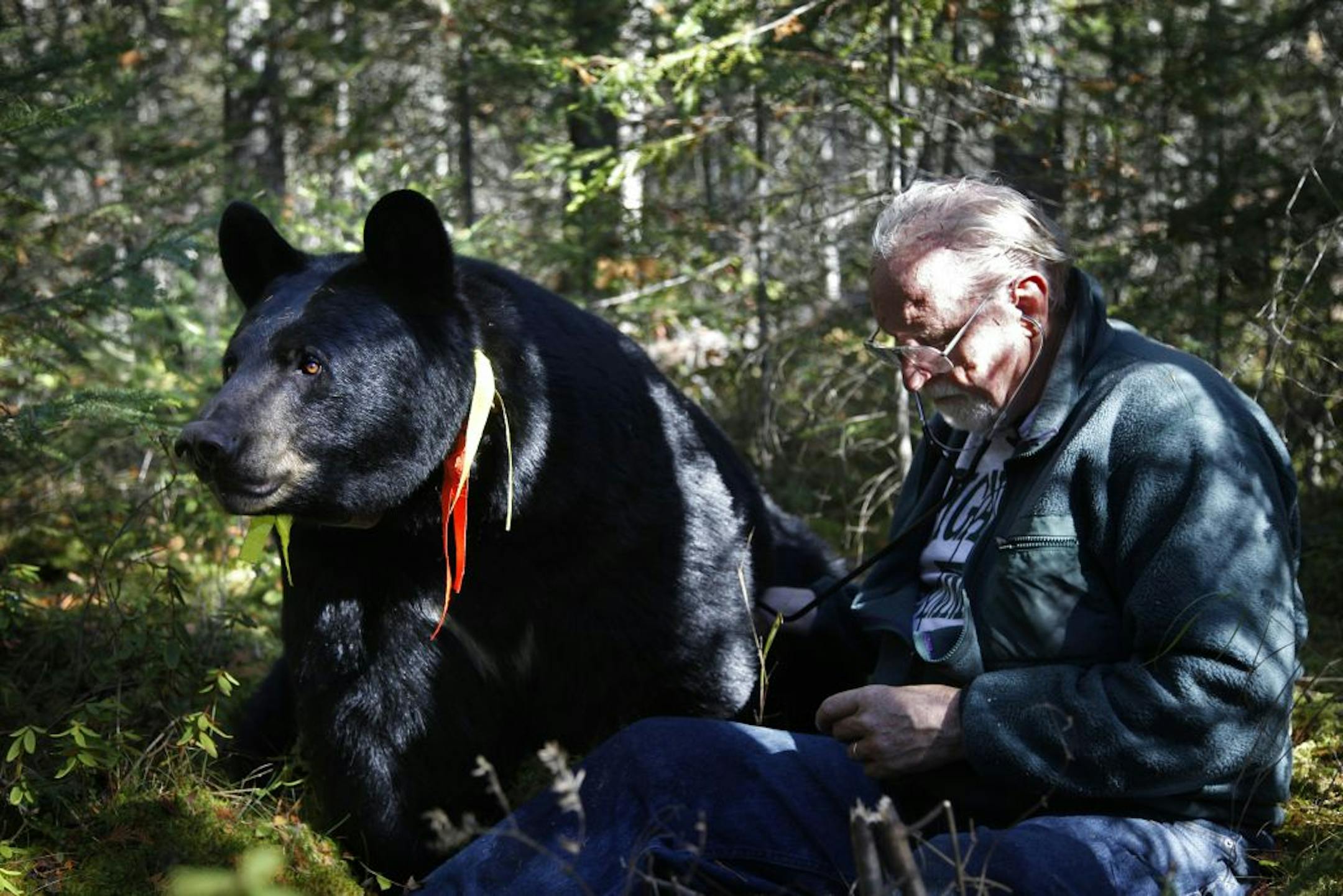
Longtime bear researcher Lynn Rogers can resume his Internet video den cameras, but he cannot use radio collars to track the wild animals, the Minnesota Court of Appeals ruled Monday.
"I'm thrilled that the court recognized the value of my research and ruled I can place the den cameras for science research," Rogers said. "But we could do a much better job with radio collars to find particular bears. We will do the best that we can."
Last year, the Department of Natural Resources affirmed its earlier decision to deny a permit to Rogers, who gained fame by putting radio collars on North American black bears in northern Minnesota. The DNR decision came after an administrative law judge said the DNR had the authority to refuse to renew Rogers' permit.
For 14 years, Rogers had hand-fed wild black bears in order to collar them with satellite tracking devices.
He would post live Internet video feeds from their dens. He drew a global audience and more than 140,000 Facebook followers, who got to know bears such as Lily and Hope through Rogers' live feeds. The cameras have been highly praised by scientists and teachers.
But on Monday, the Court of Appeals ruled that radio collaring of bears meets the statutory definition of "constructive possession," which requires a permit. Rogers' lawyer David Marshall said he is considering whether to reapply for a permit or appeal to the Supreme Court.
DNR spokesman Chris Niskanen said it's very unlikely the agency would issue a permit to Rogers because of continuing public safety concerns. "We are very satisfied with the court's decision," Niskanen said. "The decision was really about whether a permit is required to collar a bear. We believe we are the agency that's responsible for permitting wildlife research. Anyone interested in it needs to come to us."
The Court of Appeals ruled that Rogers needs no permit to use den cameras. Rogers plans to resume the broadcasts this winter. He has research information, including GPS coordinates, regarding the location of bear dens, which he will use for camera placement. State law does not allow a person to disturb the burrow or den of a wild animal between November 1 and April 1. If Rogers needed to adjust a den camera during that time, he would need a DNR permit. The agency would have to see his proposal before it would consider it, but Niskanen again said it is doubtful they would issue such a permit.
![BRIAN PETERSON • brianp@startribune.com ELY, MN - 10/04/2010 ] After a long search through a dense spruce bog, Lynn Rogers, founder and Executive Director of the North American Bear Center in Ely, was able to approach Brave Heart, one of the collared black bears in his study. Brave Heart who weighs 400 pounds allowed Rogers to change the batteries in the bears GPS collar and record it's heart rate without the use of a tranquilizer. ORG XMIT: MIN2013062817435597](https://arc.stimg.co/startribunemedia/RUFI2SYCDUKTI2J7JE2ZI52FUA.jpg?&w=1080)


