

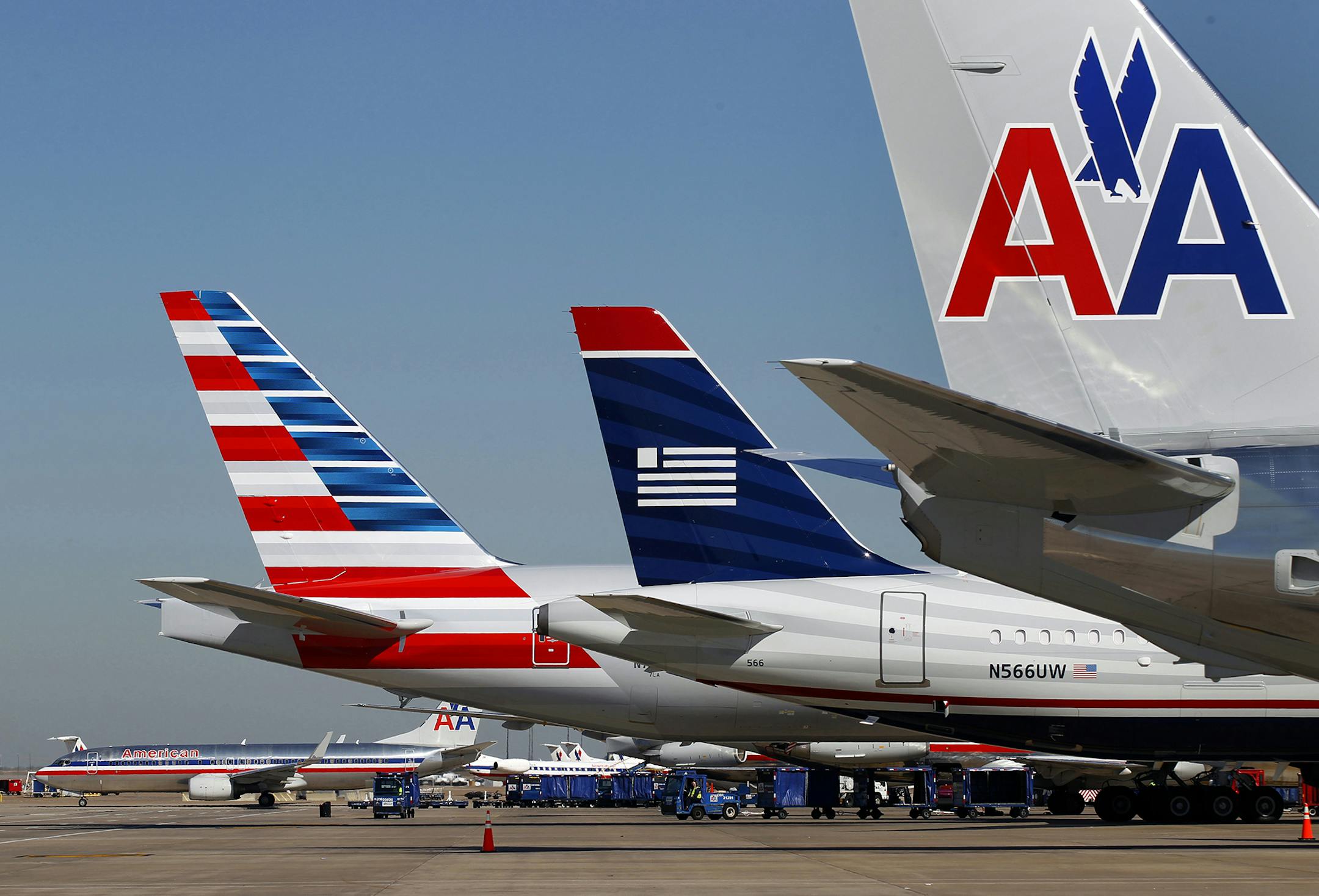
Next month, the largest airline in the world will be American. Literally — the merger between the parent companies of American Airlines and US Airways to create "the new American" will consolidate two major international travel networks. Instead of four big legacy carriers in the United States, there will be three. Justice Department regulators announced Tuesday that they are OK with that, as long as the companies comply with a settlement they hammered out over several months.
Everyone seems to be happy, for conflicting reasons.
"This agreement has the potential to shift the landscape of the airline industry," Attorney General Eric Holder declared Tuesday.
The settlement "doesn't change the competitive dynamic," a company executive shot back.
The merger represents the final phase in an industry consolidation. Delta and Northwest merged, then United and Continental. When American and US Airways arrived late to the consolidation gate, the government balked. That arguably wasn't fair to the companies, which wanted a web of connections that can match those of the now-huge Delta and United, instead of having to surrender potential profits to those behemoths. They also wanted to streamline their combined operations, which would save money.
Yet, the government argued in August, US Airways has been a plucky competitor, disrupting the pricing schemes of the larger legacy carriers. Merged with American, it wouldn't play the same role. Passengers might pay too high a price if the consolidation continued.
The key to the settlement was bringing JetBlue, Southwest, Spirit and other lower-cost carriers into the equation. Requiring the merged American to surrender coveted slots at seven major airports, such as New York LaGuardia, Los Angeles International and Chicago O'Hare, will introduce a measure of competition on high-demand routes, offsetting — or more than offsetting, in regulators' view — the anticompetitive effects of having fewer big players in an already concentrated industry.
Some fares are still likely to rise as the industry completes this phase in its quest for stability. But some could be suppressed. At least passengers will have a few more names to choose from in some of the nation's largest airports. That could well be a better result than taking the matter to trial would have yielded.


