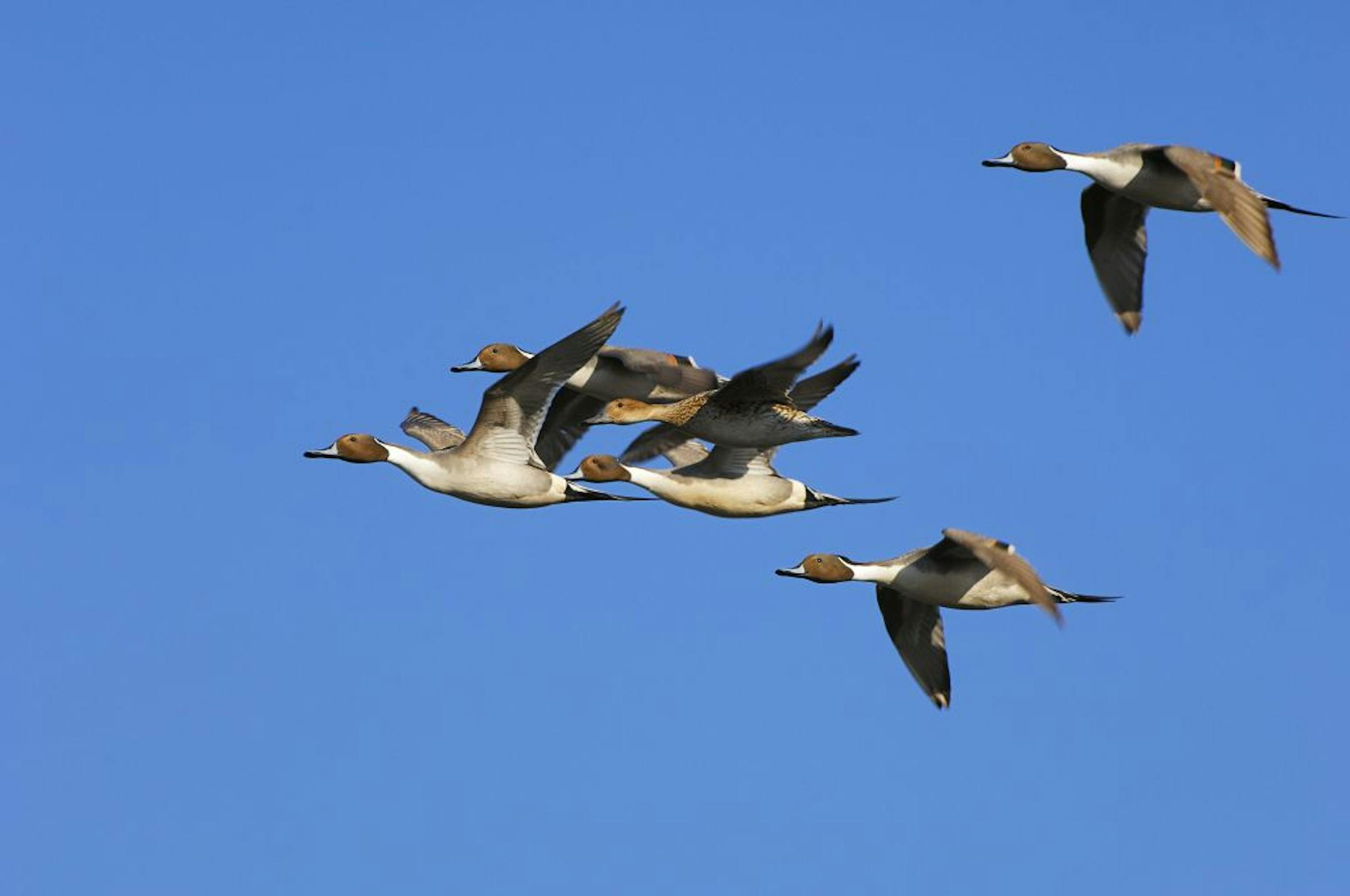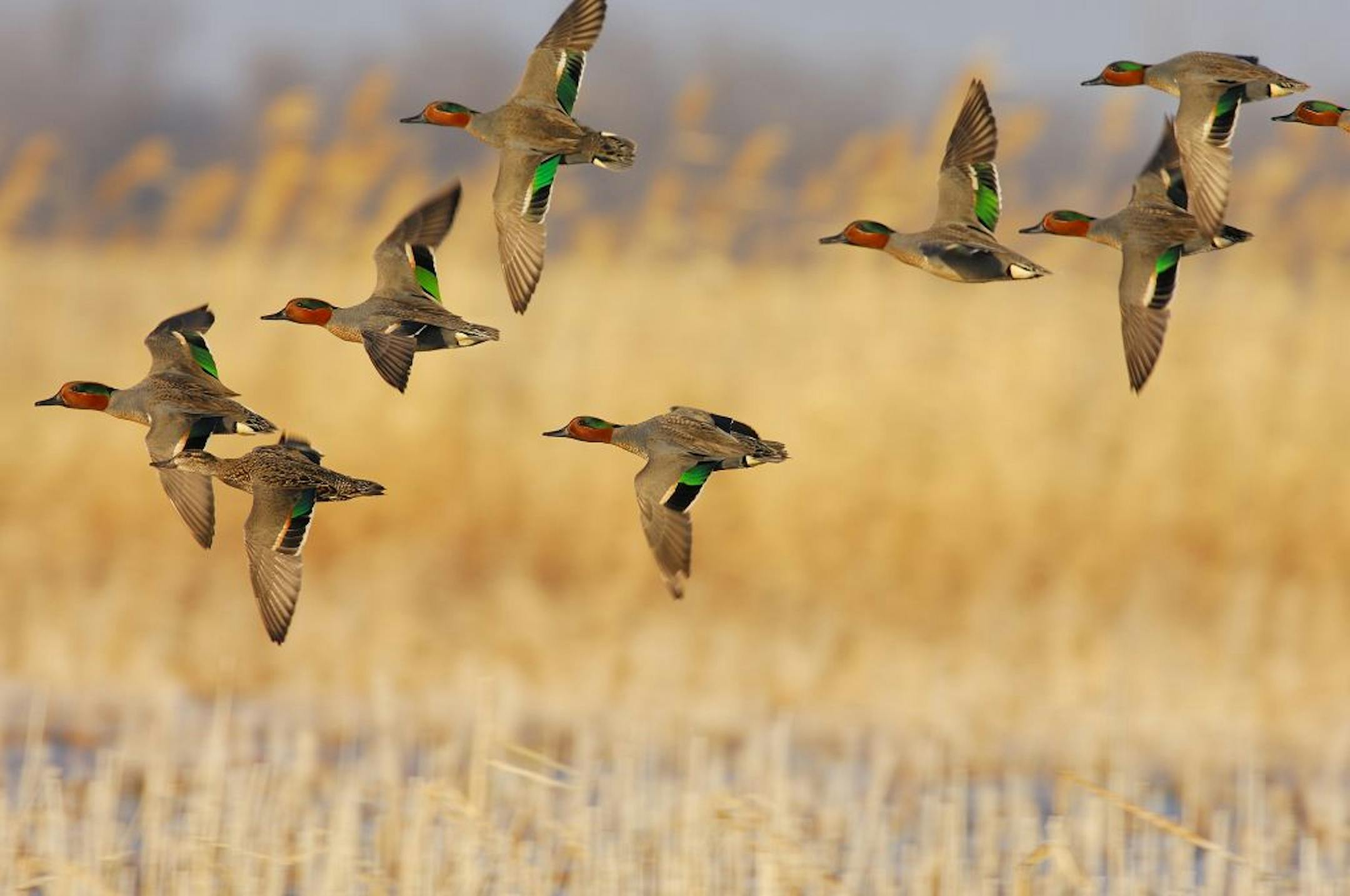
Springtime offers some of the best waterfowl viewing of the year. The males are dressed in their colorful breeding plumage, flashing iridescent greens, purples and blues. Often the ducks are absorbed in courtship activities, which makes them less wary and more visible. A portion of this breeding ritual involves what are called courtship flights. The photos on this page depict courtship flights of several species of ducks. During a courtship flight male ducks -- numbering from a few up to as many as 25 -- will chase a single hen while in flight. Each drake does its best to woo the unpaired hen.
Most species of ducks engage in courtship flights to some degree, but the puddle ducks, especially mallards, pintails, wigeon, gadwalls and green-winged teal are much more acrobatic during courtship flights than the diving duck species such as scaup, redheads and canvasbacks.
The champions of courtship flights are pintails.
The agility and elegance these swift fliers demonstrate while courting are amazing. In unison, an entire flock will dive and dart, sometimes nearly stopping in midair, only to change direction suddenly before continuing swiftly on. The males, with their extended center tail feathers trailing behind, are continually whistling and grunting while doing their best to stay close to the hen as the flock meanders aimlessly above a marsh. The event is both an audio and visual delight.
In general, pintails tend to stay low during their courtship flights. So do the teal species and most diving ducks. Wigeons and gadwalls are inclined to perform their aerial displays at mid -levels, while mallard courtship flights often occur high in the sky.
Just why ducks engage in courtship flights is not fully understood. Perhaps it is a method for the hen to test the stamina of several potential suitors. Some biologists claim the drake that stays nearest the hen during a courtship flight is the one that wins her favors. That theory might be true since I've noticed that the more mature, fully plumed and most colorful drakes seem to occupy locations closest to the hen during courtship flights while the lesser males are often positioned at the edge of the flock or to the rear.
In the book "Ecology and Management of Breeding Waterfowl," several renowned waterfowl biologists mention the difficulty in assessing the function or functions of courtship flights.
Whatever the reason, waterfowl courtship flights are always a highlight of any springtime birding venture.