

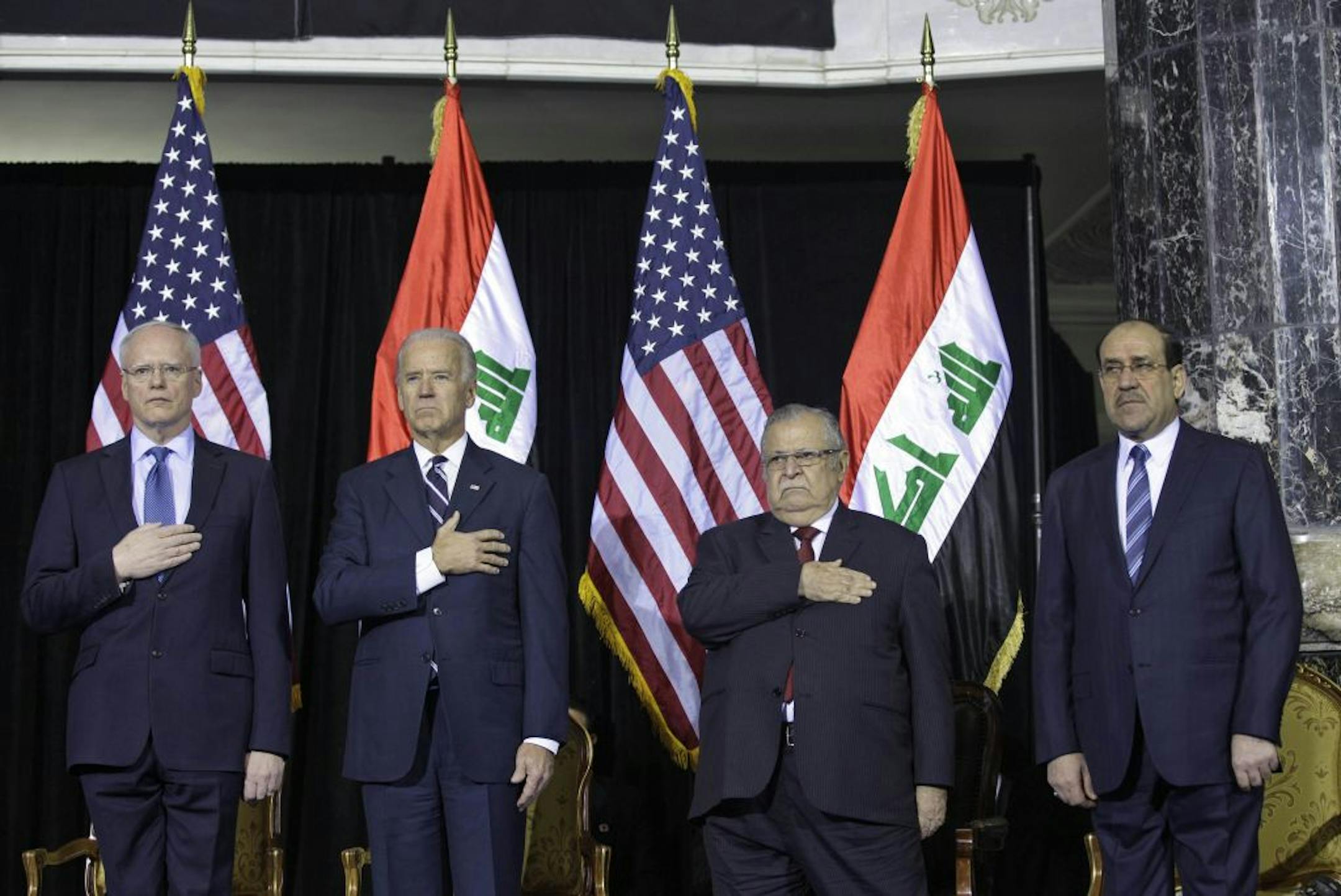
The request was an unusual one, and President Obama himself made the confidential phone call to Jalal Talabani, the Iraqi president.
Marshaling his best skills at persuasion, Obama asked Talabani, a consummate political survivor, to give up his post. It was Nov. 4, 2010, and the plan was for Ayad Allawi to take Talabani's place. With Allawi, a secular Shiite and the leader of a bloc with broad Sunni support, the Obama administration calculated, Iraq would have a more inclusive government and would check the worrisome drift toward authoritarianism under Prime Minister Nouri al-Maliki.
But Obama did not make the sale. "They were afraid what would happen if the different groups of Iraq did not reach an agreement," recalled Talabani, who turned down the request.
Short of its goals
Obama has pointed to the U.S. troop withdrawal last year as proof that he has fulfilled his promise to end the Iraq war. Winding down a war, however, entails far more than extracting troops. In the case of Iraq, the U.S. goal has been to leave a stable and representative government, avoid a power vacuum that neighboring states and terrorists could exploit and maintain sufficient influence so that Iraq would be a partner or, at a minimum, not an opponent.
But the Obama administration has fallen short of some of those objectives. The attempt by Obama and his senior aides to fashion an extraordinary power-sharing arrangement between Al-Maliki and Allawi never materialized. Neither did an agreement that would have kept a small U.S. force in Iraq to train the Iraqi military and patrol the country's skies. A plan to use U.S. civilians to train the Iraqi police has been cut back. The result is an Iraq that is less stable domestically and less reliable internationally than the United States had envisioned.
A complex situation
White House officials portray their strategy as a success, asserting that the number of civilian fatalities in Iraq is low compared with 2006, when the war was at its height. Politics, not violence, has become the principal means for Iraqis to resolve their differences, they say.


