

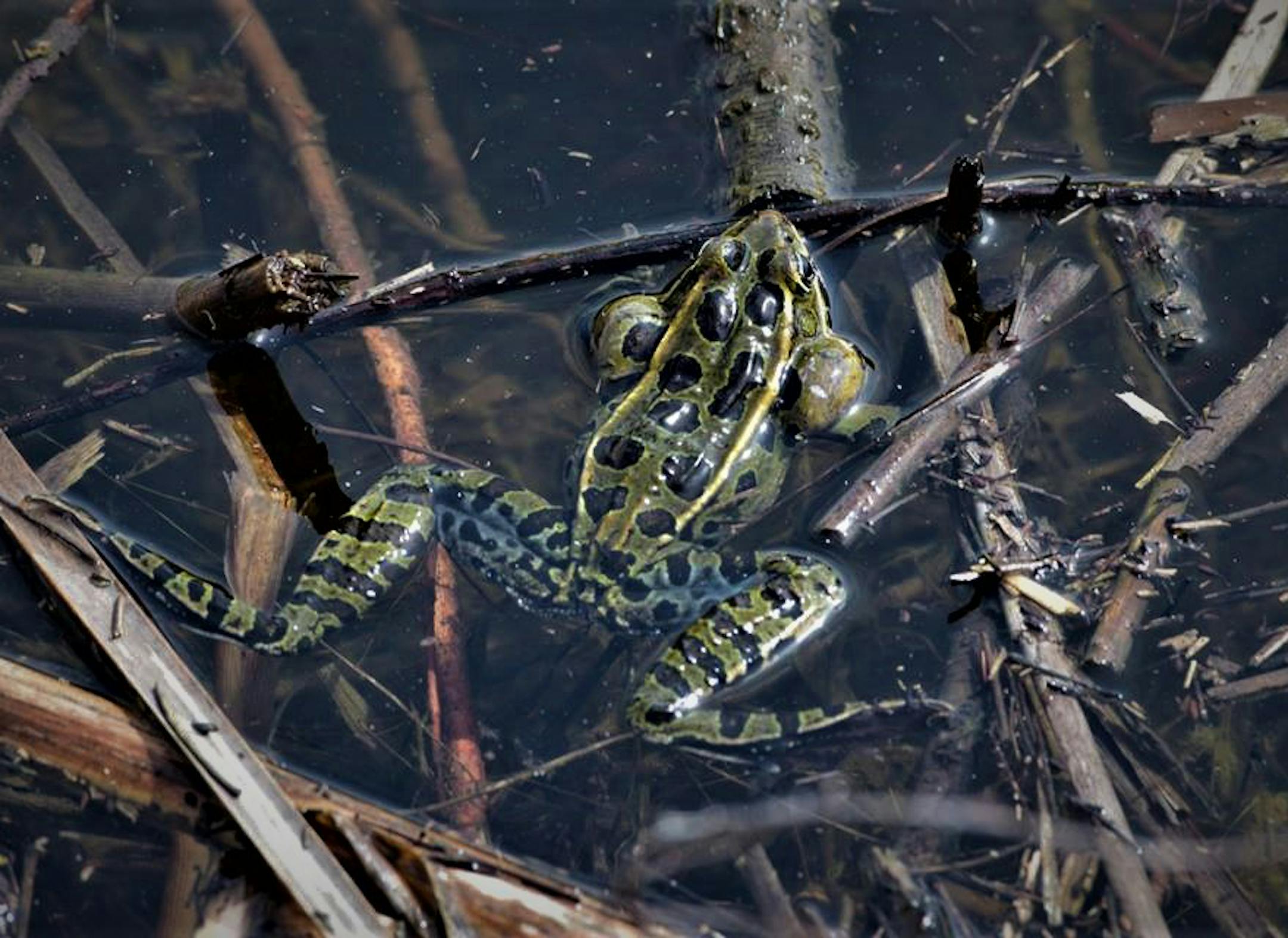
The last light of the day was an orange blaze seen through the filigree of leafless branches of the forest. The air was still and cool without a bug to be slapped. Four fearless "froggers," my group descended into the gloaming of the oak and maple woods at Lee and Rose Warner Nature Center in Marine on St. Croix to conduct a frog survey.
As a citizen-science project, we were there to collect data on what species of frogs are calling, in search of mates, at several spots along a trail called listening posts. We were also tasked with estimating the number of that species at each post — frogs being a bellwether species to watch in this time of climate change.
We found them to be amazing animals.
Frogs' bodies and their strategies to adapt to dramatic temperature changes are fascinating. In winter, unlike turtles, aquatic frogs such as the green frog need to be near oxygen-rich water to keep their metabolism going, so they squiggle into mud at the bottoms of ponds or lakes. Terrestrial frogs, such as the wood frog, secure themselves in deep crevices of rocks or wood, or simply burrow under layers of leaves or snuggle into topsoil. Still, they freeze, but their metabolism has infused muscle, blood and joint with glucose, a sugary antifreeze, to cradle them in their sleep. And toads, aka diggers, are able to drill down below the frost line.
We froggers were here in early April after the thaw, when frogs and toads revive from their suspended animation, to listen to their songs that give life to future generations.
Structured approach
The survey has a simple protocol modeled after the system used by the state Department of Natural Resources' Frog and Toad Calling Survey. It requires a shift from eyes to ears. As we followed a trail with several key posts, we listened, identifying frogs by their call and estimating their number by the collective intensity of their calls.
For one minute, we stood quietly. Apparently, the frogs can sense visitors and will stop calling until they are comfortable with their presence. Then, a timekeeper gave us a nod to begin active listening for five minutes. Our ears scanned for the calls of distinctive frogs. At time's end, we shared what frog was heard, confirm the frog call, discuss the sound intensity, and settle on number designation: 1, for intermittent, singular frogs with no overlapping calls; 2, for singular but overlapping calls; and a 3, for continuous, overlapping calls.
Of course, nature is not going to yield its mysteries easily to a simple survey. To complicate things, at each post, several different frogs might present their calls at the same time. Intermingled among a torrent of sound from western chorus frogs, a person might hear only the banjo twang of one green frog. Frogs also are sensitive to weather. They don't "present" when winds are more than 13 mph, or when it is raining or snowing and cold.


