

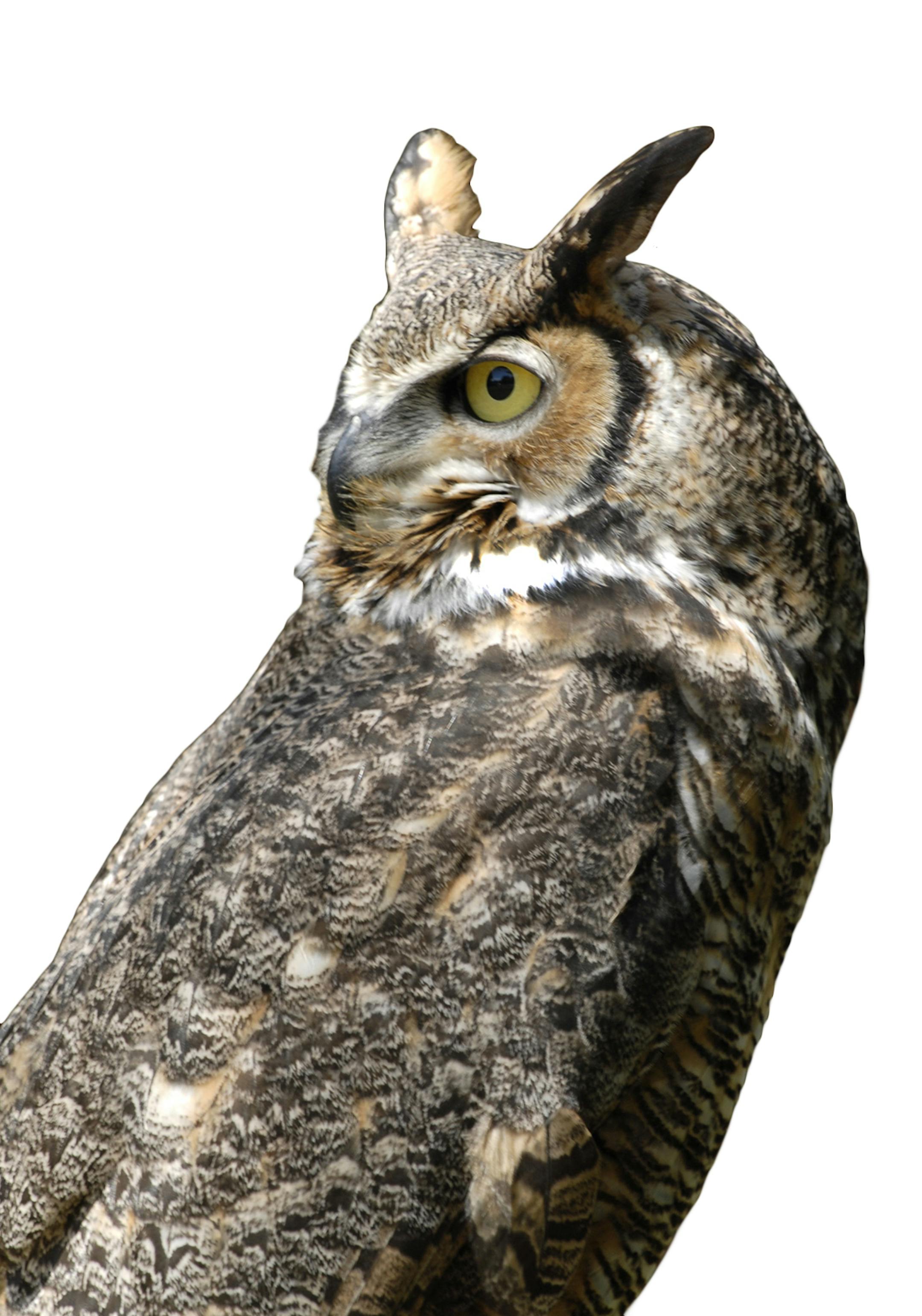
One evening shortly before Christmas, I heard hooting down by Como Lake. I could hear the great horned owl, but I couldn't see it, and I could not figure out where the sound was coming from. I stood on the path in the cold dark, clinging to my dog's leash, and listened hard. The hoot seemed to come from my right, which would put the owl in the middle of the frozen lake. Of course, the owl was not out on the lake; sometimes that wide expanse of open space plays tricks with sound. I walked back the way I had come, and the hooting grew faint. Walked ahead, and it grew louder and then, as I continued along the path, fainter again.
I trotted back and forth, listening. After a while my dog got tired of playing this game and refused to move. It was below zero, he had not had his dinner, he is old. We went home, and the next night I went down to the lake at the same time but all was quiet.
That same night a neighbor reported hooting in the trees by her house; it was so loud that she could hear the sound over the noise of her television set. She lives in a different part of the park, away from the lake, so the following night the dog and I trolled the wooded area near her house but heard nothing.
Throughout December, this was the game the owl and I played, and while the owl had no idea it was involved, it was always one step ahead of me. Every night I walked quietly, scanned the tree branches in the dark, listened: Owl in the pines by the conservatory. Owl on a branch behind the swimming pool. Owl in the trees by the neighbor's house. Sometimes I heard it, three times I saw it, sometimes I got reports a day or two later from various neighbors who were on their own owl patrols. But most nights, no owl at all.
Choosing a nest
December is when the male great horned owl begins to reclaim his territory, so it was not surprising that he was somewhere new every night, hooting, letting other male owls know, This park is taken. But in January and early February, the hoot changes. By then, the owl has decided where to nest, and he is calling in a mate. (Great horned owls do not build nests, but the male finds a cozy place — an abandoned hawk nest, a hole in a tree — where the female lays the eggs.)
One evening in mid-January, right around dusk, I glanced up at a silver maple, and there sat an owl, as solemn and still as a gargoyle on a building. This was the tree where the pair had nested the previous year, and I was filled with hope that this meant they would reuse the old nest. I kept walking briskly, so as not to disturb the bird, and then stopped to text my husband: "BEST NEWS EVER. OWL ON THE OLD NEST!"
And then I heard hooting and looked up. This sound was different; this was two-tone hooting. This was two owls doing call and response: the deeper, close-by hoot of the male, and the higher hoot of the female. I plunged straight into the deep snow in my hurry to get back to the path, dragging the reluctant dog behind me.
A neighbor stood at the bottom of the path, so I stayed at the top, and we both listened. Hoo hoo hoo hoooooooo! Called the male. Hoo hoo hoo hooooooooo! came the female reply. It was a thrilling sound, tremulous and haunting, like wind blowing through a narrow pipe; I could feel it in my chest. The male flew from tree to tree, hooted, flew again. There was something so joyous in his flying, his calling, her answering, that I felt joyous too; this is the courtship phase, the dance, the play before the serious drudgery of egg-sitting and owlet-raising begins. Come to my bachelor pad, he is cooing. Come see my etchings! We'll have some fun!


