

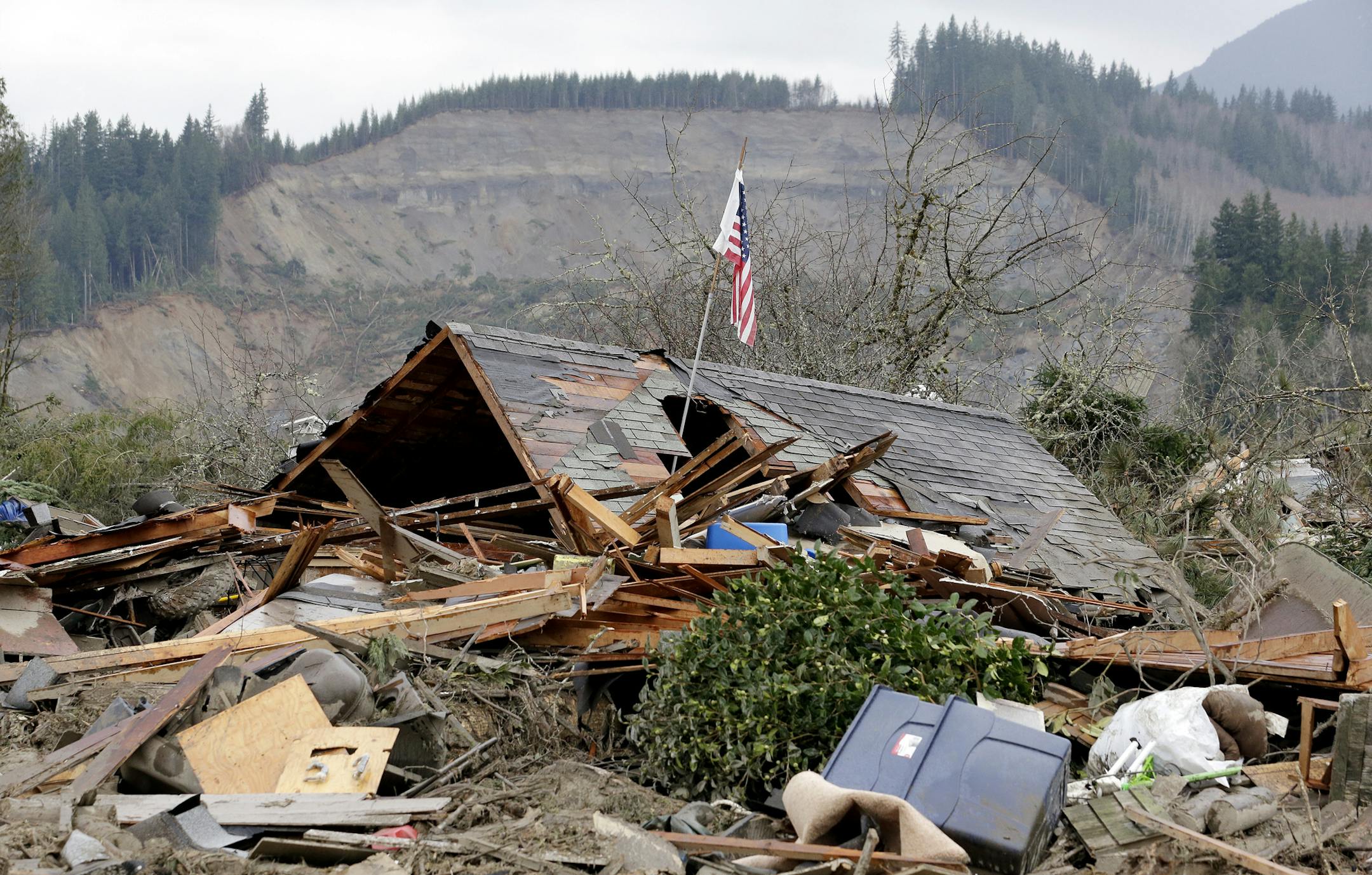
The Oso, Wash., landslide that killed 43 people last year originated from a relatively mild slope but still managed to gain deadly speed and power, a phenomenon that a new study attributes to a two-step process that unfolded in about a single minute's time.
An initial failure on March 22, 2014, near the base of the hill released loose-packed sediments. Then, a second collapse of the upper bluff compressed, pressurized and liquefied this material, enabling it to cross the North Fork of the Stillaguamish River at speeds that averaged 40 mph and strike the Steelhead Haven neighborhood, the study found.
This entire process was primed by water, and models indicate that about 5 percent less moisture saturating the unstable slope would have likely resulted in a far less mobile and less deadly slide.
"The calculations show how incredibly sensitive this kind of behavior can be," said Richard Iverson, U.S. Geological Survey hydrologist who was the lead author in the study published in the journal Earth and Planetary Science Letters. "It's kind of remarkable and sobering."
Iverson worked with 13 scientists from the Geological Survey, the University of Washington and the NOAA National Weather Service to put together the study investigating why the slide moved so rapidly over a large area.
Iverson said that scientists should strive to do more than simply identify areas where a slide may occur. The challenge is to improve forecasting about the potential scope of a slide to understand risks to the public.
The Oso landslide in Snohomish County involved about 18 million tons of sediment — or almost three times the mass of the Great Pyramid of Gaza — and sent debris across the flood plain of the Stillaguamish's North Fork. It came down from a bluff that has failed numerous times in the past and was identified as an unstable zone for landslides.
Estimates indicate that about half of that debris still remains on the slope that failed, and more analysis is required to determine how great a hazard it represents.


