

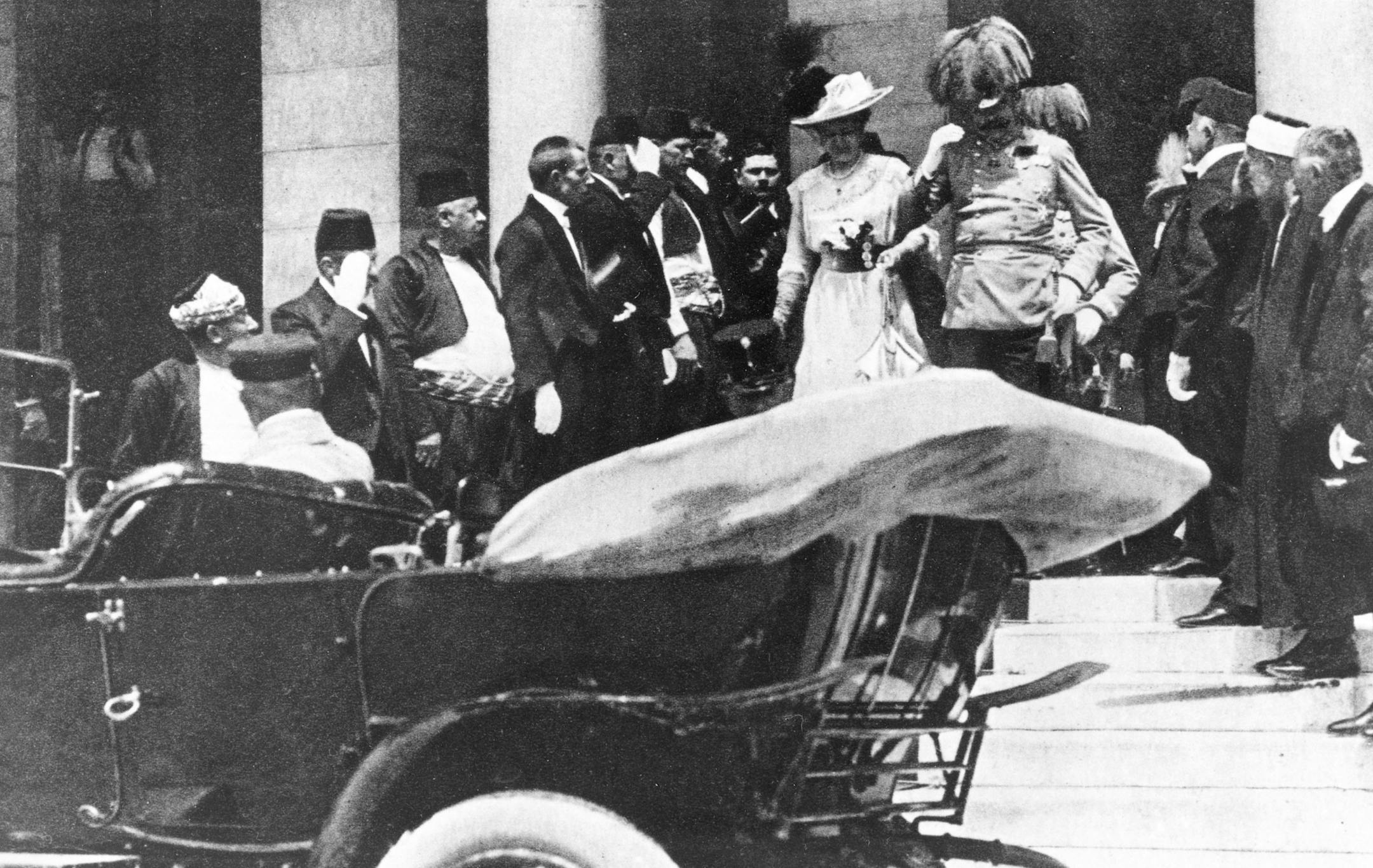
No sooner had the news broken last week that Andrey Karlov, the Russian ambassador to Turkey, had been assassinated than the comparisons to 1914 began to flow. Google searches for "Franz Ferdinand" briefly spiked. Bill Kristol tweeted that the headlines had "an alarming 1914-ish feel," and Owen Jones of the Guardian caught "a whiff of 1914 that is too pungent to be ignored."
That year, Bosnian nationalist Gavrilo Princip assassinated Ferdinand, heir to the Austro-Hungarian throne, setting in motion events that would result in World War I, a globe-consuming fight that left 17 million dead and Europe in ruins.
Given the uncertainty of the current moment and the players involved, the pull toward such analogies is strong. But there is a real danger here, a danger that exists in any historical analogy that draws surface comparisons while ignoring particulars. Such analogies give us a false sense of security, even when the antecedents are horrific: a sense that we know what's coming next and how to respond, that everything is knowable and under control. But the reality is that we have no idea what comes next, and if we act too assuredly, too trapped within the analogy, the odds of miscalculating grow exponentially.
Let's take that World War I analogy. In 1914, Europe was a tinderbox in search of a spark. A system of alliances that had kept peace, more or less, for a half-century had failed to adapt to the new realities of expanded empires, modern warfare and decaying monarchies. What had once granted stability now almost assured chaos. The empires involved were too insecure to allow the moment of Ferdinand's assassination to pass. And when the dominoes fell, they fell with unimaginable consequences.
There are echoes with today, to be sure. Both Turkey and Russia are led by authoritarians eager to show their power. Turkey is a member of NATO, an alliance system erected to counter Soviet aggression. Add to that the instability in Europe and the United States, as well as the palpable fear that instability has created, and surely 2016 is 1914 redux.
But here is the problem with such analogies: They latch onto similarities, flattening the particulars of each historical moment. Which is why historical analogy is so dangerous in times like this. Russia is not itching for war with NATO. When it comes to testing NATO, Russia prefers to nudge the edges of the alliance, not strike at the heart of it. Witness Vladimir Putin's actions toward Ukraine. The annexation of Crimea is alarming, but Putin was unwilling to risk war by grabbing the rest of Ukraine, which he believes to be properly part of Russia. And in Syria, where Russia has been supporting the Assad regime, Putin was slow to enter the fight, preferring to offer political and munitions support for the first several years of the war rather than direct involvement. Why would he pick a fight with Turkey, a valuable U.S. ally and NATO member? Were he to declare war on Turkey, he would not be acting predictably but in a manner entirely out of line with his recent actions.
The other issue with historical analogy is that it ignores, well, history. Before World War I, an alliance system had never resulted in such catastrophic outcomes. The very fact of the war — the knowledge every actor in the drama now carries — changes the calculation every player makes. In 1914, no one knew something like the Great War, with its destructive, devastating results, could happen. Now, everyone does.
We are in a season rife with historical analogy, with many Americans glancing fretfully toward Germany in the 1930s and '40s, drawing on the experience of those decades to illuminate this one. But historical analogies can often obscure rather than enlighten, assert rather than explain. Easy historical analogies lead us to think we understand more about the world and the future than we do.


