

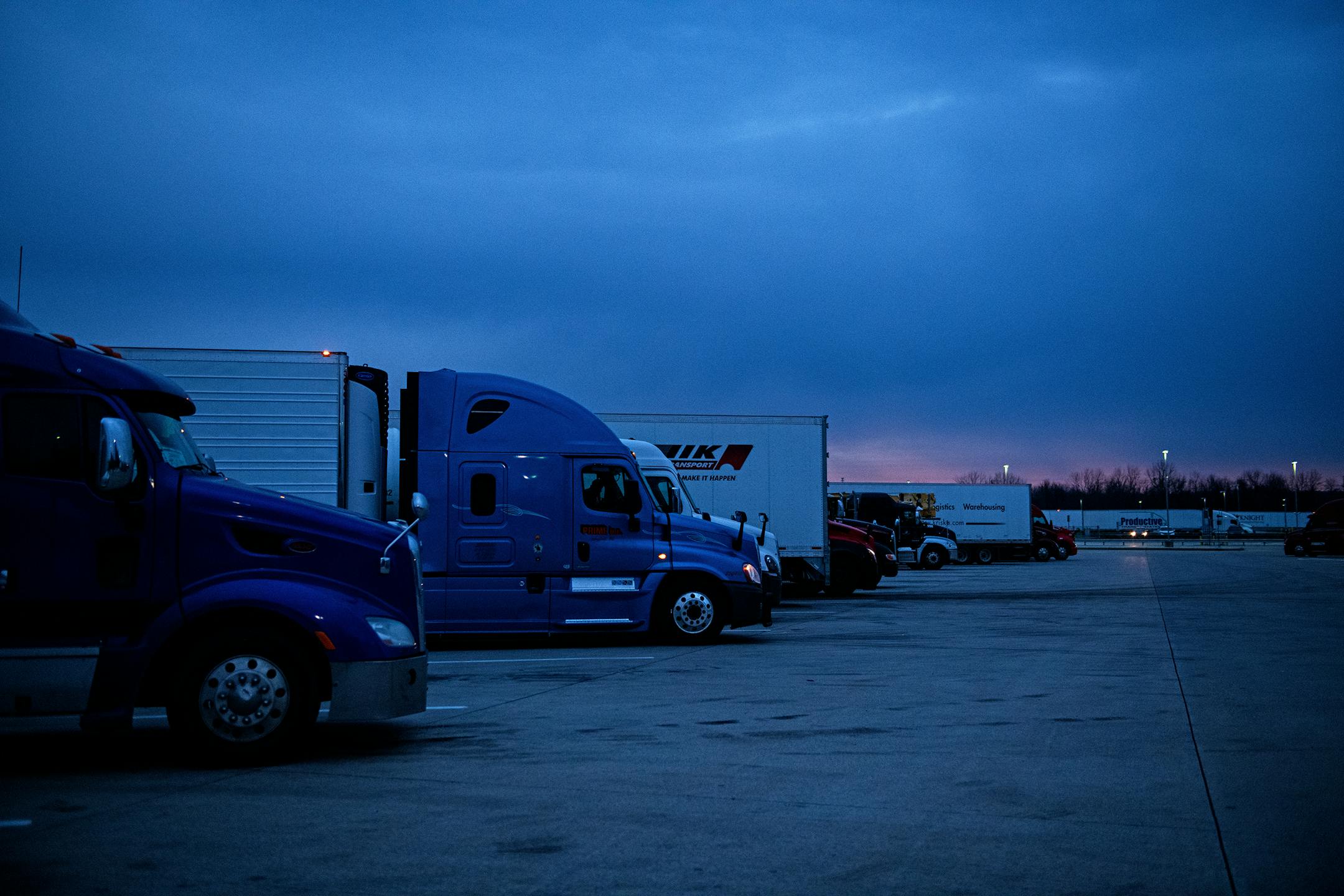
A few years ago, Jon Knope was standing in a rainy parking lot littered with smashed soda bottles in Cartersville, Ga., learning the finer details of how to park a Class 8 combination tractor-trailer. He was in his early 20s, somewhat rootless, and needed a job that would beat hustling on rideshare apps in his mother's station wagon.
He liked driving fine, so he went through trucking school. He could make a lot more money, largely because he was allowed to work much more than Uber or Lyft would let him. In the next few years, he would spend more than 900 nights on the road, drive at least 350,000 miles, and, while he was technically alone in his truck cab watching every sunrise and sunset fly by, he was never really by himself. While many associate trucking with freedom, he was, like every trucker, hemmed in by low wages, long hours and an unbelievable level of automation and surveillance.
Today, long-haul truckers are some of the most closely monitored workers in the world. Cameras and sensors dot their trucks, watching the road, the brakes and even the driver's eye movements. Once, when his truck's cabin heater broke, Knope was forced to sleep in freezing temperatures for several days while traveling across northern Ohio and New York because an automated system made sure his engine was turned off at night. The company told him there was no way to override the system.
Just imagine finishing 10 hours at a desk job, only to return to your apartment to find the heat didn't work. That'd be quite frustrating. Then imagine your apartment was your office and most nights dinner was a microwaveable burrito or a bag of fast food. And then imagine your desk job required you regularly press a little pedal, you couldn't stand up, you had essentially no face-to-face contact with co-workers, and if a bathroom didn't easily present itself you were forced to use a plastic jug — all while a computer or a person at a desk hundreds of miles away monitors your every move.
Trucking is a supremely dangerous job, with large trucks involved in 10% of all fatal crashes in the U.S. in 2019, and Knope often described tractor-trailers as "40 tons of death." One wrong move and your truck could easily kill the family in the minivan next to you. Much of the surveillance truckers experience is in the name of safety, and truckers agree that safety is paramount.
However, experts say the fatigue that leads truckers to be unsafe — to fall asleep at the wheel or lose focus — is a direct result of low wages that encourage drivers to spend too much time on the road. While we often think of automation and A.I. as developments that will eventually replace workers (think of Tesla's partly automated tractor-trailer), those tools are already in heavy use in the workplace. And they haven't replaced workers; they've simply been brought in to manage declining working conditions.
While journalists tracked the Canadian trucker protest as it radiated out from Ottawa, becoming a worldwide movement adopted and amplified by conservative politics, few asked why it was truckers specifically who started the movement when plenty of other workers in Canada and the U.S. had already been subject to vaccine mandates. And yet there were warnings that truckers would rebel.
The American Trucking Associations, a major industry trade group, noted last October that truckers were likely to cause supply chain disruptions if subjected to a vaccine mandate. They already experience the extreme end of workplace control, diminishing wages and an intense lack of privacy, and ultimately a vaccine mandate pushed more than a few of them over the edge.


