

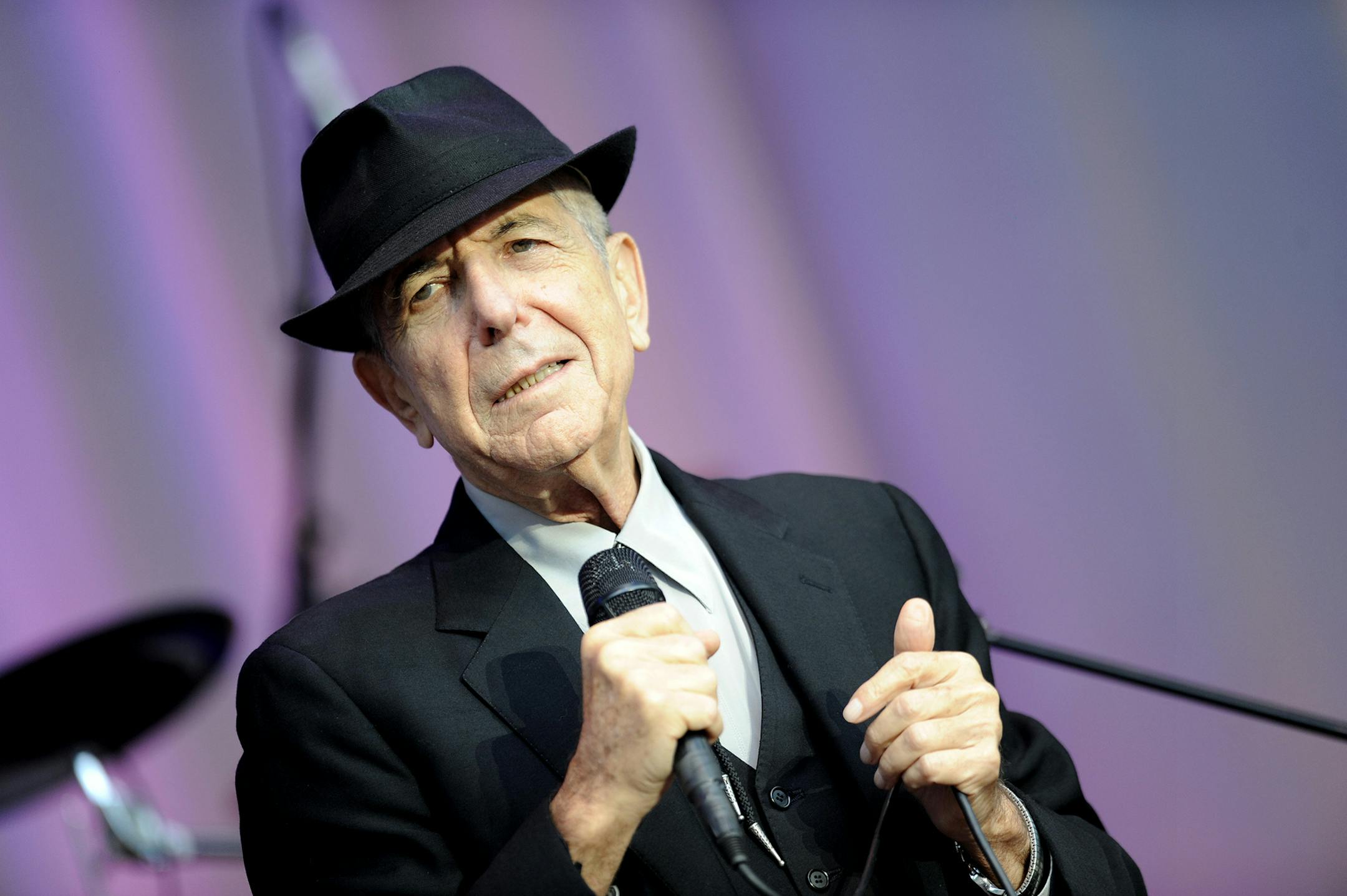
In 1988, still in his 50s, Leonard Cohen sang that "I ache in the places where I used to play" and suggested that he was just getting by. He was "paying my rent every day in the tower of song," like any old tunesmith for hire.
It's a humbling image that recalls the Cohen of his recent concerts. The nattily dressed singer, who died Monday at 82, would doff his fedora and kneel in front of his audience as if delivering a sacrament or receiving one, a song-and-dance man even as he pondered mortality, betrayal and obsessive need.
In interviews, Cohen would gently note that he felt his role on this planet was to serve. He had only his songs to offer, and they proved to be extraordinary, from "Famous Blue Raincoat" and "Suzanne" to "Bird on the Wire" and "Hallelujah." A large number were covered by dozens of famous singers, and "Hallelujah" seemed like it was interpreted by hundreds.
Cohen's songs over six decades blended seemingly conflicting impulses: spirituality verging on the divine, a ribald sense of humor, a withering lack of sentimentality and an almost desperate passion for the deepest type of human connection — no matter how elusive it might prove to be. He was called a "master of erotic despair," and the label fit like one of the tailored suits he often wore in concert.
Although he wasn't blessed with a conventionally attractive singing voice — a low-octave rumble that became progressively more subterranean with the passing years — it was distinctive and unforgettable. It evoked the sound of monks chanting in a cathedral, or the feel of well-aged whiskey sliding down the throat. His response was to joke about it: "I was born like this, I had no choice," he sang in "Tower of Song." "I was born with the gift of a golden voice."
Covers and movies
Born Sept. 21, 1934, in Quebec, Cohen learned guitar in his teens and played in a folk group but was smitten by poetry. He published a collection of his poems, "Flowers for Hitler" (1964), and two novels while working in Montreal.
Frustrated by poor sales, he visited New York in 1966 to investigate the folk scene and met singer Judy Collins. She included two of his songs on an album later that year, and Cohen was invited into the inner circle of the city's musical and literary cutting edge.
His 1967 debut, "Songs of Leonard Cohen," connected deeply with a generation of listeners who heard its sparse meditations as an autumnal respite from Summer of Love psychedelia. Cohen was in his 30s when the album was released, and he sounded like a weary traveler amid the callow infidels.

