

Gov. Mark Dayton and Republican legislative leaders were in an all-out scramble Sunday to finalize agreements on the state's next two-year, $46 billion budget — and running into a time crunch as they edged closer to the last day of the session.
By late Sunday, the House and Senate had passed only three of 10 budget bills that will shape the state's next spending plan. Among the biggest challenges as private budget talks tumbled on: finding agreement on spending on transportation and health and human services programs, and final details on hundreds of millions of dollars in tax cuts sought by Republicans.
"I'm feeling good, but I'm the eternal optimist," said Rep. Greg Davids, R-Preston, chairman of the House Taxes Committee. Lawmakers must adjourn by midnight Monday to avoid a special session to finish their work.
"We'll get there," Davids said.
GOP leaders said they believed Dayton, a DFLer, would sign the first three budget bills they passed Sunday, with funding for public colleges and universities, another for the state Department of Agriculture and related programs, and a third for environmental operations, including parks, trails and fish and game programs.
Dayton and top aides along with House Speaker Kurt Daudt, R-Crown, Senate Majority Leader Paul Gazelka, R-Nisswa, and several other top lawmakers spent Sunday in a series of closed-door meetings. They reported few details other than that the two sides were making progress and expected to continue working nonstop though the night and up to Monday's deadline.
Tax cuts scaled back
Daudt said Sunday evening that he still believed a global spending deal was within reach but admitted he was starting to sweat the shrinking amount of time.
GOP leaders agreed earlier in the week to scale back their $1 billion tax-cut package to $660 million and were hoping to hold to that number. Dayton, meanwhile, has been pushing to use much of the state's $1.65 billion surplus to help fund such priority areas as health and human services and expanded prekindergarten classes at public schools.
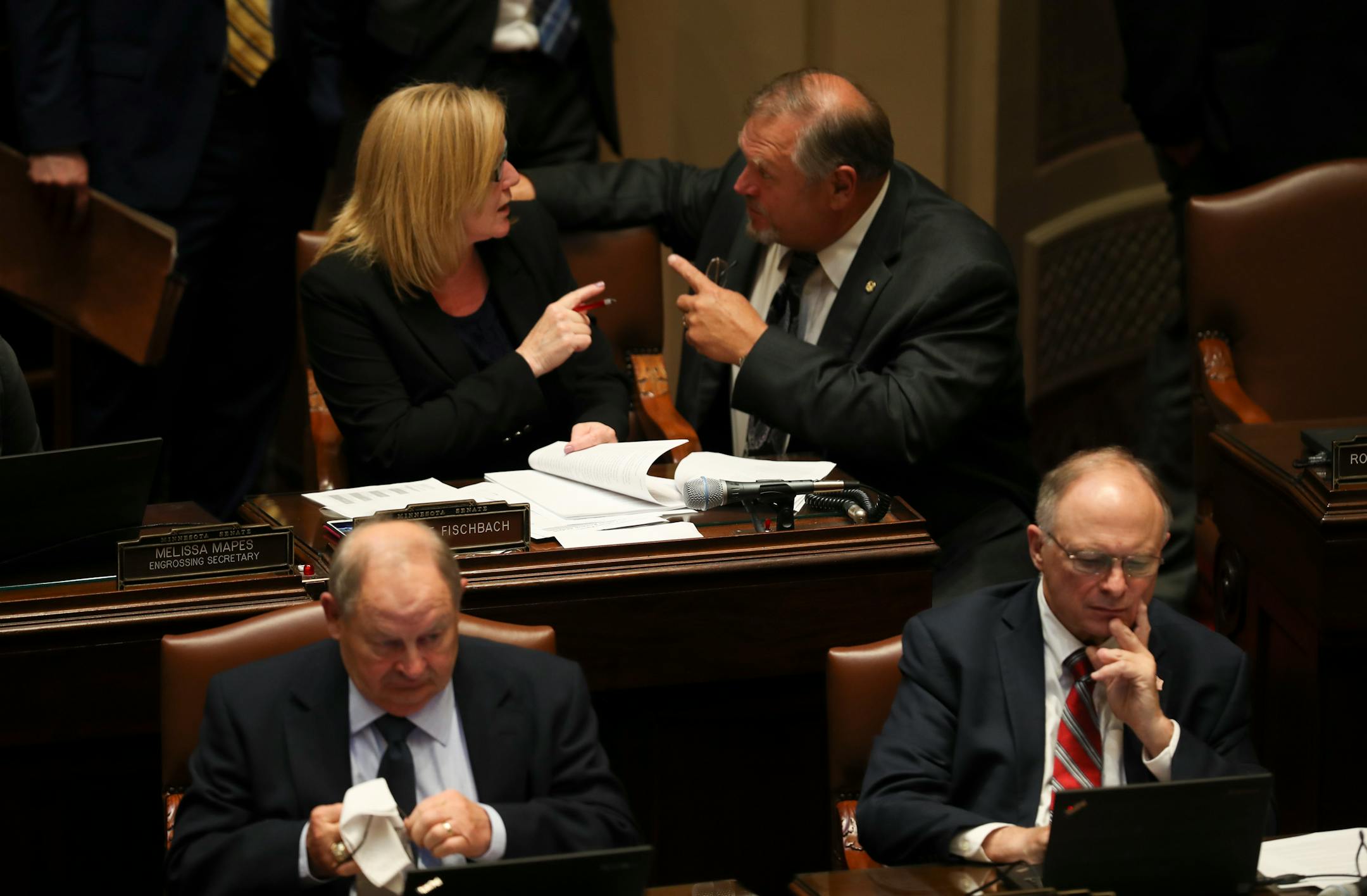
![Senators conferred in pairs while other members discussed the Omnibus Higher Education Bill Sunday afternoon. Foreground to background, they are, Sen. Kent Eken, DFL - Win Valley, left, with Foung Hawj, DFL - St. Paul, John Hoffman, DFL - Champlin, left, with Sen. Jim Abeler, R - Anoka, and Sen. Torrey Westrom, R - Elbow Lake, left, with Senate researcher Andrew Larson ] JEFF WHEELER ï jeff.wheeler@startribune.com With just a day left in the session, the Minnesota legislature was busy Sunda](https://arc.stimg.co/startribunemedia/ZTCBLWVKFO63CPWZ4OCOJ2MOCA.jpg?&w=1080)


