

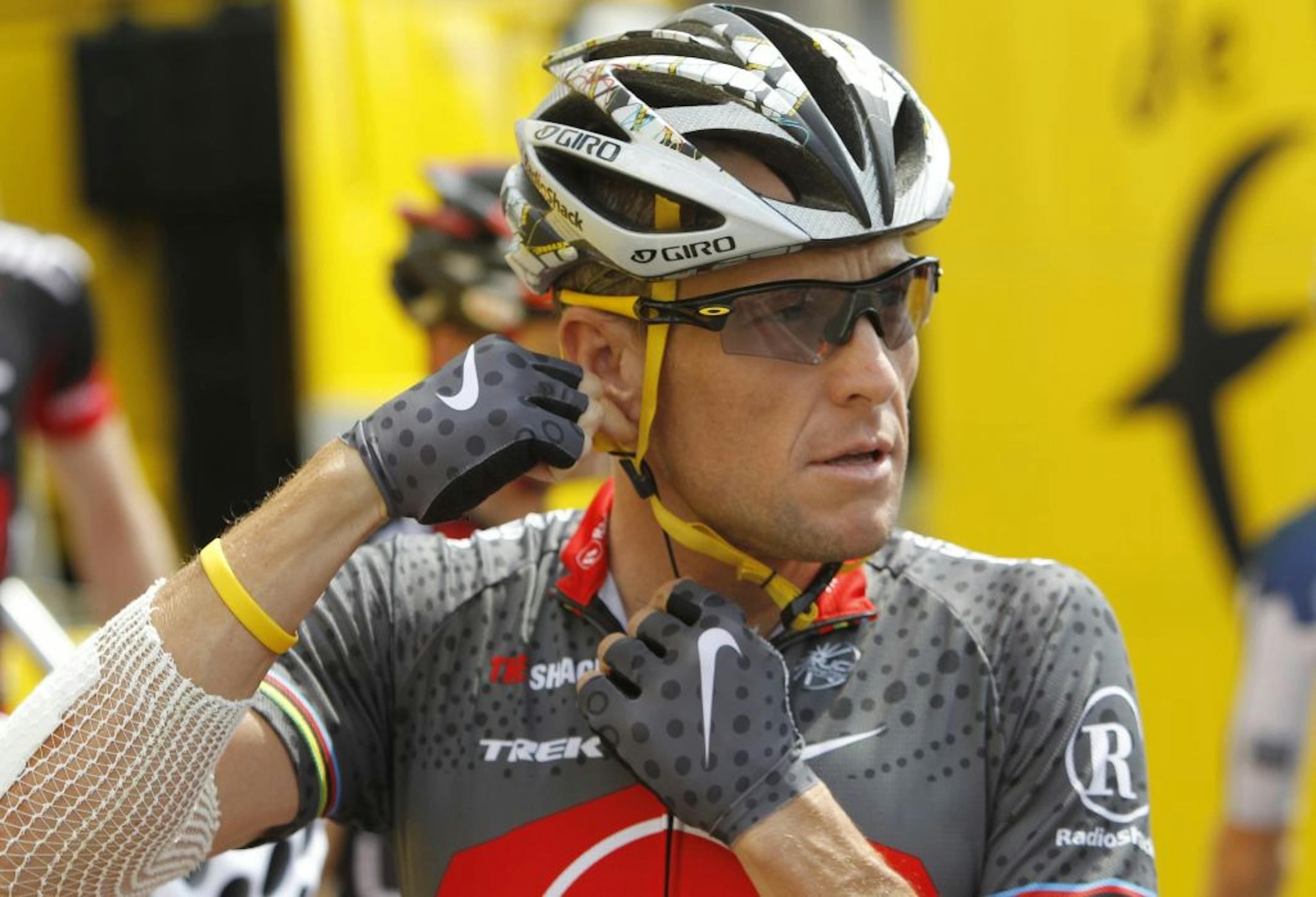
An anemia drug has likely harmed hundreds of thousands of patients, soiled the reputations of two Fortune 500 companies and shamed one of our legendary sports heroes, the cyclist Lance Armstrong.
Only that last part was at issue in the United States Anti-Doping Agency report, released on Wednesday, that laid out the astonishing evidence against him. It didn't explain the seductive power of the drug -- an artificial blood booster called erythropoietin, or EPO for short -- or how our health care providers and our culture pushed its irresponsible use.
EPO is a naturally occurring hormone that stimulates the production of red blood cells. As any anemic can tell you, without sufficient red blood cells we become exhausted, unhealthy and depressed. Those who couldn't make natural EPO, like dialysis patients and people without functioning kidneys, had to rely on blood transfusions to get it.
But that changed during the biotech drug rush of the 1980s, when a start-up called Amgen found a way to genetically engineer the hormone. After patenting its artificial EPO, Amgen formed a partnership with the marketing mavens at Johnson & Johnson and boomed into the world's largest biotech company.
Hailed as a wonder drug, EPO looked innocuous -- 3,000 units of clear liquid swirling in a glass vial. To athletes, those tinkling vials also represented a way to "goose" the oxygen-carrying component of blood, increasing stamina. And really, what red-blooded American doesn't crave more energy? Our literature is rife with fictional drugs that bestow superhuman abilities -- like the "spice" found in Frank Herbert's "Dune" -- and so is our history; leaders from Grover Cleveland to John F. Kennedy used cocaine, "pep pills" or amphetamines.
But those energy boosts came with bad side effects. Not so, it seemed, with EPO, which was seen as safer than ephedrine, less risky than coke and more effective than a double espresso.
Before long, Amgen and Johnson & Johnson were selling two EPO brands -- Epogen and Procrit. (Those who biked the short races called criteriums joked it was for "pro-crit riders.") By the 1990s, in addition to cyclists, runners, skiers and other endurance athletes were injecting the stuff regularly -- and illegally. All they had to do was pay a black-market dealer in Amsterdam or Marseille, France.
But it wasn't until 1994 that the marketing of these drugs burst into the mainstream. Amgen and Johnson & Johnson began trying to expand the uses of their energy-boosting drugs to include treatment for fatigue, depression and quality-of-life issues. Commercials depicted old, slow-moving people who, after a shot of Procrit, displayed a zest for life, and a young cancer patient, who after an EPO injection happily returned to work.


