

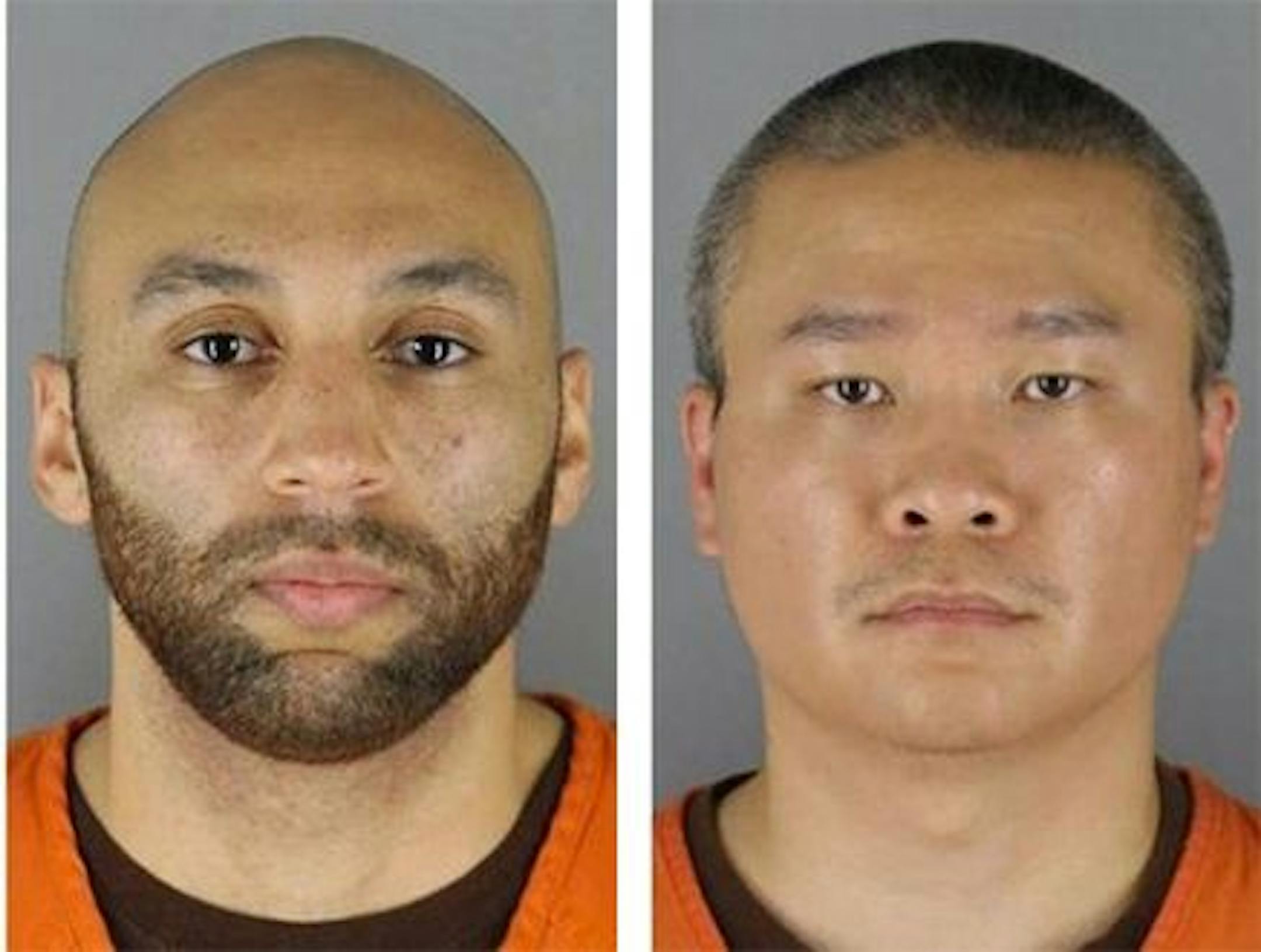
A federal judge will sentence the remaining two former Minneapolis police officers convicted of violating George Floyd's civil rights during his 2020 killing in back-to-back hearings next week in St. Paul.
J. Alexander Kueng and Tou Thao will be sentenced Wednesday for a pair of convictions handed down by a federal jury earlier this year. Kueng and Thao are still awaiting an Oct. 24 trial in Hennepin County on state charges of aiding and abetting second-degree murder and manslaughter, but their federal sentencings will bring to a close the Justice Department's criminal civil rights prosecutions stemming from Floyd's murder.
U.S. Senior Judge Paul Magnuson sentenced Derek Chauvin to more than 20 years in prison earlier this month and imposed a 2 ½-year sentence on Thomas Lane on Thursday, deciding in both cases for a lesser term than what prosecutors sought and Floyd's relatives urged.
After a half-hour hearing Friday to dispute sentencing guideline calculations, Kueng and Thao now also stand to receive lesser sentences than they might otherwise have received. Magnuson sided, in part, with arguments raised by attorneys for the two ex-officers by finding that involuntary manslaughter and not second-degree murder should be used to calculate the offense levels in their cases.
"Defendants Kueng and Thao each made a tragic misdiagnosis in their assessment of Mr. Floyd," Magnuson wrote in an order. "The evidence showed that Kueng genuinely thought that Mr. Floyd was suffering from excited delirium with a drug overdose, and Thao genuinely believed that the officers were dealing with a drug overdose with possible excited delirium."
Magnuson found that those facts precluded the element of "malice aforethought" necessary to prove second-degree murder.
Magnuson rejected a motion from the defense attorneys not to enhance the penalty based on the two men acting under "color of law," arguing that their position as law enforcement officers was already addressed in the criminal conviction.
Kueng and Thao also asked for a reduction in the calculation for "mitigating roles" in the crime. But Magnuson wrote that because the "mitigating-role determination is unique to each Defendant and dependent on the facts of each case, the Court will rule on these requests at sentencing."


