

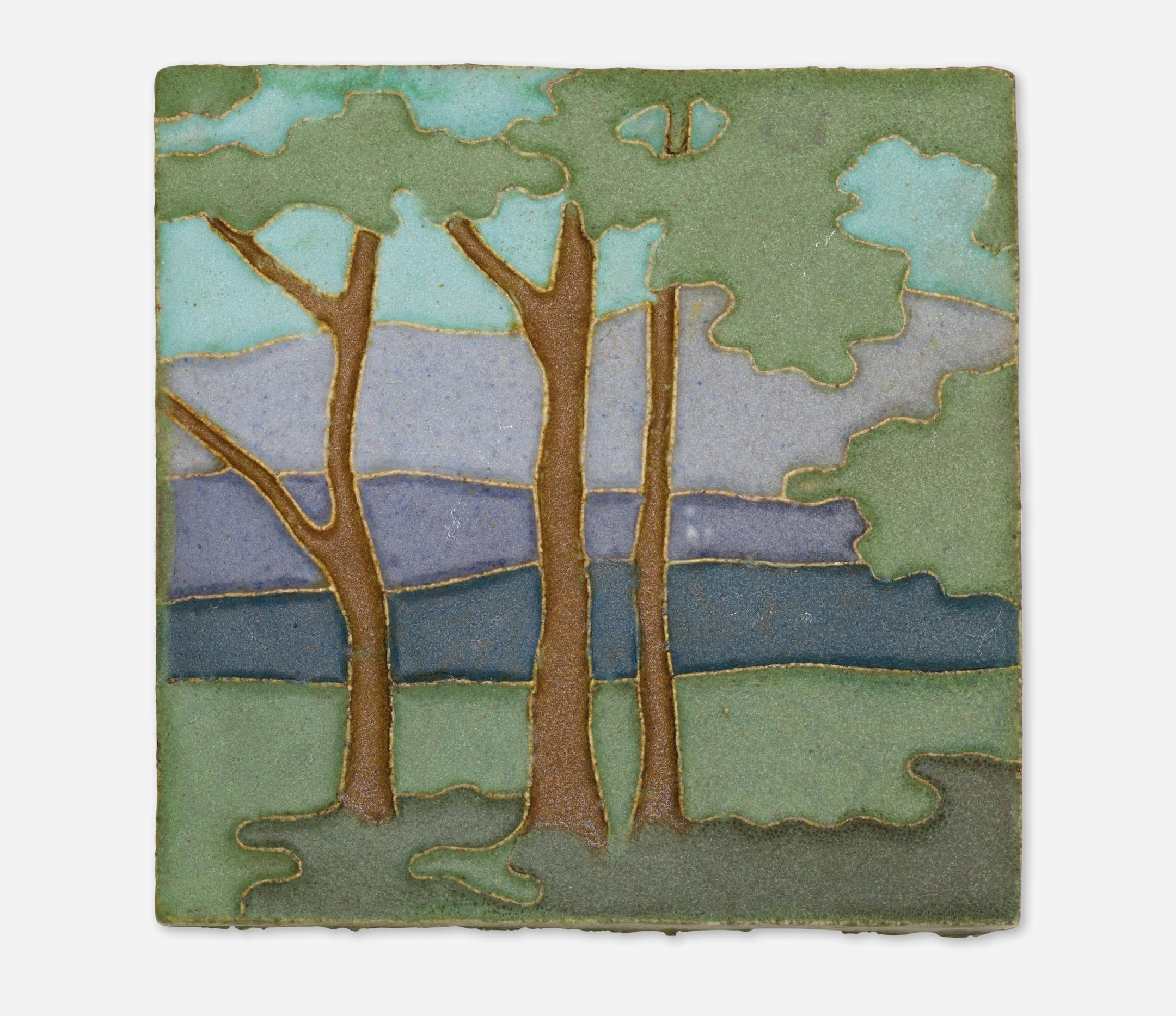
Artus Van Briggle and his wife, Anne, were decorators at the Rookwood Pottery in Ohio. They moved to Colorado after Artus was diagnosed with tuberculosis, and he opened his own pottery there, the Van Briggle Pottery, in 1901.
After Artus died in 1904, Anne took over the pottery. Van Briggle Pottery is known for its art nouveau vases with abstract flower shapes or graceful human figures in a single rich color, subtly varied shades or tonal gradients of matte glazes. The glazes were Artus' passion, inspired by centuries-old Chinese pottery.
This tile, which sold for $2,125 at a Rago auction, shows another side of the pottery. The subject matter of a few trees in a landscape may have been influenced by Artus' training as a painter in Europe before his career in ceramics. The shapes in the background may have been inspired by the mountain scenery of Colorado.
The scene was created with the cuenca technique for decorating tiles. Spanish for "basin," cuenca involves molding a design onto the tile before it is fired, leaving shapes outlined with raised lines. The shapes are then flooded with glaze; the raised lines keep the different glazes separate.
Q: I'm looking for some advice on selling antique Coca-Cola items. I have some 1920s brown bottles, lithographed cardboard signs from 1948 to the 1950s, and mirrors from the 1970s to 1980s.
A: Coca-Cola syrup was invented by pharmacist Dr. John Stith Pemberton. The first glass of Coca-Cola was sold at a soda fountain in Atlanta in 1886. Coca-Cola has become one of the world's most recognized brands. Thousands of Coca-Cola advertising items have been made and are popular collectibles today. There is even a club for collectors, the Coca-Cola Collectors Club (cocacolaclub.org). Many items have been reproduced. Authentic memorabilia sells well in shops, online sites and auctions. Check online sites to see what items like yours are selling for. There are auction houses that specialize in sales of bottles and auction Coca-Cola mirrors, signs and other items. Prices for rare items are high, but common signs, bottles and toys sell for less than $100.
Q: I have a beautiful, old steel gliding hobby horse. I can't find much information about it. It's 36 inches long, 12 1/2 inches wide and 28 inches tall. The name "Nobby Hobby" is painted on the bottom side rail, and on the front rail it reads "Trade Mark Corcoran, Green Arrow Line, Corcoran Mfg. Co., Cincinnati, Ohio, U.S.A." It's in amazing condition but no longer has a saddle or reins. Any idea of the age or value?
A: Corcoran Mfg. Co. was incorporated in Cincinnati in 1916. The company was dissolved in 1934. "Nobby Hobby" is a gliding horse attached to a stationary base sometimes called a "safety stand" or "swinger stand." A similar stand was patented by Philip Marqua of Cincinnati in 1878 as an "Improvement in Hobby or Rocking-Horses." The horse swings back and forth on the stand, avoiding the wear and tear on the carpet or the noise an ordinary rocking horse makes. Rocking horses were sometimes called "exercising" horses. Steel rocking horses are rare. An online seller lists a Nobby Hobby horse missing the leather ears, reins and saddle for $1,195. A Corcoran pedal horse sold for over $3,000 a few years ago.

