

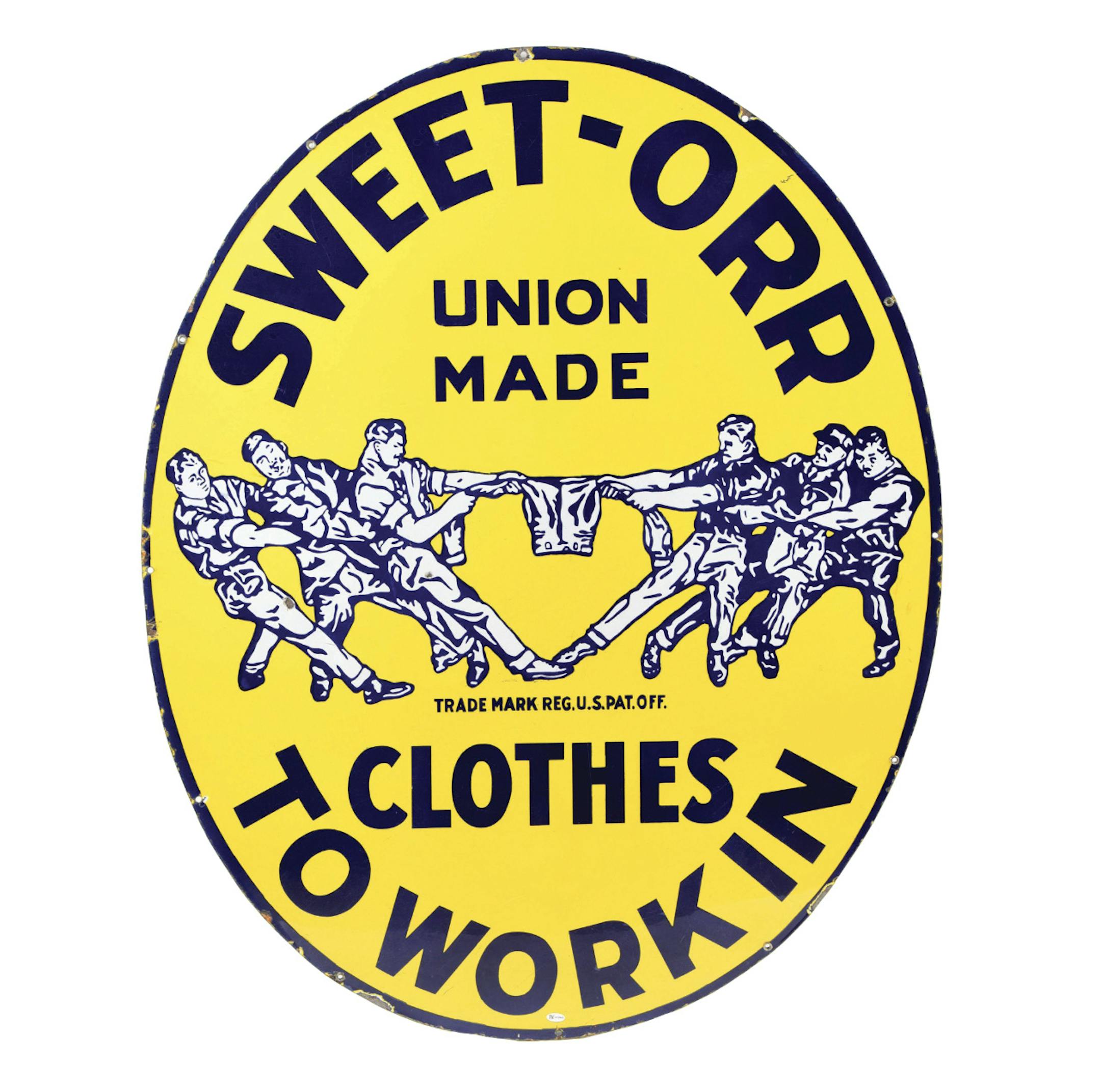
Trade unions played a crucial role in establishing Labor Day as a holiday. "Union Made" has long been a point of pride for American industries, as in this sign advertising Sweet-Orr clothing, which sold for $7,380 at a Morphy auction. Talk about the value of hard work! The sign celebrates workers as not just the makers of the clothes, but as the brand's clientele.
The story goes that James Orr returned from the Gold Rush without gold, but with a business idea. Having seen firsthand how easily prospectors' work clothes were damaged, he persuaded his nephews Clayton and Clinton Sweet to join him in starting a company to make high-quality off-the-shelf workwear.
The Sweet-Orr company started making overalls in Wappingers Falls, N.Y., in 1871. By the 1880s, it had an iconic advertising strategy: Representatives would hold events challenging groups of six men to play tug-of-war with a Sweet-Orr garment, showing the clothes' resistance to tearing. This was supposedly inspired by feedback from customers claiming that their lives had been saved by the strength of their Sweet-Orr clothing. This strategy soon made it into the company's logo and stayed there.
This sign, depicting such a tug-of-war, dates to about 1920. Although the original New York factory has closed, the Sweet-Orr company is still operating today.
Q: Can you tell me something about the maker and value of my platter marked "Walbrzych, made in Poland, A.D. 1845"? It's white with bunches of roses and has gold trim on the edges. It's 11 inches by 6 3/4 inches and is in perfect shape.
A: Carl Tielsch started a porcelain factory in Altwasser, Germany (now part of Walbrzych, Poland) in 1845. The Tielsch family left after the town was occupied by Russian troops at the end of World War II. Some German workers remained and continued to operate the factory. It was nationalized in 1952 and became Walbrzych Table Porcelain Plant. In 1992, it was privatized, and the name was changed to Table Porcelain Works in Walbrzych S.A. In 2007, it became Porcelain Factory Walbrzych S.A. The factory closed in 2012. The mark on your dish was used from 1952 to 1992. A 13-inch platter in this pattern is listed online for $20.
Q: My father's estate had three small silver trays, one with a lid (but the lid fits on all of them), that say "made in occupied Japan." As he was in WWII, I'm sure that this is something he picked up along the way. They also have the stamp "Amerexware" on them. I am curious to know if they are worth anything other than the silver value.
A: There is little information available about Amerexware. The mark "Amerex" also appears on tableware and cameras made in Occupied Japan and on some Japanese electronics made later. It isn't clear if it is a brand name or if it means the product was made for export to America. There are a few references to an Amerex Trading Co. in Japan that was owned by Americans and associated with the Sogo Department Store in the 1950s.


