

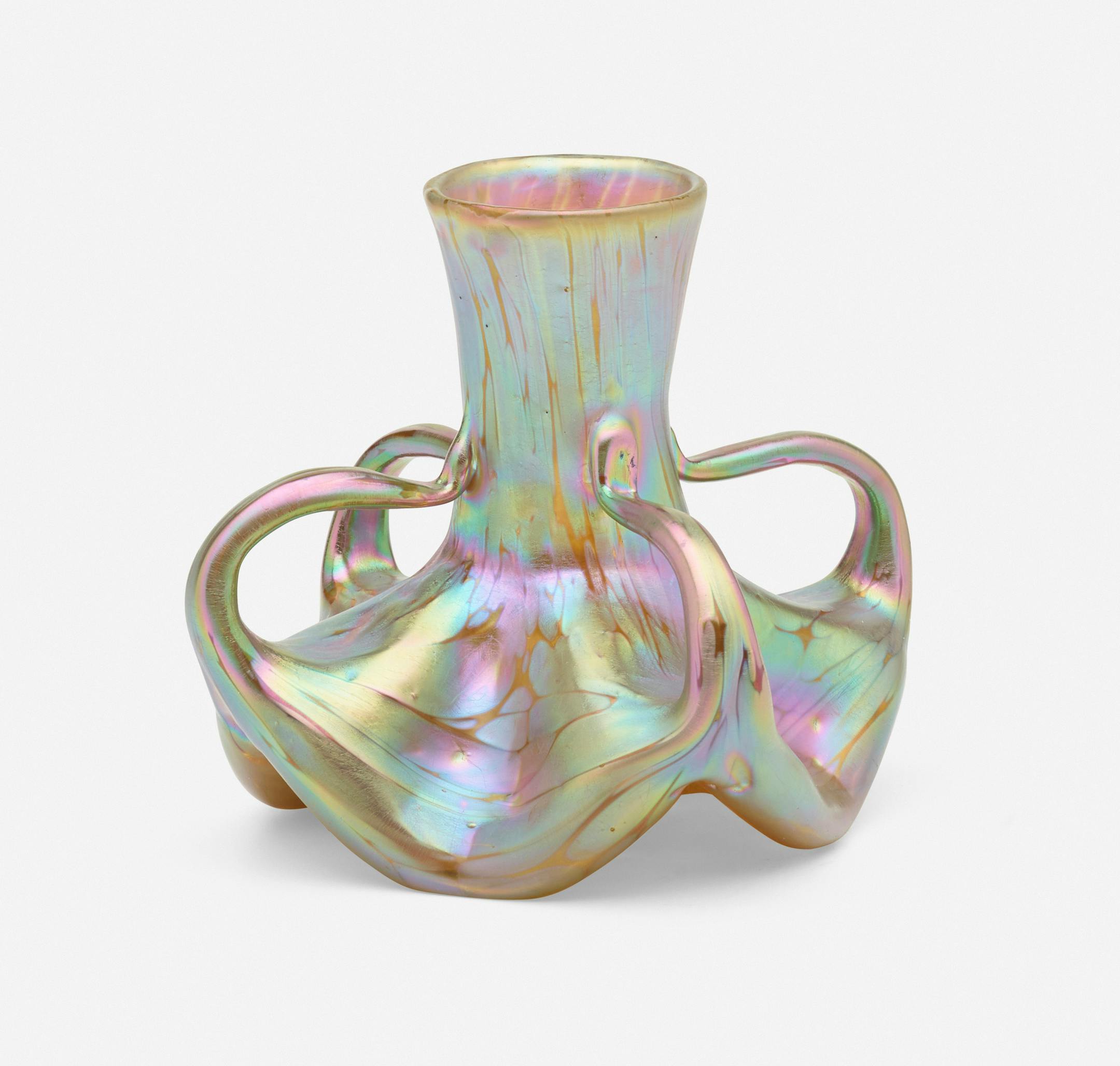
Identifying antique glass isn't always easy. If you're lucky, a piece may be marked, like this Phanomen vase, which is signed "Loetz Austria" on its pontil (the spot on the base where the blown molten glass was attached to a pontil for shaping).
Proof of its maker, not to mention its complex shape and silvery iridescent sheen, brought its price to $4,940 at a Rago/Wright auction. But glass isn't always marked. While it can take an expert to authenticate glass, it's helpful to be able to recognize some of the characteristic shapes and colors made by particular glassmakers.
Loetz received patents for iridescent glass in 1895 and 1896, shortly after Tiffany launched the fashion with its famous Favrile glass. Loetz produced several lines of iridescent glass, and Phanomen was its triumph, winning a Grand Prix award at the Paris Universal Exposition in 1900. It combines the beauty of iridescence with the technical expertise required to create its organic shapes and silvery pulled threads.
Q: I picked up an antique set of furniture at an auction, and I have looked for years online to identify and see what it used to look like back in 1894. I got that date from the casters. I want to make it look like whatever it did when it was made. Can you please help me? All three pieces are gold-velvet upholstered, the chair has leaves carved, and the other chair is similar to a barrel style with no arms. It's just a high back like the settee.
A: A word of caution: 1894 may be the patent date for the casters, not the date the furniture was made. An appraiser or antique furniture dealer would have to see your furniture in person to be able to accurately date it. Remember that furniture styles have been revived, copied and reproduced for hundreds of years, and some reproductions are so well-done, even experts have a hard time telling them apart from originals!
Q: I inherited a pair of lamps and would like to know the value of them. I have attached some pictures. There is a signature on one of the lamps that I can't make out and painted numbers on the bottom of each of the lamps. There is nothing wrong with them. They work and have no chips, etc.
A: Your lamps look like banquet lamps, a type of lamp used in the late 19th century with a pedestal base and a glass globe shade. They originally burned kerosene, but many, like yours, have been electrified for modern use. Banquet lamps usually have a bronze base, or one made of decorated glass that matches the shade. Yours are unusual, with porcelain figures for the base.
There is a mark visible on the underside of the figure in one of your pictures with a crown over the letter "N" and the word "Capodimonte." Capodimonte porcelain (also spelled "Capo-di-monte") was first made in Naples, Italy, in 1743. It is still being made today, and still uses the crown over "N." Other factories are also making "Capodimonte-style" porcelain and marking them with a crown and an N. These pieces are usually less expensive than authentic Capodimonte. Your mark looks like it is a Capodimonte-style mark. Authentic Capodimonte marks are blue underglaze; yours looks stamped on. Early marks were very simple, with a stylized crown.


