

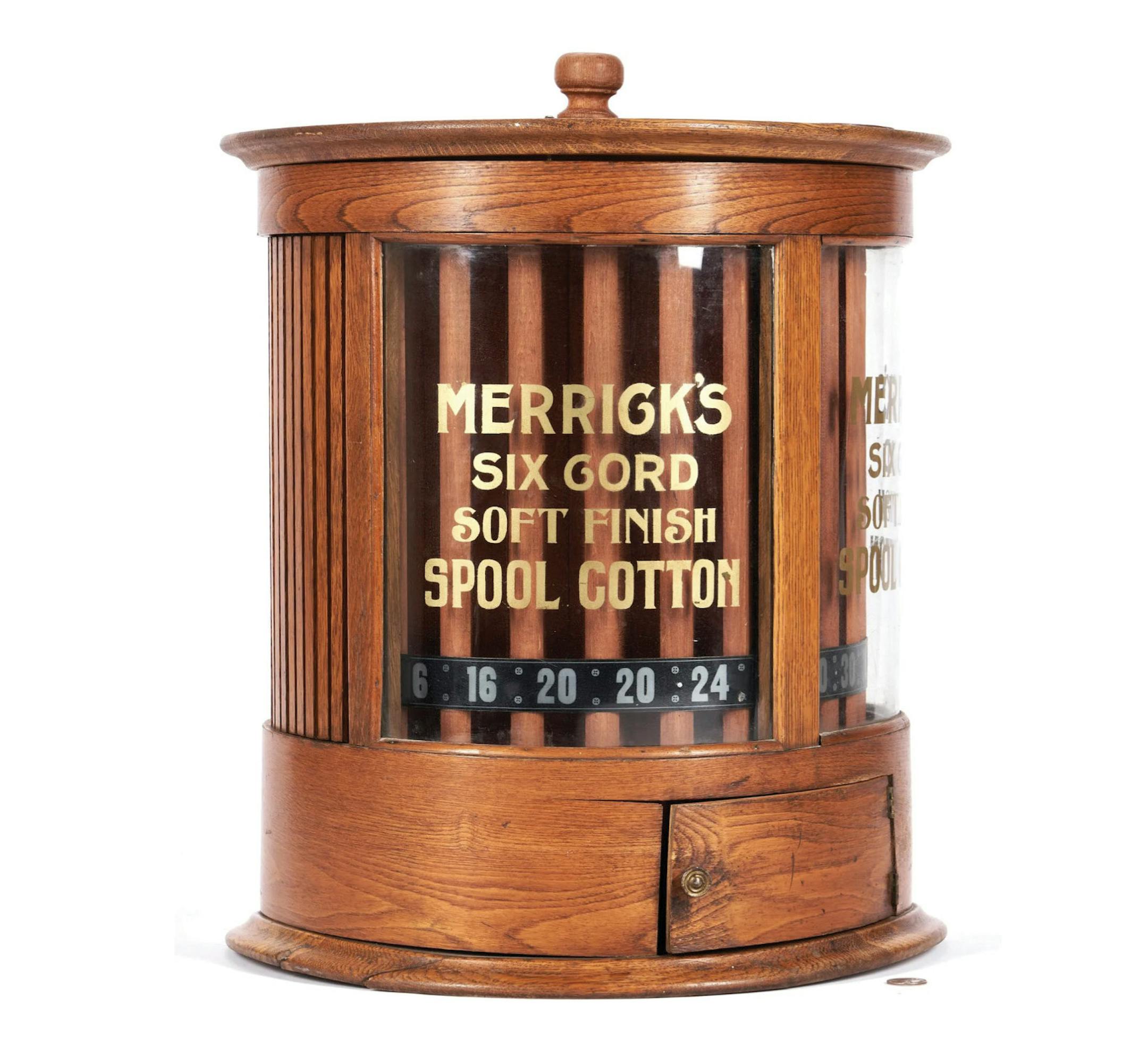
In the old days when clothes were sewn and mended at home instead of bought ready-made, spools of thread were household essentials. You would see a spool cabinet in any country store, usually on the counter. They were shaped like a miniature chest of drawers, with lettering on the front of each drawer, often on a plaque or window, telling you the company's name, the type of thread and colors of thread stored in that drawer.
This one is a different style, which may be one reason why it sold for $1,063 at an auction by Case Antiques. It is cylindrical, with a stenciled glass door that leaves the contents visible. A revolving case ensures that you can get a look at everything inside. When it was filled with spools of thread, customers' eyes must have been drawn to the colors and motion.
Merrick, the thread company that this cabinet advertises, was known for this type of display. Like any company, they wanted to distinguish themselves from the competition. And not just to get customers' attention: In 1893, Merrick Thread Co. was sued by Coats, another thread company that would later merge with Clarks, becoming J&P Coats Ltd., which is still producing thread today. Coats claimed that Merrick thread spools were marked with a design too similar to theirs, creating confusion between the two companies' products. The case was dismissed. However, considering the patent date of 1897 on this cabinet, its unusual design may have been intended to assert Merrick's identity.
Q: I have a hammered copper candy dish marked "Gregorian, Made in U.S.A." I've had it for 69 years. What is it worth today?
A: Gregori Copper was started in 1946 by P.R. Gregori and his brother, Fred. At first, they worked out of their parents' garage in Capistrano Beach, Calif. In 1948, they moved into a building in San Clemente. P.R. Gregori designed the pieces and took care of manufacturing while Fred was the salesman. Pieces were hand-hammered and finished with a bluing process. They were lacquered and baked so the copper would keep its color. The company was sold to Sunbelt in 1968 and moved to Albuquerque, N.M., later. Sunbelt sold the company to a company in Lemmon, S.D., in 1989, and the name became Gregorian Inc. This company made wholesale copper and silver jewelry for at least 20 years. Gregorian Inc. is now a manufacturer of farm and ranch equipment, portable steel buildings and garage doors. A 5-inch Gregorian hammered copper candy dish recently sold for $12 and a 7-inch candy dish sold for $17.
Q: I'd like information about the maker of a plate I bought at a house sale. It's decorated with blue and white flowers and leaves and is marked "Windsor, W.R. Midwinter, Porcelon, Burslem, England."
A: William Robinson Midwinter founded his pottery in Burslem in 1910. It was one of the largest potteries in England in the late 1930s. Production was limited under wartime restrictions during World War II. When the restrictions were lifted in 1952, new lines of dinnerware with contemporary designs and shapes were introduced. The company ran into financial difficulty and merged with J.&G. Meakin in 1968. It became part of the Wedgwood Group in 1970. Meakin & Midwinter (Holdings) Ltd. closed in 1987. "Windsor" is the name of the pattern on your plate. The transferware design was made in blue, brown, red, multicolor and other variations. The word "Porcelon," a trade name used by Midwinter from the 1930s until about 1953, helps date your plate.
Q: I have an old gooseneck lamp. It's in good condition and it works, but the finish is worn. Here is what's on the back: "Magic Arm Co. PAT. 2665.870." Would you be able to let me know if it's worth anything?


