

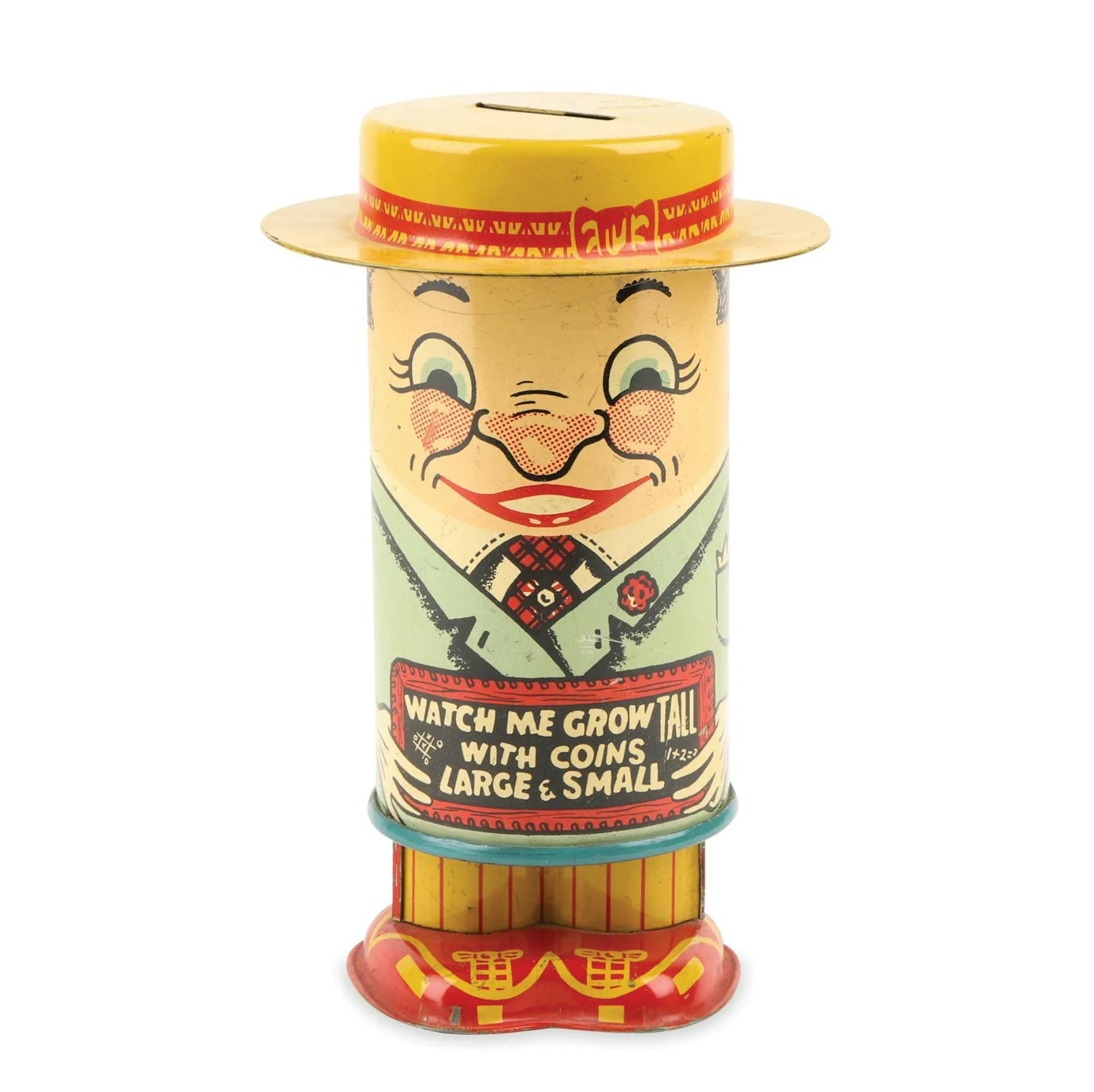
Mechanical banks function as both a toy and a useful, even educational, device. Deposit a coin and a figure dances or jumps into the air, an animal swallows the coin, a flag is raised or some other action is performed. They entertain children and encourage them to save money.
Now, antique mechanical banks, particularly the cast-iron examples made in the 1800s, sell for impressive prices. Later mechanical banks can sell well, too.
This lithographed tin "Watch Me Grow" bank was made in the 1940s by General Metal in Canada and sold for $615 Canadian (about $459 U.S. currency) at a sale by Jon Dunford, Miller & Miller Auctions. It is shaped like a cylinder and decorated to look like a figure of a man in a colorful suit holding a sign saying, "Watch Me Grow TALL with Coins Large & Small." The coin slot is on top of the man's hat. The figure's "legs" are hidden inside the cylinder. A spring inside the bank causes the cylinder to rise when coins are dropped in, appearing to lengthen the "legs" and make the figure grow taller.
Q: A pitcher and washbowl set with the name "Dresden" on the bottom has been in our family for many years. They are white with an embossed design and a few brown flowers and leaves. The pitcher has scalloped edges and a leafy handle. Can you tell me about the history and value of this set?
A: The word "Dresden" was used as a mark by companies in the United States as well as in Dresden, Germany. German porcelain exported to the United States was marked with the country of origin beginning in 1891. Without seeing the mark on your set, we can't be sure who made it, but it was probably made by the Dresden Pottery Works in East Liverpool, Ohio. It was operated by Brunt, Bloor, Martin and Co. beginning in 1875 and was sold to the Potters Co-operative in 1882. The cooperative made ironstone toilet sets, dinnerware, tea sets, sanitary ware and hotel china. Dresden Pottery Co. bought the Dresden Pottery Works in 1925. It went out of business in 1927. Your pitcher and bowl were probably part of a larger "toilet set." These were popular before indoor plumbing became common. A pitcher and washbowl might sell for as low as $25 to as much as $50 or $100, depending on the maker, design and condition.
Q: I inherited a huge amount of jewelry from a relative. I don't know what to do next. Most seems costume (not sure), but I would like to hold a sale or auction. What do I do and how?
A: Look for marks on the back of the jewelry, then search Kovels.com and other online sites for information about the makers. Check "sold" prices on eBay and liveauctioneers.com, and "asking" prices on other sites, to see what similar jewelry sells for. If you think you have fine jewelry made with real gold or precious stones, take it to a jeweler for an opinion on authenticity and value, and perhaps a sale. Contact an auction house that sells jewelry. If they sell jewelry, they also buy it. Go to flea markets to see what costume jewelry sells for. If you plan to hold an online sale or auction, include a clear photo, size, material, maker, any interesting history and a good title that includes keywords to attract buyers' attention. If you decide to sell the jewelry yourself, you must charge sales tax. It's a lot of work but good jewelry sells for fair prices.
Q: Family members who traveled to China in the late 1800s bought a wooden four-panel Chinese screen that has been passed down in the family. A village scene is on one side and birds and flowers are on the other. Each panel is 60 inches high and 16 inches wide. It's marked "China." The screen is in fairly good condition but has a few cracks, the paint has faded, and the finish has chipped off some of the edges. Can you tell me anything about it and what it might be worth? Do you recommend any repairs or restoration?


