

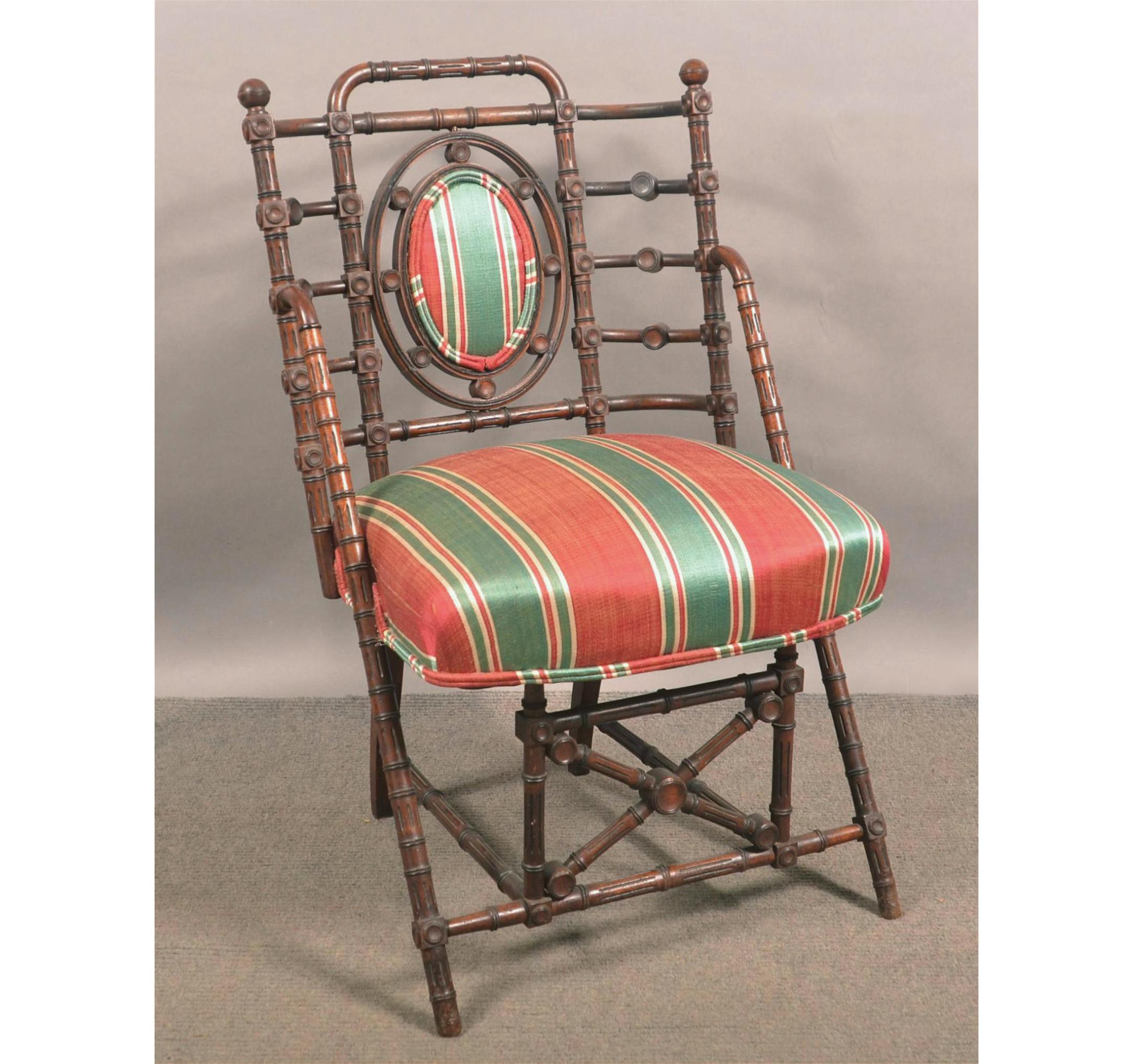
Victorian furniture has a reputation for being impractical and out of style. After all, it's all heavy, dark wood pieces covered in dust-collecting carvings and shabby old upholstery, right? Think again! The Victorian era, which lasted from the mid-19th century to about 1900, covers many different design periods and saw plenty of technological advances and innovative styles.
Designers patented many new styles of furniture, especially chairs. George Hunzinger, a cabinetmaker who emigrated from Germany to New York in 1855, was one of the more inventive furniture designers of the time. He held patents for many designs, methods and materials.
This Hunzinger chair, which sold for $406 at Conestoga Auction Co., is marked with its patent date of March 30, 1869. It is made of beech wood carved to resemble bamboo. Hunzinger was inspired by machinery for the look of his furniture as well as construction methods. Like many of his designs, this chair looks like it could be made from pipes. X-frames are another characteristic Hunzinger element; some of his chairs could fold, and some just looked like it.
Q: A friend gave me a teapot that he purchased in France in 1950. The background is white with a different red outdoor scene on each side and red floral trim. "Medaille D'or 1834 Creil" is printed on the bottom of the lid. I was able to translate this to "Gold Medal 1834." The bottom of the pot is harder to read, and I haven't had luck finding anything else. Can you help with any more information?
A: Your teapot is faience transferware. A metal plate was engraved with a pattern, inked with the desired color and then impressed onto paper. The paper was used to transfer the pattern to the ceramic object. Creil is a community in northern France famous for opaque porcelain. Your photo of the bottom of the teapot shows "Porcelaine Opaque de St. Cricq Casaux a Creil, Medaille 1834." Charles Gaspard Alexandre de Saint Cricq Casaux (1774-1840) was the director and owned the largest share of the porcelain factory. He also owned Montereau pottery and merged it with Creil in 1840. Creil-Montereau won awards for its porcelain and printed this on their pieces. The factory closed in 1955. Red transferware sells for more than the popular blue transferware because fewer pieces were made.
Q: My son was in a book club in the late 1950s, early 1960s. They had the first editions of Dr. Seuss books. The books are in good condition because I just read them to him and they were not played with. Are they worth anything?
A: Theodor Seuss Geisel wrote more than 60 children's books under the name Dr. Seuss. Some of his most famous books were written in the 1950s and '60s and continue to be the most popular children's books in the world. Identifying Suess' first edition books is a challenge. The publishers did not explicitly print "First Edition" but printed a copyright date. There are experts who can help identify books that may be valuable first editions. Recent high-priced books include "The Cat in the Hat," "Horton Hears a Who" and "How the Grinch Stole Christmas." They have sold for $300 to $2,400.
Q: My father was in England from 1943 to 1945 in the Army Air Corps. He received a gift of six silver-plated spoons from an Englishman who said they had been made by H. Nicolai of St. Petersburg, the silversmith to the House of Romanoff. The name "H. Nicolai" and "12 WS" are stamped on the back of the spoons. I have the letter sent to my father that describes them, suggesting their value for customs as two pounds but saying their market value would be much higher if sold along with their history. I'm wondering if there is any validity to the claim.


