

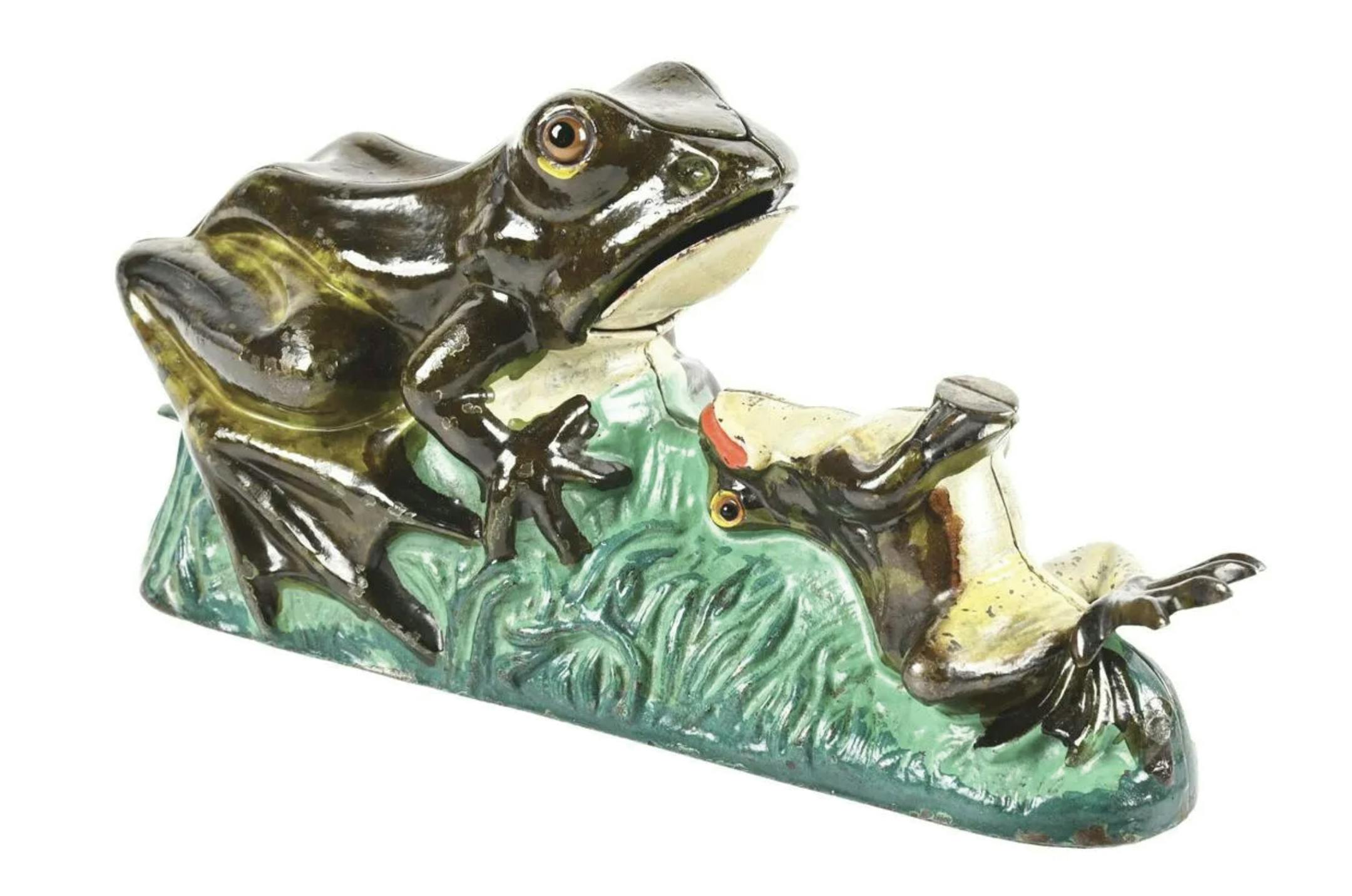
A mechanical bank like this "Two Frogs" bank used to put on a show for as little as a penny. Place the coin on the flat spot on the small frog's chest, press the lever on the back of the bank, and the large frog opens its mouth to catch the coin as the small frog kicks it in.
In the 19th century, mechanical banks taught children that saving money could be fun. Now, collectors save up their money to buy them: This bank was the top seller at a Morphy auction, bringing in $12,800. Cast-iron mechanical banks from the late 19th to early 20th century have been popular collectibles since the 1950s, and they keep selling for high prices. Collectors look for examples in excellent condition with functional mechanisms and the original paint intact.
Mechanical banks are well-documented, with names (like "Two Frogs") coming from the advertisements and order forms where they originally appeared. Serious collectors are familiar with these advertisements, which also provide the bank's maker, date and original price: "Two Frogs" used to sell for 85 or 95 cents!
Q: I have 12, seven-piece place settings of china, with three platters, two serving bowls and a coffee or tea server. It's marked "Thomas" above the letter "R" in a shield, and "Germany." It is in excellent condition with no cracks or chips. Can you tell me something about the maker, age and value of this set?
A: Fritz Thomas and a partner founded Porcelain Factory Thomas & Ens in Marktredwitz, Bavaria, Germany, in 1903. After Ens left the company in 1908, Porcelain Factory Thomas became a subsidiary of Rosenthal. The Thomas/R/Germany mark was used from 1953 to 1960. In 1960, porcelain production moved to Speichersdorf, Bavaria. Thomas is still in business as a brand owned by Rosenthal, which is now part of the Arcturus Group. They make "everyday tableware." Sets of dinnerware are hard to sell. You can find prices for individual pieces of your dinnerware pattern on sites like eBay (look for "Sold" pieces), etsy, or Replacements.com.
Q: I'm hoping you can help me with this question. I inherited this table from my great aunt. I'm interested in selling it, but have no idea who the maker is or if it's worth anything. She had it ever since I was a child; I'm 57. Can you help? If I need to pay for an appraisal I'm willing to do so, depending on the cost.
A: To estimate the date of a piece of furniture from family history, take your age and add 25 years for each generation before you owned the piece. By this method, your great aunt's table would be about 107 years old. However, this method isn't always accurate. If you don't know how old your relative was when they got the piece, you may estimate that the furniture is older than it really is. Without a maker's mark, it is difficult to determine the age of a piece of furniture from photographs alone. Remember that furniture styles are often copied or reproduced by later makers. Look for an appraiser in your area. You may find some online, in local business resources or listed in the Business Directory on Kovels.com. Tables that look similar to yours have sold at recent auctions for about $100 to $200.
Q: I have several pages of appraisals from Sonja Henie's jewelry and I'm wondering if this would be something of interest and possibly sellable. This came from my family that started Holiday on Ice. I also have her ice skates but no documentation on them, given to us by her secretary along with Holiday on Ice programs showing my great uncles as vice presidents.


