

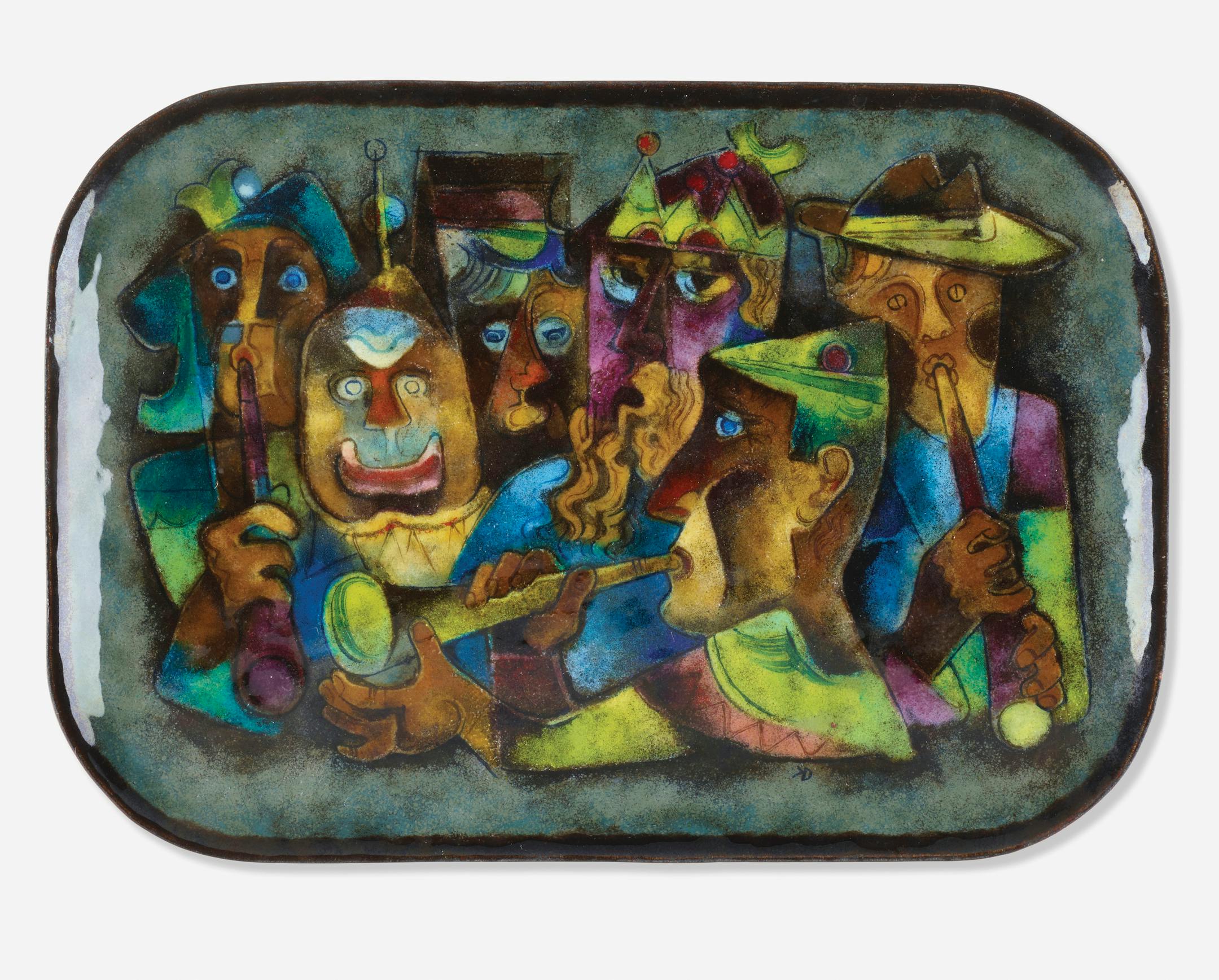
Enamel has been used in decorative arts since at least the Middle Ages. It was especially popular in Europe and Asia in the 18th and 19th centuries. With this in mind, it may sound like an unlikely medium for the 20th century. But modern art embraces the unexpected.
Karl Drerup, an artist who trained in painting, illustration and ceramics in Berlin and Florence, then emigrated with his wife in the 1930s to escape the rise of fascism, started making enamels in New York in the 1930s. Later, he would call himself "the first one in New York who made any enamels at all." That may have contributed to his success; the Metropolitan Museum of Art purchased one of his decorated bowls in 1940.
Drerup's enamels have a distinctive style with vibrant, abstract scenes of natural elements or human figures in bright colors, like this copper plaque called "The Merry Makers" that sold for $2,750 at a Rago auction.
Q: I need a price to insure an 1870 bisque figurine. It was listed in your 2015 price guide on Kovels.com for $45. It was not listed in later price guides. I find it hard to believe a bisque figurine that was almost 150 years old in 2015 was worth so little. How can I find the current value for insurance purposes?
A: The value of your figurine depends on the maker, decoration, size and condition more than on its age. An unmarked bisque figurine is not worth as much as a figurine by a well-known maker. If you want to insure your figurine, contact your insurance company to see if they require a written appraisal. In that case, your figurine would have to be seen by a licensed appraiser to determine the value. The prices listed in Kovels' Antiques & Collectibles Price Guide are new each year, not "updates" of entries that were listed in previous years. Prices are from completed sales in auctions, stores or at shows. A few "asking" prices are included.
Q: My mother used an electric Simplex Model 5-463 mangle to iron sheets and pillowcases. It was made by the American Ironing Machine Co. of Algonquin, Ill. It's in fairly good condition and works very well, though I've never ironed anything with it. Do you know what its value might be?
A: The American Ironing Machine Co. was founded in Chicago in 1905. It made rotary ironers (mangles) and other laundry equipment for home, commercial and institutional use. Early ironers were powered by electricity or gasoline engines. The machines were made by Peter Brothers Manufacturing Co. of Algonquin, Ill. The two companies merged in 1920 and continued to operate as the American Ironing Machine Co. Your ironer was made before 1946, when American Ironing Machine Co. became the Simplex Division of Barlow & Seelig Manufacturing Co. Rotary ironers were popular for home use from the early 1900s to the 1940s or '50s, but interest faded after permanent press fabric became common in the 1960s. New rotary irons are being made and sell for high prices. Some "used" mangles sell for about $50 and others are listed for over $100.
Q: I have some china and cannot find the stamp it has anywhere. Is it real? I was wondering if you can identify it.


