

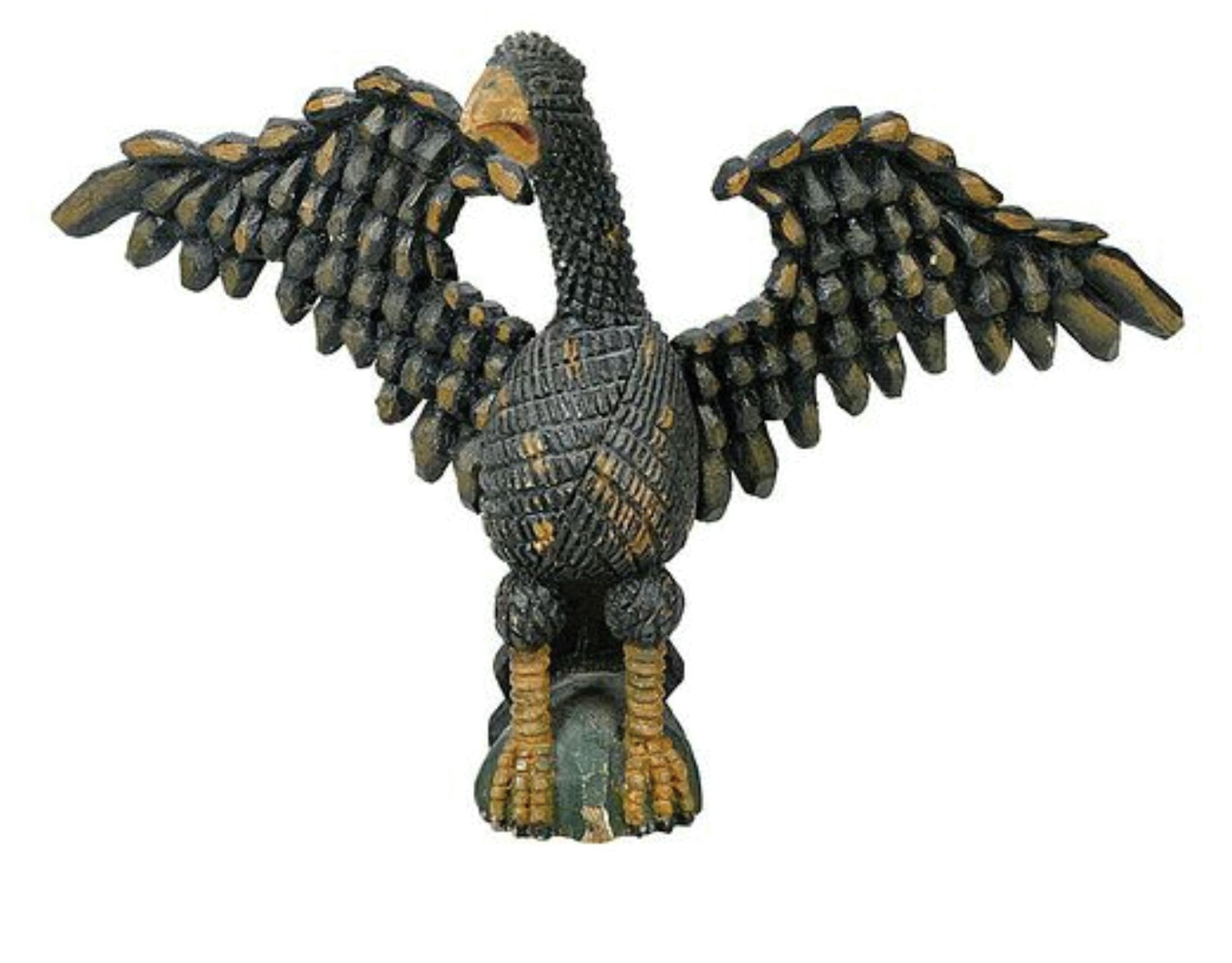
July 4th is a time to display American symbols like stars and stripes; red, white and blue: Uncle Sam, Lady Liberty and, of course, the majestic eagle. The bald eagle became the national bird of the United States with the creation of the Great Seal in 1782. Eagle symbolism was already well established by then.
Eagles are sacred to many Native American nations. European colonists brought their own eagle symbolism to the Americas. Eagles were associated with the divine in mythological pantheons and appeared in heraldry. The eagle, aquila in Latin, was used as a standard by ancient Roman legions. "Aquila" is also the name of a prominent constellation in the summer skies of the Northern Hemisphere.
Eagles appear in American folk art, as well. This carved and painted wooden eagle, wings outstretched like the eagle on the Great Seal, sold for $5,000 at Brunk Auctions. It is attributed to Wilhelm Schimmel, who emigrated from Germany to the United States in the late 19th century. Wandering around Pennsylvania, having run-ins with the law, doing odd jobs at farms and selling his wooden carvings, he was something of a folkloric figure himself.
Q: Among a box of my grandfather's papers, I found an envelope postmarked April 8, 1925, with a letter to my grandfather from an appraiser of "Autograph Letters of Celebrities, Manuscripts, and Historical Documents" and four old letters. One letter was written by Thomas Jefferson in 1786 while he was in Paris, another by U.S. Grant in 1880. One was written to Patrick Henry in 1769, and one was signed by James Monroe in 1800. The appraiser assigned a value of $20 to the Jefferson letter and lesser values to the other three. Since it has been nearly 100 years since this appraisal, I'm wondering if you have an idea of the value of the letters now.
A: The value of a letter depends partly on the importance of the person who wrote it, the contents of the letter, its rarity and condition. A handwritten, signed letter is usually worth more than a signed document or single autograph. Historically important letters sell for high prices. Letters handwritten by Thomas Jefferson have sold at auction for several thousand dollars. You should contact an auction house or gallery that sells historic documents and autographs. Most will give you a free estimate of value.
Q: I need to sell some blue and white pitchers with a profile of an Indian chief, teepees and trees on them. Some have a diamond-shaped mark with "WSCo, Monmouth, ILL" inside it. Any suggestion on how to sell them and how much to ask for them?
A: These are Sleepy Eye pitchers. They picture a 19th-century Indian chief named "Sleepy Eye" because of his drooping eyelid. His image was used on premiums offered by the Sleepy Eye Milling Co. of Sleepy Eye, Minn., from 1883 to 1921. They were made by Weir Pottery Co. from about 1899 to 1905. Weir became Western Stoneware in 1906. The mark on your pitchers was used by Western Stoneware. The Sleepy Eye Milling Co. closed in 1921, but Western Stoneware continued to make Sleepy Eye pieces until 1937. Pitchers came in five sizes: 4, 5 1/4, 6 1/2, 8 and 9 inches. Sleepy Eye sells at auctions and online shops. Pitchers have sold recently for $25 to $188 or more. A lot of six pitchers, ranging from 4 to 8 inches, sold for $650 plus premium at a recent auction. Reproduction pieces are being made and sell for less. If your pitchers are in good condition, they should be easy to sell. Contact the Blue & White Pottery/Old Sleepy Eye Collectors Club (website: bluewhitepottery.org) or an auction that sells this pottery.
Q: I'd like some information about Wallace Nutting and his work. One of his pictures has been in my family for over 50 years. The words "The Swimming Pool" are written below the picture on one side and it's signed "Wallace Nutting" on the other side. There are some stains, water spots and discoloration. It's in the original frame.

