
King's dream has come true ... but only for some

Much progress has been made, but poverty is still a growing problem.

January 16, 2023 at 12:00AM
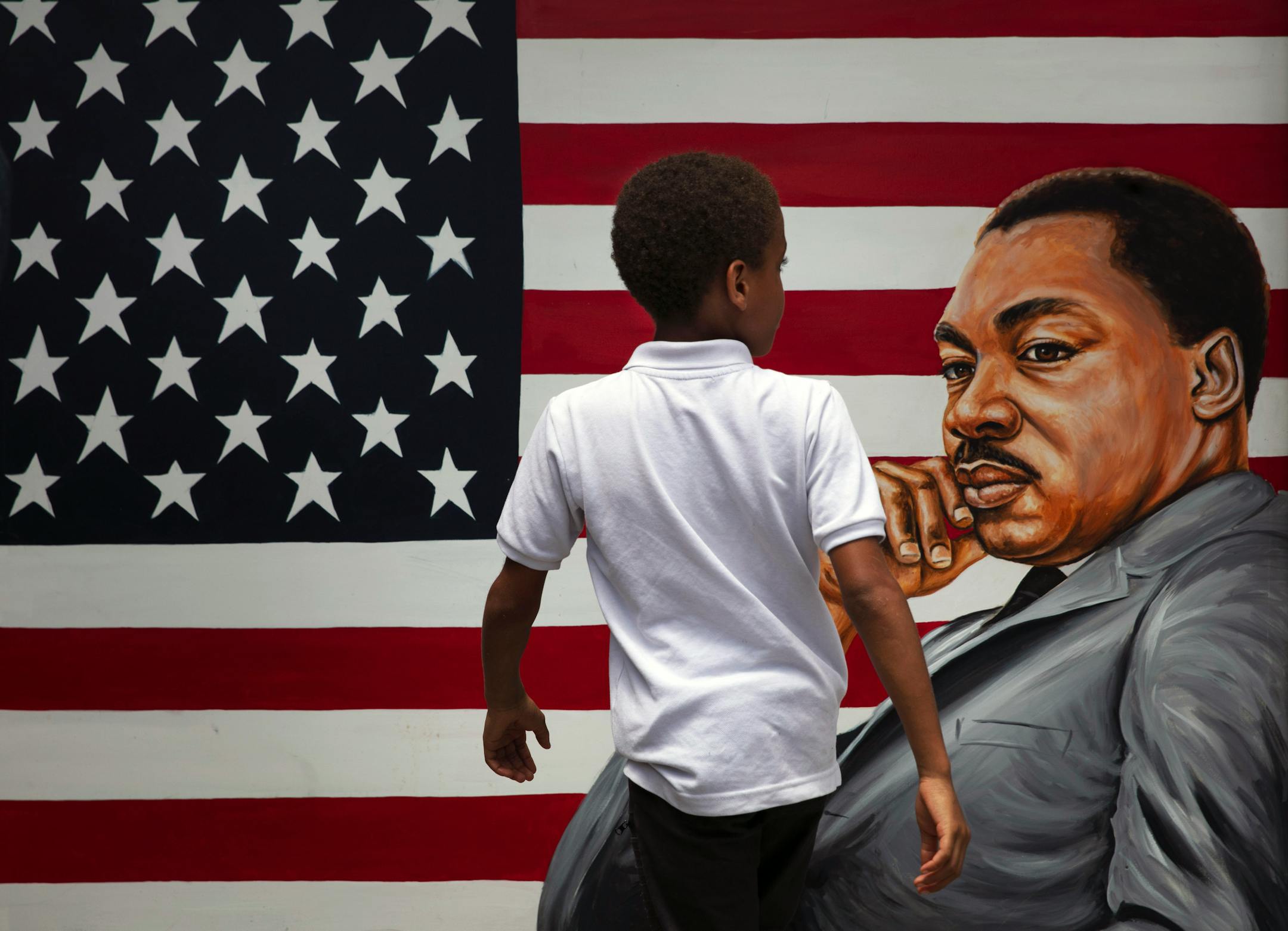
A young boy walks past a painting of Dr. Martin Luther King Jr. during a Juneteenth celebration in Los Angeles on June 19, 2020. (Jae C. Hong, Associated Press/The Minnesota Star Tribune)

Opinion editor's note: Star Tribune Opinion publishes a mix of national and local commentaries online and in print each day. To contribute, click here.

•••

As another Martin Luther King Jr. Day holiday arrives, our nation has much to celebrate as we strive toward the Rev. Martin Luther King Jr.'s dream of a colorblind society.

Since King's assassination in 1968, America has elected and re-elected its first African American president. We've also recently sworn in our first African American female associate Supreme Court justice, who joins fellow African American Justice Clarence Thomas on the nation's highest court.

There are now African American entrepreneur billionaires and African Americans (male and female) who have reached the pinnacle of the business world as CEOs of Fortune 500 companies.

The substantial progress many African Americans have made since the 1960s civil rights era is genuinely momentous and should be celebrated.

Unfortunately, not every member of the African American community has experienced the upward mobility many of their Black brothers and sisters have enjoyed.

According to a CNN article, "The typical Black American family is virtually no closer to equal footing with its white peers in terms of income and wealth than it was 50 years ago."

The bipartisan Joint Economic Committee, which consists of Republicans and Democrats from the U.S. Senate and House, released a study in 2020 titled "The Economic State of Black America in 2020." The study found some troubling statistics.

  • The typical Black household earns a fraction of white families' income — just 59 cents for every dollar. The gap between Black and white annual household incomes is about $29,000 per year.
    • The median wealth of Black families ($17,000) — is less than one-tenth that of white families ($171,000).
      • Black Americans are more than twice as likely to live in poverty as white Americans. Black children are three times as likely to live in poverty as white children.
        • The wealth gap between Black and white households increases with education.

          African Americans have traditionally been the constituency that the Democratic Party has relied upon for consistent and loyal votes, typically voting 90% or more for the Democratic choice. But we witnessed a significant change in that pattern starting with the election of Donald Trump in 2016. Trump received a whopping 20% of the African American male vote in 2020, and he also increased his vote percentage with African American females. Other Republican officeholders also made gains.

          The Associated Press' AP VoteCast performed an extensive national survey of the electorate after the 2020 midterms, and what it found should be cause for alarm for the Democratic Party.

          AP found that Republican candidates were backed by 14% of African American voters. In the 2018 midterm elections, Republicans only won 8% of the Black vote.

          There are two reasons for the exodus of African American voters from the Democratic Party. One is inadequate schools. The other is the rising crime rate, disproportionately affecting inner-city communities.

          The COVID pandemic opened the eyes of many parents to the "wokeness" their children were being taught in their schools, and because of that, more Black families turned to home schooling during the pandemic.

          As ABC News reported: "Census shows the proportion of Black families home schooling recently quintupled. Home schooling, once a relatively niche form of education that has been growing steadily in the past decades, has seen a big uptick due to the COVID-19 pandemic with Black families adopting the practice at a notably high rate."

          Violent crime is at levels we haven't seen since the 1970s.

          Education and crime are universal concerns that appeal to every voter regardless of race, color, creed, religion or ethnicity. Most voters don't want to be pandered to with insulting, shopworn campaign tactics supposedly geared toward them. The political party or movement that understands this and plans accordingly will make further inroads with voting blocs with whom they have traditionally not done well.

          Christopher Arps is a member of the Project 21 Black leadership network and a managing partner with the public affairs and communications consulting firm Red Tail Strategies.

          about the writer

          about the writer

          Christopher Arps, InsideSources.com (TNS)

          More from Commentaries

          See More
          card image
          Elizabeth Flores/The Minnesota Star Tribune

          My hope for the new year is that we each try a little harder to know and understand the stories and experiences of others.

          card image
          card image